
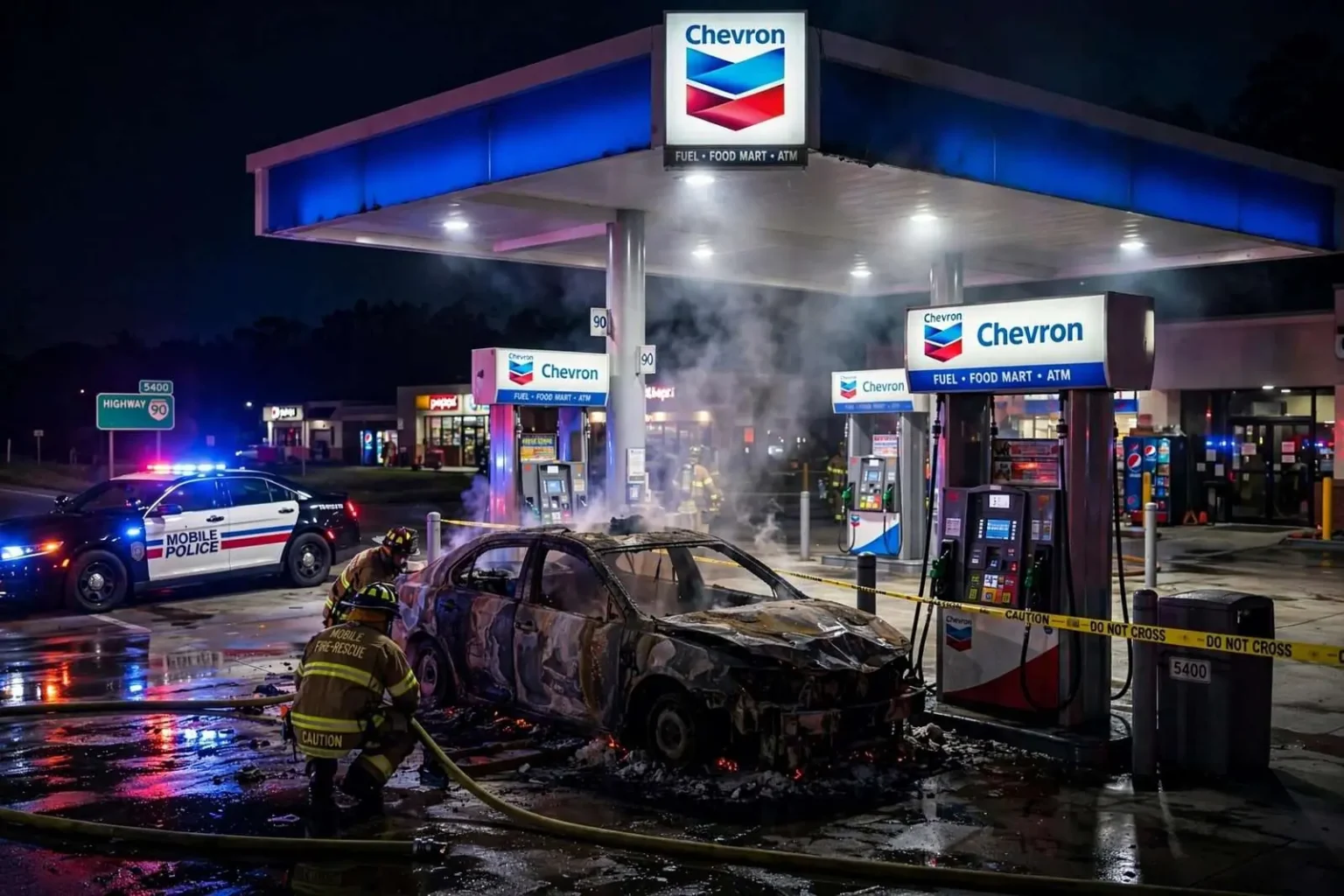
MOBILE, Ala. — A Mobile man is facing charges after a car caught fire at a gas station pump early Thursday morning. Mobile police were called to the Chevron station in the 5400 block of Highway 90 around 4 a.m. after reports of a vehicle fire, and officers arrived to find a car engulfed in flames at one of the pumps. Mobile Fire-Rescue crews extinguished the blaze before it could spread to the pump island or the station building, and the incident has grown into a criminal investigation with a local man in custody.
Police arrested 42-year-old Jarii Nicholson at the scene on outstanding warrants along with a criminal mischief charge. The outstanding warrants meant Nicholson was already sought by authorities when officers arrived at the burning car, and the criminal mischief count was added in connection with the fire. Investigators said additional charges could follow once an arson investigator completes a review of the fire, leaving the full legal picture of the incident open until that review is finished.
A vehicle fire at an active fuel pump ranks among the most dangerous scenarios fire crews face, because the flames sit within feet of underground tank venting, dispensing equipment and other parked vehicles. The 4 a.m. timing meant the station was nearly empty, but a fire that reaches a pump can force evacuations of the entire property and close the highway frontage while crews work. Mobile Fire-Rescue’s quick extinguishment kept Thursday morning’s incident to a single burned vehicle.
The scene on Highway 90
The Chevron station in the 5400 block of Highway 90 sits along one of Mobile’s busiest east-west commercial corridors, a stretch of the old federal highway lined with service stations, restaurants and retail storefronts running west from the city toward the state line docks area. Overnight, the corridor carries far less traffic than its daytime volume, which is part of why a 4 a.m. vehicle fire drew a fast police and fire response without a crowd of bystanders. The station’s pumps and canopy sit close to the highway frontage, meaning the response staged on-site quickly and the roadway itself was not closed for an extended period.
When officers arrived, the car was engulfed in flames at one of the pumps. Fire-Rescue crews took over suppression, protecting the surrounding pump equipment and the station structure while knocking down the vehicle fire. Modern fuel dispensers include emergency shutoffs that stop the flow of gasoline once activated, and the first tasks at any pump fire are cutting power to the island and confirming that no fuel is feeding the flames. With those steps complete, extinguishing the vehicle itself is a contained operation.
The burned car remained as evidence once the flames were out, its condition part of the record the arson investigator would review. Vehicle fires destroy much of the physical detail that origin-and-cause examiners rely on, but fire patterns, fuel system condition and the sequence of the burn all leave traces that trained investigators can read.
The arrest and the charges
Nicholson’s arrest at the scene combined two threads: the outstanding warrants that predated the fire and the criminal mischief charge connected to the incident itself. Criminal mischief under Alabama law covers the criminal destruction or damage of another person’s property, and it can be charged as a misdemeanor or felony depending on the value of the damage. A vehicle destroyed by fire typically clears the felony threshold, and prosecutors weigh the arson investigator’s findings when deciding how the case proceeds from the initial charge.
Outstanding warrants add a procedural layer. Defendants arrested on warrants are booked on those charges first, with the new offense added during the same booking, and bond amounts are set on each count. Nicholson’s transfer into the Mobile County jail system follows the standard path for arrests made by Mobile police, with initial appearance and bond review before a district judge.
The pending arson review is the piece that could reshape the case. Arson investigators examine whether a fire was deliberately set, and their findings support charges that carry far greater penalties than criminal mischief, including first- or second-degree arson depending on circumstances and whether lives were endangered. A fire at an occupied-adjacent fuel station raises exactly the endangerment questions that investigators weigh. Until that review concludes, police describe additional charges as possible, and the Mobile County District Attorney’s office will ultimately frame the charges presented to a grand jury or district court.
Why gas station fires are treated with urgency
Fire services across the country treat gas station fires as high-priority calls because of what sits beneath and around the pump island. The underground storage tanks hold thousands of gallons of fuel, connected to dispensers through lines that run directly under the forecourt, and a fire that damages dispensing equipment or reaches a tank vent can escalate from a vehicle fire to a property-threatening blaze in minutes. Emergency shutoff switches, breakaway hoses and fire-suppression requirements in modern station design all serve to keep small incidents small, but they depend on fast activation and an immediate fire response.
The early-morning hours concentrate the risk differently than the busy daytime. Fewer customers mean fewer people at risk and faster detection of anything unusual, but overnight incidents also draw the station attendants, delivery drivers and late-shift travelers who are the only witnesses to how the fire began. In this case, the 4 a.m. call brought officers to a car already fully involved, and the sequence of events that led to the flames became the arson investigator’s task to reconstruct.
Drivers who witness a vehicle fire at a pump are advised to move away immediately, alert the station attendant so the emergency shutoff can be activated, and call 911 from a safe distance. Attempting to drive a burning car away from the pump or fighting the fire with handheld extinguishers beyond their capacity are the mistakes responders most often have to correct.
The Highway 90 corridor and overnight incidents
Highway 90 through Mobile has carried traffic since the days when it was the main coastal route across the South, and its commercial strips remain a working cross-section of the city’s economy. Service stations along the corridor operate around the clock, and their overnight hours generate the steady background of police calls — thefts, disputes, and occasionally incidents like Thursday morning’s fire — that the Mobile Police Department’s overnight units handle. A car fire at a pump draws a larger response than the typical overnight call, and the department’s approach combined fire suppression support, scene security and the arrest that was already within reach when officers arrived.
The 5400 block sits in the western stretch of the corridor, an area whose stations and storefronts serve both neighborhood traffic and the commuters passing between Mobile’s western suburbs and the port areas of the city. Incidents there close lanes but rarely isolate the corridor, since parallel routes absorb diverted traffic. By morning rush, the burned car had been removed and the station’s operations were the main lingering question for its owner.
The case now moves on the arson investigator’s timeline. Until that review is complete, the charges stand at the outstanding warrants and criminal mischief, Nicholson remains in the county system, and the Mobile Police Department’s description of the incident stops where the evidence does: a car engulfed in flames at a Chevron pump on Highway 90, a quick fire response, and an arrest made at the scene.
Inside an arson investigation
The arson review that police say could bring additional charges follows a defined methodology. Fire investigators begin at the least-damaged area and work toward the point of origin, reading burn patterns, heat shadows and the direction of charring to establish where and how the fire started. In a vehicle fire, the engine compartment, fuel system and electrical system are examined first because those are the most common accidental origins, and only after accidental causes are ruled out does the investigation turn toward intentional ignition. The distinction matters legally: criminal mischief covers property damage, while arson charges require proof of intentional burning, and the arson investigator’s report is the document that supports whichever conclusion the evidence supports.
Investigators also gather the surrounding record. Surveillance video from the station’s cameras, the 911 call timeline, statements from the first officers and firefighters on scene, and the condition of the pump island all become part of the file. Witnesses to the moments before the fire — where the car was parked, who was with it, what was visible in the minutes before flames appeared — provide the sequence that physical evidence alone cannot. That is why police ask anyone with information about such incidents to come forward even after an arrest has been made.
The timeframe for the review varies with the complexity of the fire. Straightforward origin determinations can be reached quickly, while ambiguous vehicle fires can take weeks of laboratory work on recovered components. Until the review is complete, the charges Nicholson faces remain the outstanding warrants and the criminal mischief count, and the possibility of additional charges stays open exactly as police described it.
Criminal mischief and how the charges fit together
Criminal mischief is the charge Alabama prosecutors reach for when property is damaged by a criminal act, and its severity scales with the value of the damage. A vehicle burned to destruction falls at the high end of the scale, where the offense becomes a felony carrying potential prison time. The charge also serves as the holding offense in cases like this one: it documents the damage immediately, keeps the defendant in the judicial system, and leaves room for the more specific arson-related charges if the investigation supports them. Prosecutors in Mobile County handle thousands of such cases, and the charging decision after the arson review will set the case’s trajectory in circuit court.
The outstanding warrants on which Nicholson was arrested operate separately. Defendants with active warrants face those charges on their own track regardless of what happens with the new offense, and the combined booking means both matters appear before the judge at the initial appearance. Bond is set count by count, and the conditions of release, if any, typically address both the old and new charges.
For the gas station’s owner and the surrounding business community, the criminal dimension changes the recovery picture. Damage to the pump island or the canopy becomes part of a criminal case as well as an insurance claim, and the station’s closed pump reopens only after the evidence work is done. The 5400 block of Highway 90 returns to its routine quickly in traffic terms, but the case itself moves at the pace of the courts.
Vehicle fires on the Gulf Coast
Vehicle fires are a recurring call for Mobile Fire-Rescue across a fleet-aging region, where heat, humidity and coastal corrosion take a toll on wiring, fuel lines and batteries. Most are accidental — mechanical failures on the highway, electrical shorts in parking lots — and most end with a burned vehicle and no criminal dimension at all. Thursday morning’s incident stands apart because of where it happened, at a fuel pump where the margins between one burning car and a larger disaster are measured in feet, and because of the arrest that followed at the scene.
The quick work of the crews who extinguished the blaze is the quiet headline of the incident. A car engulfed in flames at a Chevron pump in the 5400 block of Highway 90 could have become a much larger emergency; instead, the response kept it to one vehicle, one arrest, and an arson investigation that will determine what charges ultimately follow.