Carjacking suspect arrested after pursuit ends in Flomaton
A carjacking suspect was arrested after a pursuit from Florida ended in Flomaton, Alabama, on Tuesday night; the chase began in Okaloosa County.
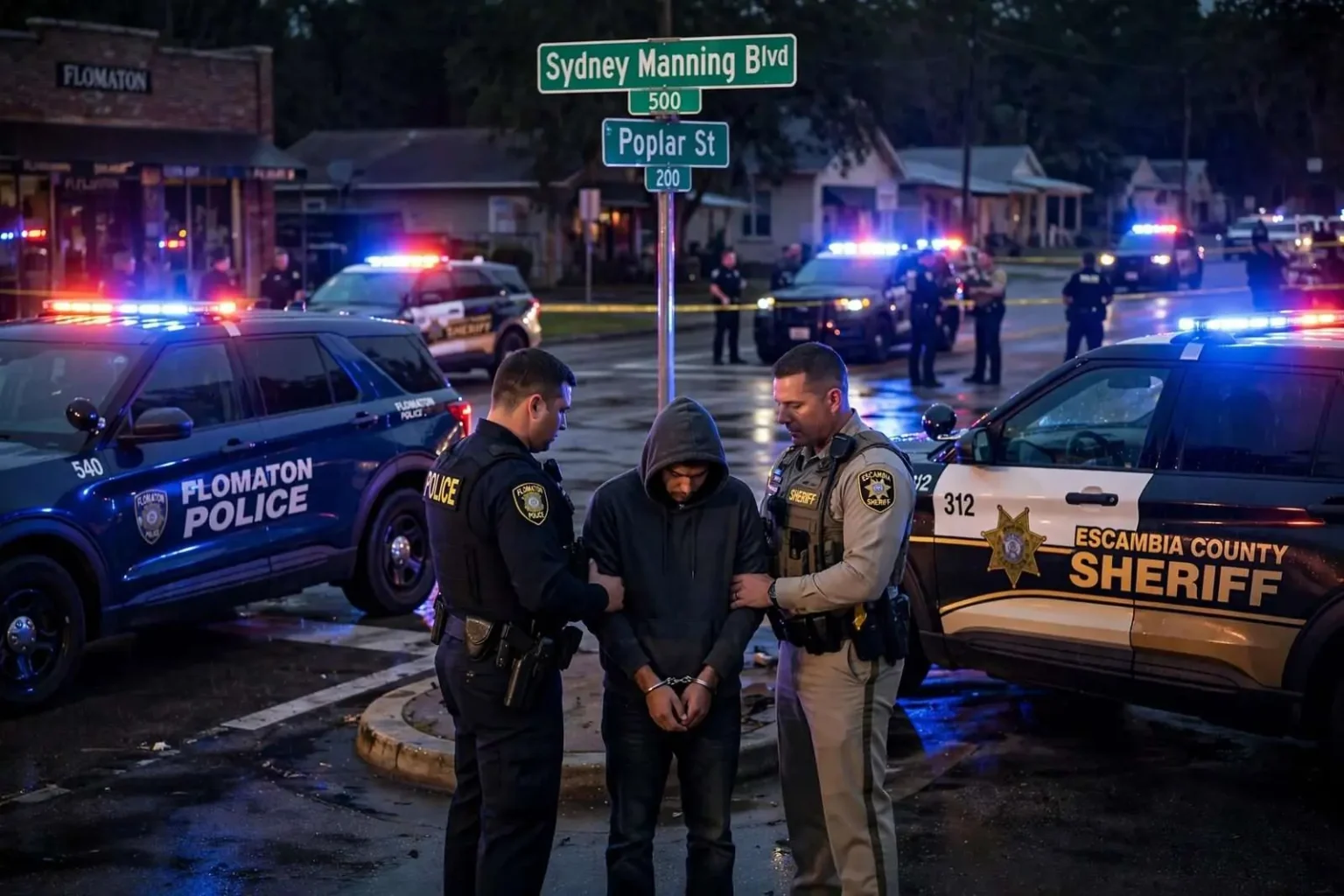
FLOMATON, Ala. — Flomaton police arrested a carjacking suspect Tuesday night after a chase that began in Florida and ended on an Alabama street just across the state line. The pursuit began around 6 p.m., when Flomaton officers received word that a stolen vehicle was being followed by the Escambia County Sheriff’s Office in Florida and heading toward the state line.
Authorities said the incident originated with a carjacking in Okaloosa County, Florida, an area that includes the Fort Walton Beach and Crestview communities along the Panhandle. The stolen vehicle traveled westward, crossing county lines and eventually the state line, with law enforcement officers from multiple agencies tracking its movement the entire way. The chase came to an end in Flomaton at the intersection of Sydney Manning Boulevard and Poplar Street, where officers took the suspect into custody.
No injuries connected to the pursuit itself were reported, and Flomaton police did not release the name of the suspect or details about any charges filed in the immediate aftermath of the arrest. A carjacking is typically charged as first-degree robbery under Alabama law when a vehicle is taken from another person by force, one of the most serious felony classifications on the books, carrying a potential sentence of twenty years to life for those convicted.
How a Multi-Agency Pursuit Unfolds
Vehicle pursuits that cross jurisdictional lines require rapid coordination between agencies that operate under different sets of policies and, in this case, different states. When the Escambia County Sheriff’s Office in Florida began following the stolen vehicle, deputies alerted agencies along the likely route, giving officers in Alabama time to position themselves before the vehicle crossed the line. That early notification is a critical part of modern pursuit protocol, allowing the receiving agency to decide whether and where to engage rather than reacting blindly to an oncoming chase.
Radio traffic between dispatch centers, sometimes relayed through mutual aid channels, keeps everyone updated on the vehicle’s location, speed, and direction of travel. Many departments also equip patrol vehicles with automatic license plate readers and receive real-time alerts when a stolen tag passes a camera, which narrows the search area considerably. In rural stretches of south Alabama, where distances between towns are long and intersections are limited, a fleeing vehicle often has few realistic escape routes, and officers can anticipate where a pursuit will end up.
Pursuit policies generally instruct officers to weigh the seriousness of the underlying offense against the dangers a high-speed chase poses to the public. Because a carjacking is a violent felony, authorities are more likely to sustain a pursuit than they would for a minor traffic offense. Departments also call off pursuits when conditions become too hazardous, relying instead on aircraft, plate-reader networks, or follow-up investigation to locate the vehicle later.
Flomaton and the State Line Factor
Flomaton is a small town in Escambia County, Alabama, sitting directly against the Florida border along the U.S. 29 and U.S. 31 corridors, with Interstate 65 running just to the west. Its position makes it a natural funnel for traffic moving between the Pensacola area and interior south Alabama, and it also makes the town a frequent endpoint for pursuits that start on the Florida side of the line. Local officers are accustomed to coordinating with their counterparts in Escambia County, Florida, as well as the Florida Highway Patrol, on cross-border incidents.
When a suspect crosses a state line during a pursuit, the legal mechanics of the arrest depend on where the vehicle actually stops. In this case, the vehicle was stopped in Alabama, so Flomaton officers made the arrest and the Alabama court system will handle the charges connected to events inside the state. Florida authorities can pursue extradition or file their own charges separately, and prosecutors on both sides of the line coordinate on cases like this to determine where the strongest cases can be brought.
Residents of Flomaton who witnessed the pursuit or its aftermath saw the kind of multi-agency operation that has become more common as stolen vehicles move quickly across jurisdictional boundaries. The intersection where the chase ended, Sydney Manning Boulevard and Poplar Street, sits within the town’s residential street grid, and police work to conclude pursuits away from heavy traffic when possible to reduce the risk to bystanders.
Carjacking Charges and What Comes Next
A carjacking — taking a vehicle directly from its driver or occupant by force, threat, or intimidation — is prosecuted as first-degree robbery in Alabama, a Class A felony. The classification reflects the violence inherent in the crime: the victim is confronted face to face, often at gunpoint or under threat, and the trauma extends well beyond the loss of the vehicle. Convictions can bring decades in prison, and Alabama juries and judges treat these offenses among the most serious short of capital crimes.
If the suspect in this case is also charged in Florida for the Okaloosa County carjacking, the two prosecutions would proceed in parallel. Defendants facing charges in multiple states are typically resolved through a process in which one jurisdiction’s case is completed first and the other follows through a governor’s warrant and extradition, or through negotiated agreements about where the harshest penalties will be sought. The total exposure can span decades, which gives defendants a strong incentive to resolve the cases together.
The stolen vehicle itself becomes evidence once the pursuit ends. Investigators process it for fingerprints and DNA, inventory any property inside, and document damage from the chase. If the owner is a private citizen, the vehicle is held until the forensic work is complete, then released. Insurance companies track the case as well, since the theft claim and any damage to the vehicle feed directly into the owner’s coverage.
For the officers involved, pursuits of this length carry their own after-action requirements. Most departments review every pursuit, examining whether the chase complied with policy, whether any collisions or near-misses occurred, and whether the termination decision came at the right moment. The review is not a formality — it shapes training and can lead to policy changes when patterns emerge across multiple incidents.
What Residents Should Know About Vehicle Theft
Carjackings remain rare relative to ordinary vehicle theft, but both crimes respond to the same prevention basics. Law enforcement agencies across south Alabama remind drivers to keep doors locked and windows up in traffic, to stay alert in parking lots and gas stations at night, and to park in well-lit areas. If a driver is confronted by someone demanding the vehicle, the standard guidance is to comply — vehicles can be replaced, and no car is worth a life.
Technology has changed the recovery picture in recent years. Many newer vehicles come with built-in telematics that can be tracked by the owner or manufacturer once a theft is reported, and inexpensive GPS trackers let owners share a live location with police directly. That real-time information is what allows pursuits like Tuesday night’s to be coordinated across two counties and two states instead of dissolving into a search. Residents who install trackers are encouraged to share the location data with dispatchers immediately rather than following the vehicle themselves, which adds risk without helping officers.
Anyone with information about the Okaloosa County carjacking or the events of the pursuit is encouraged to contact the Flomaton Police Department or the Okaloosa County Sheriff’s Office in Florida. Tips that help connect the timeline — where the vehicle traveled, who was inside, and where it stopped — strengthen the cases on both sides of the state line.
Escambia County on the Alabama side has seen its share of cross-border cases over the years, a byproduct of its geography. The county seat at Brewton lies to the northeast, while Atmore anchors the northern end of the county, and Flomaton sits at its southern edge against Florida. Sheriffs’ deputies cover long stretches of rural road between those communities, and state troopers from both states patrol the highways that funnel traffic through the area. Tuesday night’s pursuit touched all of those jurisdictions in one way or another before it ended.
Coordinating Across Two States
Formal agreements between Alabama and Florida govern how law enforcement officers can operate when a chase or an investigation crosses the border. Officers in hot pursuit generally retain authority to continue an arrest across state lines under mutual aid provisions, but the paperwork that follows — warrants, charges, and custody transfers — must be sorted out after the fact. Communications between dispatch centers in the two states, once a genuine obstacle in cross-border pursuits, have improved through shared radio interoperability channels and direct lines between county emergency communication centers.
Area agencies also train together periodically, running scenarios that simulate exactly the kind of incident Flomaton handled Tuesday night: a violent crime in one state, a fleeing suspect on the highway, and a handful of small-town departments suddenly at the center of a multi-state operation. Those exercises pay off in the field, where the difference between a smooth arrest and a chaotic one often comes down to agencies knowing each other’s radio call signs and command structure before the emergency begins.
The Escambia County Sheriff’s Office in Florida, which initiated the pursuit, covers a stretch of the western Panhandle that includes communities near the Alabama line. Its deputies work the kind of long rural roads where a fleeing vehicle can cover a lot of ground quickly, and their familiarity with the border crossing points along U.S. 29 and the county roads that parallel it helped direct the chase toward Flomaton rather than letting the suspect slip into the interior unnoticed.
Small police departments like Flomaton’s play an outsized role in these incidents. With limited staffing, a local department’s primary contributions are local knowledge, early positioning, and a safe place to end a pursuit. Tuesday night, that combination worked: the vehicle was stopped inside town limits, the suspect was taken into custody without a reported collision, and the surrounding neighborhood was spared the worst outcomes that pursuits can produce.