
Carnival Confirms Death of Passenger With Special Needs Aboard Mobile-Based Fantasy
Carnival confirmed a 22-year-old passenger with autism died after climbing over a rail aboard the Mobile-based Carnival Fantasy in December 2018.
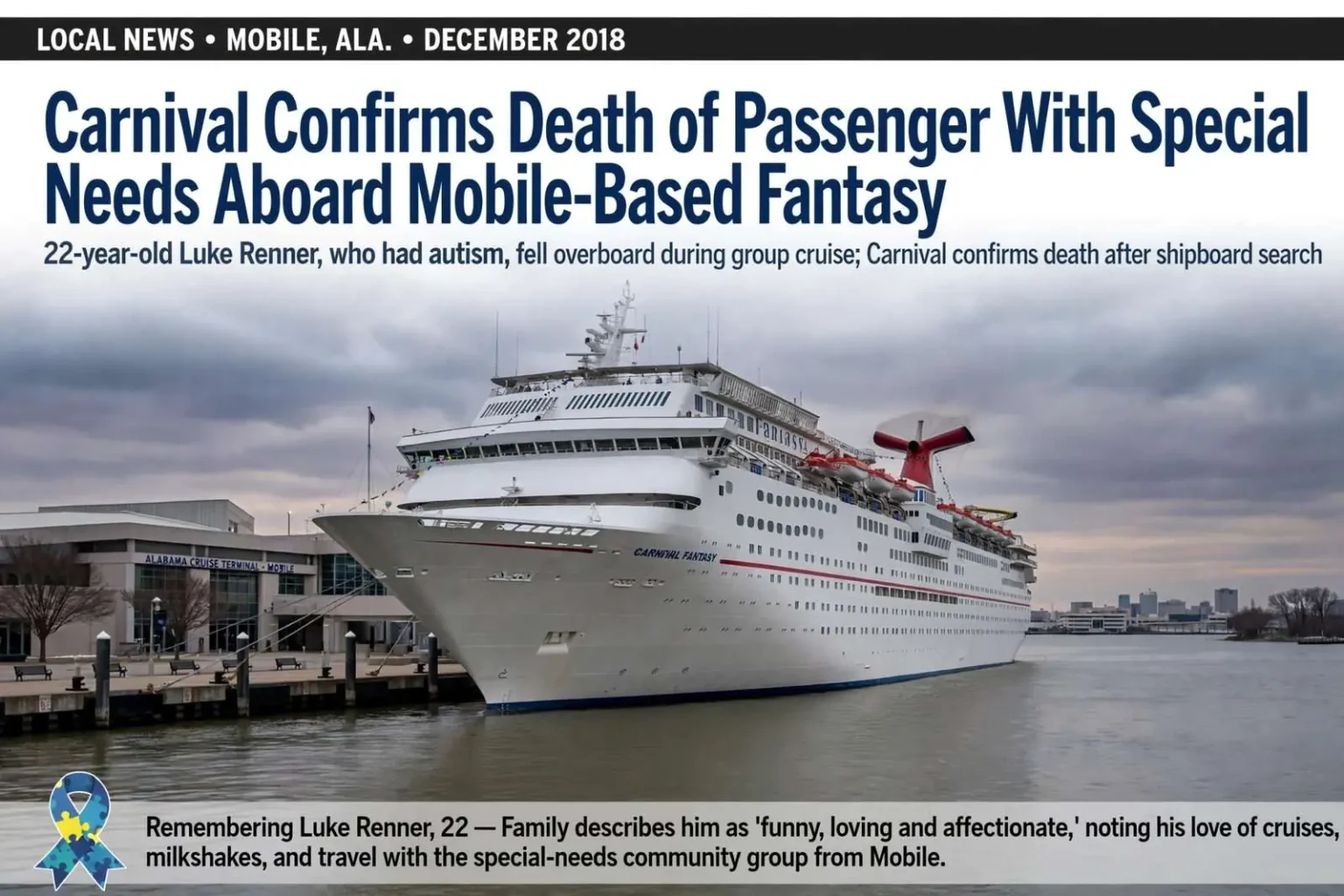
MOBILE, Ala. — Carnival Cruise Line confirmed in December 2018 that a 22-year-old passenger reported missing aboard the Mobile-based Carnival Fantasy had died after going overboard, closing a search that began when the young man was discovered absent from the ship.
According to a statement from the cruise line, Luke Renner, who had autism, climbed over a deck rail and went over the side of the ship. His family said they believe he may have been under the mistaken impression that he was going swimming, a detail they shared as they tried to make sense of the loss of a young man they described as full of warmth.
Carnival said its care team was assisting his family and traveling companions, the group of caregivers and fellow residents with whom Renner had boarded the ship in Mobile for the cruise. The ship continued to Port Canaveral, where officials handled the next steps in the case.
Who Luke Renner was
In a statement released through the cruise line, Renner’s family described him as funny, loving and affectionate, and thanked the special-needs community where he lived, which they said had organized and staffed the cruise. The trip was a group outing arranged by that community, an excursion designed to give residents a shared experience at sea with familiar caregivers around them.
The family said it did not hold that organization responsible for his death and asked for privacy to grieve. Their statement directed attention away from blame and toward the life the community had built around Renner — a life they described as marked by joy and connection.
They recalled his love of cruises, milkshakes and smoothies, and remembered him with the mischievous warmth that defined his life. He had sailed before, they noted, and being on a ship was among the experiences he loved most. A private celebration of life would be held later, the family said, away from public attention.
The ship and its Mobile homeport
The Carnival Fantasy was a familiar sight on the Mobile waterfront, sailing year-round from the Alabama Cruise Terminal on the Mobile River. The ship carried short itineraries — typically four- and five-day trips to the western Caribbean and Mexico — and drew passengers from across Alabama and the surrounding states who preferred Mobile’s terminal to the longer drive to New Orleans.
Overboard incidents remain among the rarest events in cruising, and they are among the most difficult to investigate. Ships keep rail heights above regulatory standards, and passengers who go overboard are usually not recovered unless witnesses or cameras record the moment, which fixes the ship’s position for search and rescue crews.
When a passenger is reported missing at sea, cruise lines follow protocols established under international maritime rules: a ship-wide announcement and search, a review of closed-circuit camera footage, and coordination with the Coast Guard and the flag state’s authorities. The Fantasy’s crew began that process when Renner could not be located, and the cruise line’s confirmation of his death followed the review of the ship’s records and footage.
Autism and the risks of water
Renner’s family’s belief that he may have thought he was going swimming points to a danger that advocates for people with autism have documented for years. Wandering and attraction to water are among the most significant safety risks associated with autism, and drowning is a leading cause of death among children and adults on the spectrum. Water offers sensory appeal — its look, its sound, its feel — and a person with autism may approach it without the situational awareness the setting demands.
Caregivers and families plan around that risk constantly: fencing, swimming lessons tailored to special-needs students, GPS trackers and constant supervision on outings. A cruise presents the challenge at its most concentrated — open water on every side, railings high but real, and a ship large enough that a moment of separation can become hard to reverse.
That context is part of why Renner’s family moved so quickly to shield the organization that staffed the cruise. Group outings for adults with special needs are built on the same principle as any community program — shared experiences, dignity, adventure — and the family’s statement made clear they regarded the trip and its organizers with gratitude, not resentment.
The special-needs community that traveled with him
The statement’s tribute to the community where Renner lived — a residential special-needs community whose members organized and staffed the cruise — offered a window into a form of shared life that has grown across the United States over recent decades. Such communities pair housing with programming, employment and travel, giving adults with intellectual and developmental disabilities lives that extend well beyond supervised care.
Travel is a fixture of that model. Group cruises, beach trips and vacations are planned with caregivers along, and they give residents the same experiences other adults take for granted. The cruise out of Mobile was one of those trips — an adventure Renner, a previous cruiser, had anticipated.
That the community accompanied the family through the aftermath, and that the family thanked them publicly even in the depths of the loss, spoke to the bonds such communities create. The statement asked for privacy for all of them, and said the celebration of Renner’s life would be private as well.
How overboard emergencies are handled at sea
When a passenger is reported missing on a cruise ship, the crew’s response follows a checklist shaped by international maritime rules and the industry’s own protocols. The ship makes an announcement, crew members search the vessel section by section, and the bridge reviews closed-circuit footage to determine when and where the passenger was last seen. If the review shows a person went overboard, the ship’s position is fixed and the Coast Guard is notified to begin a search of the water along the ship’s track.
The Coast Guard sectors covering the Gulf — including the units that serve the shipping lanes south of Mobile — coordinate those searches with cutters, aircraft and helicopter crews as conditions allow. Searches at sea are races against time and weather, and the Gulf’s currents spread debris and drift over wide areas quickly. Recovery outcomes in overboard cases are statistically grim, a reality the industry acknowledges even as rail heights and camera coverage have improved over the years.
Cruise ships sailing from U.S. ports operate under the requirements that follow from their itineraries and flag registries, and incidents involving U.S. passengers are documented and reported through federal channels, including the Cruise Vessel Security and Safety Act reporting framework that covers missing persons and other serious incidents at sea.
The Carnival Fantasy’s years in Mobile
For years the Carnival Fantasy was essentially synonymous with cruising from Alabama. The Fantasy-class ship, one of Carnival’s longest-serving vessels, homeported at the Alabama Cruise Terminal and gave the city a steady tourism anchor on the riverfront. Travelers from Mobile, Baldwin County, Pensacola and across the Mississippi Gulf Coast boarded the ship for short getaways that required no airline ticket.
The terminal’s economic footprint spread through the city — parking, hotels, restaurants and the taxi and rideshare business that follows every embarkation day. A passenger community of that size also made Mobile’s sailing the natural choice for group travel of the kind that brought Luke Renner and his companions aboard.
Incidents aboard any ship are rare relative to the millions of passenger-days the industry logs each year, but when they occur, they resonate in the homeport community, where the ship and its crew are familiar presences. The Fantasy’s crew, like crews everywhere, trained for man-overboard scenarios as a matter of routine, and the December events put that training to its hardest test.
Grief, privacy and a community’s response
What remained after the confirmation of Renner’s death was the grief of the people who knew him — his family, and the special-needs community that had traveled with him and lost one of its own. The family’s statement did the work that statements like it do: it filled in who Luke Renner was, for the thousands of strangers who would read his name, and it drew a boundary around the privacy they needed.
The details they chose to share were loving ones — cruises, milkshakes, smoothies, mischief. The detail they shared about what they believe he was thinking — that he thought he was going swimming — was harder, and it came with the explanation families of people with autism often find themselves offering after a drowning: that the attraction of water is real and profound, and that no program, however careful, can eliminate every risk of an open deck at sea.
The private celebration of life that followed was, by the family’s choice, a family matter. In Mobile and in the community where Renner lived, the loss was marked by the people who knew him best, and the cruise line’s care team remained in contact with the family as the formal questions raised by a death at sea moved through the maritime process that follows such events.


