
Carnival Spirit to Homeport in Mobile for Five-Month Trial Run Starting October 2023
After the Ecstasy's final voyage, Carnival will base the larger Spirit in Mobile from October 2023 to March 2024 as a trial to prove year-round demand.
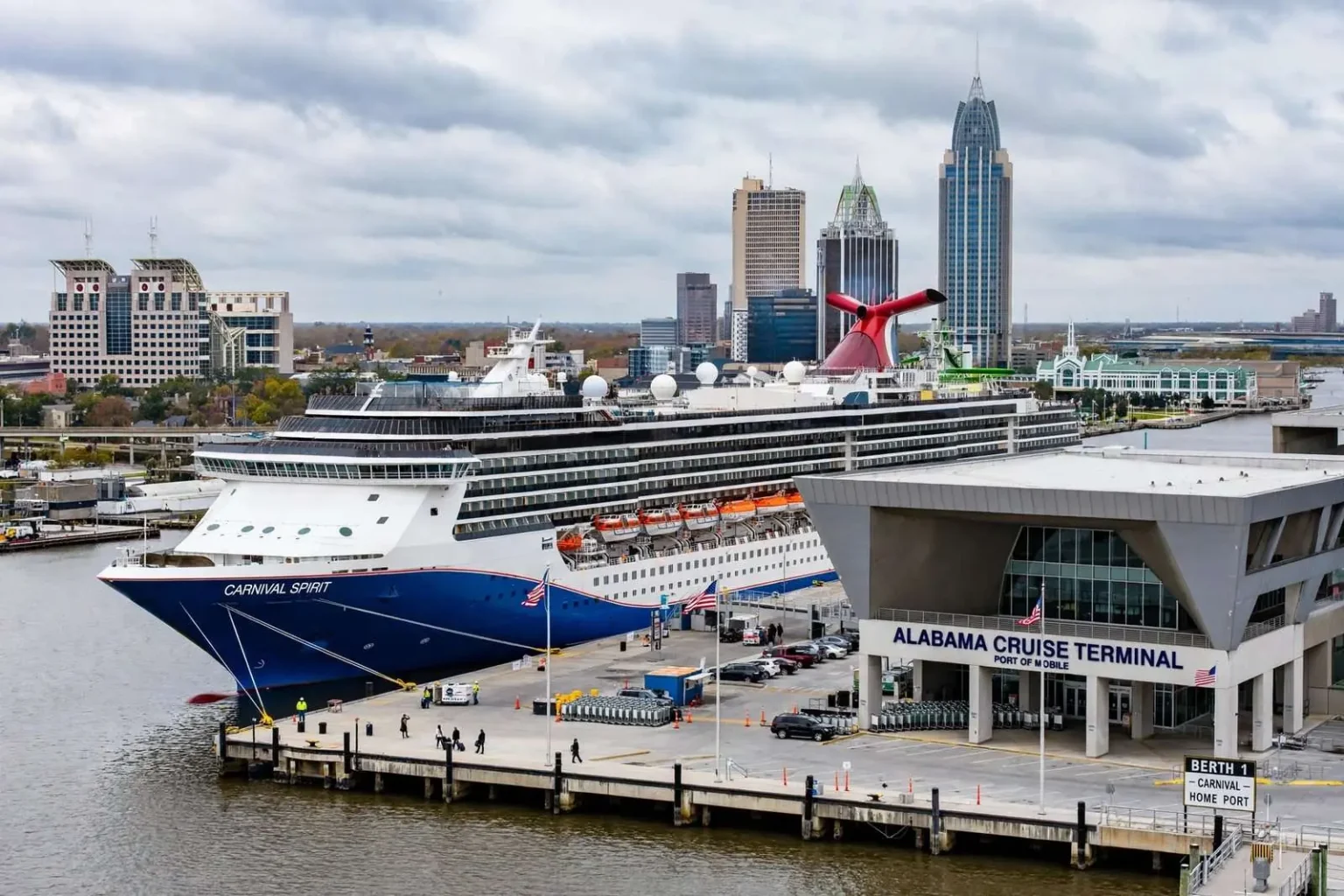
Days after the Carnival Ecstasy sailed out of Mobile for the final time, tourism officials were already working on what comes next — and they landed a bigger ship, at least temporarily. David Clark, CEO of Visit Mobile, flew to Miami to meet with Carnival representatives the day after the Ecstasy’s departure, and the talks produced an agreement that surprised even some longtime observers of the local port: the Carnival Spirit will homeport in Mobile from October 6, 2023 until mid-March 2024 in what Clark described as a “trial run” to measure demand for a larger class of cruise ship in the market.
The Ecstasy’s final sailing had marked the end of an era. The Fantasy-class ship had been the workhorse of Mobile’s cruise business for years, carrying a familiar mix of Gulf Coast families, first-time cruisers and regulars who valued the simplicity of sailing from a home port an hour’s drive from home. Its retirement left the Alabama Cruise Terminal without a year-round tenant for the first time in the modern history of the facility, and tourism officials made no secret of the urgency behind finding a replacement before the gap stretched from months into years.
“Mobile was a compelling market. We’ve never had this kind of ship before,” Clark said. “It’s an upgraded ship for us. So they wanted to give us a chance because they know we’re a great drive market.” The Spirit, a considerably larger and more modern vessel than the Ecstasy, carries more passengers, offers more onboard amenities and typically sails longer itineraries — a different proposition for both the port and the traveling public.
An upgraded ship for Mobile
For cruise passengers along the Gulf Coast, the difference between the two ships is more than a matter of tonnage. Where the Ecstasy represented an older generation of mid-size ships — casino, pool deck, main dining room and a handful of lounges — the Spirit-class design brings multiple dining options, a spa, expanded children’s programming, a two-tier main showroom and balcony-heavy stateroom layouts that appeal to travelers who once drove past Mobile to New Orleans for newer vessels. Landing a ship of that class for even a season gives Mobile a test it has never really had: whether local and regional demand will support a product closer to what the big ports offer.
Clark encouraged Mobilians and coastal Alabamians to get behind the effort, saying the goal is to prove enough demand to keep a ship in Mobile twelve months a year — bookings, in Carnival’s calculus, are the data. If the Spirit sails full from Mobile through the fall cruise season, the holidays and spring break, the argument for a permanent deployment strengthens; if sailings lag, the trial confirms the market’s ceiling.
The trial window was deliberately placed to cover the strongest stretches of the cruise calendar: October’s shoulder-season bargains, Thanksgiving and Christmas sailings that draw multi-generational family groups, and the spring break rush that historically packs Gulf Coast departures. Carnival’s analysts will read that stretch closely, comparing Mobile’s fill rates and pricing against the ship’s potential in other markets when the season ends.
The economic stakes
With no ship based in Mobile in the interim, Clark warned the gap could carry a real cost. He estimated the cruise operation brought 15,000 to 17,000 visitors into the city each month, filling some 35,000 hotel rooms and spending at local restaurants and retailers. Those figures describe more than dockside activity: embarking passengers arrive the night before, book downtown hotel rooms, eat dinner in local restaurants and buy supplies; disembarking passengers linger for breakfast or a museum visit before driving home. The cruise terminal’s rhythm feeds directly into downtown Mobile’s hospitality economy, and a season without sailings means those rooms and tables sit empty.
The departure has also rippled through local travel businesses. Ariel Chavez of New Frontier Travel said clients who relied on the convenience of sailing from Mobile are being rerouted — including a Mardi Gras organization that will now have to bus to New Orleans to catch its group cruise. For travel agencies, the shift means rebooking itineraries, adjusting group logistics and managing client frustration over longer drives, parking costs and the logistics of embarking from a different state.
What the Spirit brings to the terminal
The Carnival Spirit was slated to leave its Alaska assignment and arrive in Mobile on October 6, 2023 — a repositioning that itself says something about how the industry views the Gulf Coast market. Ships of the Spirit class were built for destination flexibility, sailing Alaska’s inside passage in summer and migrating to warmer waters for winter. Mobile’s trial deployment slots the ship into the Caribbean and Bahamas-style cruising that dominates the western Gulf, with the port positioned as a convenient embarkation point for drivers across Alabama, the Florida Panhandle, Mississippi and Louisiana.
That drive-market logic is the heart of Mobile’s pitch. Millions of prospective cruisers live within a half-day’s drive of the Alabama Cruise Terminal, and for them the alternative is often a longer haul to New Orleans or Galveston. Sailing from Mobile eliminates the flight or the long drive before a cruise, and passengers consistently cite the convenience — easy parking, quick boarding, a terminal without the crowds of the mega-ports — as the reason they choose a home port even when another departure city offers a bigger ship.
The trial also tests the terminal itself at a scale it has not regularly handled. A larger ship means more vehicles in the parking areas, more luggage through security screening, more boarding traffic in the morning and more disembarking passengers on return Saturdays. Port officials have spent years arguing that the facility can handle modern vessel classes; a full season with the Spirit gives them the operational evidence to make that case when Carnival weighs its next deployment decisions.
A gap the city felt immediately
The months between the Ecstasy’s exit and the Spirit’s arrival were never going to be idle, but they were going to be quiet, and Mobile’s hospitality industry planned around the loss. Hotel operators who had built group blocks around weekend sailings, downtown restaurants that counted on pre-cruise dinners and tour operators who sold pre- and post-cruise excursions all braced for a stretch of empty calendar. The trial deployment promises to refill much of that calendar from October through mid-March — but only if bookings materialize at the pace the line expects.
Travel advisors like Chavez sit at the front line of that test. Agencies steer clients toward specific ships and departure dates, and their recommendations shape how quickly a new deployment fills. Local advisors have a stake in the answer: a permanent homeported ship keeps regional cruise clients — and their pre-cruise spending — in Alabama, while the alternative sends them, and their money, to Louisiana or Texas. The Mardi Gras organization rerouted to New Orleans illustrated the point in miniature: the group’s cruise spending now lands in another state, along with the bus charters, hotel nights and meals that go with it.
Clark said the Spirit’s stay is short by design, but success could change that. “All we have to do is prove the demand and I think anything’s possible,” he said. For a city that has watched its cruise business shrink and restart across the years, the season ahead amounts to an audition — five months, one larger ship and a straightforward question for Gulf Coast travelers: will they sail from Mobile when given something newer and bigger to sail on? The answer, written in fall and spring bookings, will determine whether Mobile’s cruise story continues beyond mid-March.
Mobile’s cruise history in context
The trial run is the latest turn in a cruise business that Mobile has spent two decades building, losing and rebuilding. The Alabama Cruise Terminal opened with fanfare as the city’s bid to capture a share of the Gulf cruise market, and its early years delivered steady sailings that put Mobile on the itinerary maps of travelers across the Southeast. But the industry consolidated around the region’s larger ports, deployments shifted, and Mobile has periodically found itself without a homeported ship — gaps that each time forced local officials back into the pitch meetings that keep a port on a cruise line’s deployment map.
Those pitch meetings are where markets like Mobile are won. Cruise lines plan their deployments years ahead, matching vessels to ports based on past fill rates, drive-time demographics, port fees and operational costs. A CEO flying to Miami the day after a final sailing, as Clark did, reflects how competitive that process is: when a ship leaves, the line owes the market nothing, and the next deployment goes to whichever port makes the strongest case. The Spirit agreement suggests the case for Mobile rested on exactly what Clark described — a compelling market, an upgraded ship to test it with, and a drive market Carnival already believed in.
For the Alabama State Port Authority and city officials, a successful trial has implications beyond the cruise business itself. A busy cruise terminal raises the waterfront’s profile, supports the case for continued investment in the terminal facility and pairs with the port’s broader operations in a way that keeps downtown Mobile’s working waterfront active. The visitors who fill 35,000 hotel rooms a month during a healthy cruise season are, in effect, an argument the whole city makes every time a ship is in port.
How residents can shape the outcome
The trial period gives local travelers an unusually direct role in the outcome. Every cabin booked on the Spirit’s Mobile sailings becomes evidence in the demand case, and tourism officials have made clear that the target audience is local first: Mobilians, coastal Alabamians and residents across the broader drive market who have historically driven past the terminal to catch a ship elsewhere. Travel advisors in the area have echoed the message, pointing clients to the fall and winter itineraries as the way to vote, in effect, for a permanent cruise presence.
The season’s results will be measured after the Spirit sails out of Mobile for the last time in mid-March, when Carnival compares the deployment’s performance against its alternatives. Until then, the city’s hospitality industry gets a second wind it had already begun planning without — the hotel nights, the restaurant tables, the parking revenue and the foot traffic that a homeported ship generates month after month. Whether that becomes a fixture or another chapter that ends with a final sailing depends on the numbers the next five months produce.