CBS moves daytime shows online after tornado coverage near Mobile
After a confirmed tornado north of Mobile prompted live storm coverage, viewers can stream regular CBS daytime programming on the network's website.
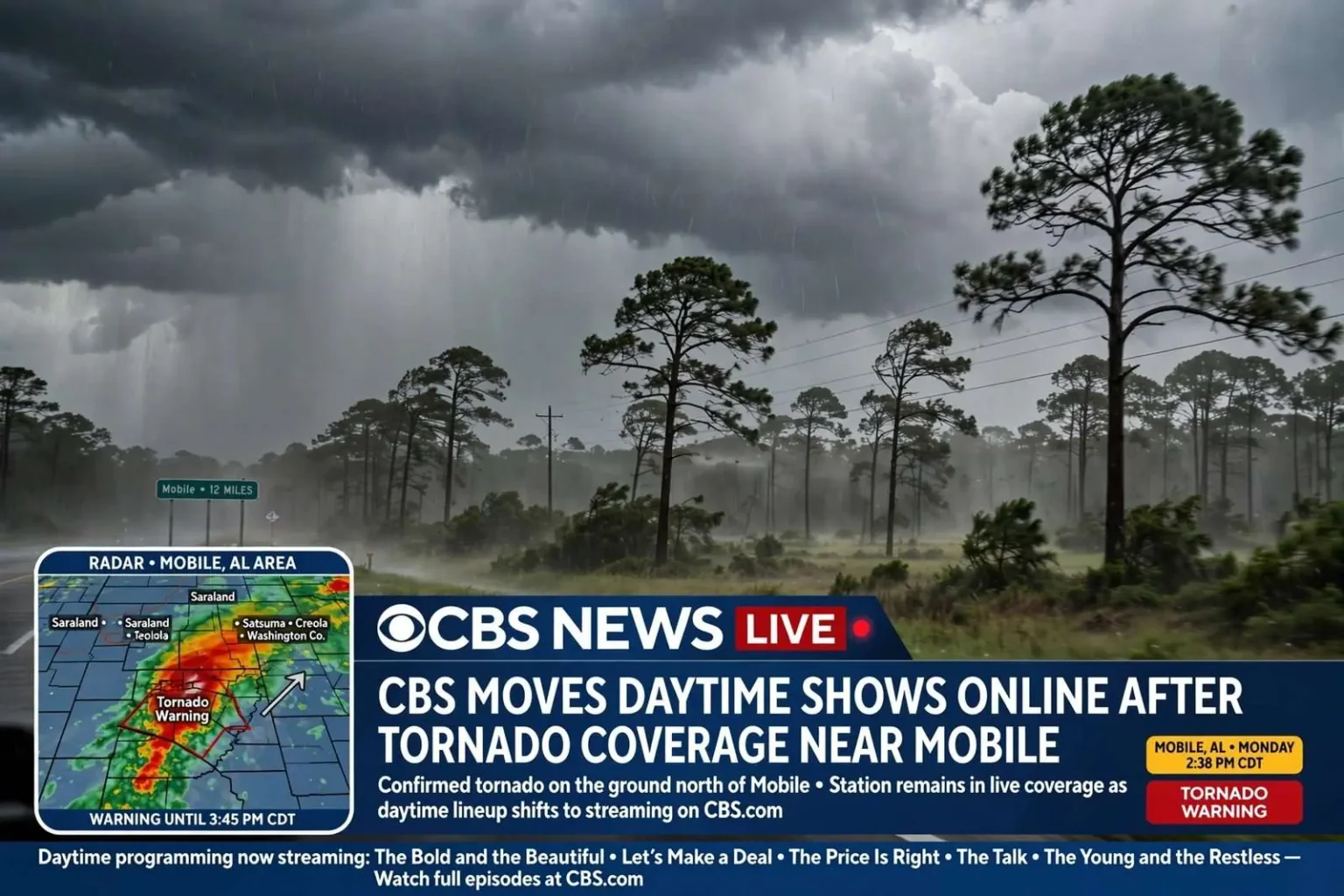
MOBILE, Ala. — With a confirmed tornado north of Mobile on Monday afternoon, the local CBS station remained in live coverage of the storm instead of airing its scheduled daytime lineup. Viewers can still watch their regular programming on the CBS website. Full episodes of The Bold and the Beautiful, Let’s Make a Deal, The Price Is Right, The Talk and The Young and the Restless are available to stream.
The decision to stay with storm coverage rather than switch back to the network’s afternoon schedule is a familiar one along the Gulf Coast, where severe weather can interrupt television programming at almost any time of year. With a tornado confirmed on the ground north of Mobile, the station’s meteorologists and anchors had a responsibility that outranked any scripted drama or game show: tracking the storm’s path, relaying warnings, and giving residents in its way time to take shelter.
For viewers who planned their afternoons around the network’s daytime lineup, the preemption was an inconvenience with an easy remedy. CBS made full episodes of its daytime programs available on its website, meaning fans of The Bold and the Beautiful, Let’s Make a Deal, The Price Is Right, The Talk, and The Young and the Restless could catch what they missed online rather than waiting for a rebroadcast. The arrangement has become standard practice in network television, built for exactly the situations local preemption creates.
Why Gulf Coast television preempts for tornadoes
The Gulf Coast sits in a region where tornadoes are a year-round hazard, not a seasonal curiosity. While the Plains states see their tornado season peak in spring and summer, the Gulf Coast experiences a secondary and often deadlier cool-season peak in late fall, winter, and early spring, when clashes between warm moist Gulf air and fast-moving cold fronts spawn quick, rain-wrapped tornadoes that are harder to see and faster to develop. Mobile and the surrounding counties have a long history of such storms, and local broadcasters treat every tornado warning as an event worthy of continuous coverage.
Stations in the Mobile–Pensacola market have generations of institutional experience with severe weather, and their coverage conventions have been shaped by deadly storms over the decades. When the National Weather Service office serving south Alabama issues a warning, television meteorologists go on the air with radar analysis, storm tracking, and county-by-county information, interrupting whatever is scheduled. The calculus is simple: a missed episode of a soap opera can be streamed, but minutes of warning time can save lives.
Monday afternoon’s confirmed tornado north of Mobile fell into exactly that category. A confirmation — whether from spotters, law enforcement, or radar signatures indicating a tornado on the ground — changes the tone of coverage immediately, and stations hold their broadcast in continuous mode until the threat passes their area. Residents north of the city, in communities that stretch toward Saraland, Satsuma, Creola, and the Washington County line, were the ones in the path, and the station’s live reporting was aimed squarely at them.
How tornado warnings reach the public
Television is only one layer of the warning system that mobilized during Monday’s storm. The National Weather Service office in Mobile issues warnings based on radar and trained spotters, and those warnings trigger alerts on phones through the Wireless Emergency Alerts system, activate NOAA weather radios, and fire off messages from local emergency management agencies. Broadcast meteorologists then translate that stream of technical information into practical guidance: where the storm is, which direction it is moving, which neighborhoods and roads are in its path, and what people in those places should do right now.
The partnership matters because severe weather on the central Gulf Coast often develops quickly. Squall lines ahead of a cold front can spin up tornadoes with little lead time, and rain-wrapped storms are notoriously difficult to spot visually. Radar indication plus ground truth from spotters and law enforcement remains the most reliable formula for confirmation — which is why officials ask residents to report damage and funnel clouds, and why stations maintain relationships with storm spotter networks across the region.
For the station’s newsroom, a confirmed tornado means every resource shifts to weather. Anchors hand off continuously, meteorologists annotate radar, and producers cut in county emergency information as it arrives. The scheduled programming simply waits, and in the streaming era, the network’s website makes that wait painless for viewers whose afternoon shows were displaced.
Streaming changes the arithmetic of preemption
There was a time when a daytime preemption meant viewers simply missed their shows, dependent on overnight or weekend rebroadcasts if the station chose to air them. That era has ended. Networks now post full episodes of their daytime programs online, and the availability of The Bold and the Beautiful, Let’s Make a Deal, The Price Is Right, The Talk, and The Young and the Restless on the CBS website during Monday’s storm coverage reflects a system designed to absorb exactly this kind of local interruption.
The change has quietly altered the relationship between local stations and their audiences. Stations can devote as much time as the emergency requires to weather coverage without worrying that loyal viewers will be permanently stranded, and viewers can ride out the disruption knowing their programs are waiting online. For the network’s daytime block, streaming availability has become a built-in safety valve for the markets where preemption is most frequent — and few regions preempt for weather as often as the Gulf Coast does.
The same streaming infrastructure has also changed how people follow the storm itself. During severe weather events, viewers who lose cable or satellite service can often still stream local coverage on a phone, and stations maintain live feeds on their websites and apps for that reason. Monday’s combination — live storm coverage on the broadcast signal, displaced daytime shows available online — shows both sides of that shift working at once.
Tornadoes north of Mobile: the local geography
The areas north of Mobile where the Monday tornado was confirmed form a corridor where cold fronts arriving from the west frequently produce rotating storms. Communities along and near U.S. 43 and Interstate 65 — Prichard, Saraland, Satsuma, Creola, Citronelle, and out toward Mount Vernon and Calvert — sit in a belt that has seen repeated tornado warnings over the years. The terrain of pine forest, creeks, and small communities means a tornado can move through wooded areas where damage is hard to spot from the road, which is why radar confirmation and damage surveys afterward play such large roles in the region’s storm accounting.
The National Weather Service conducts damage surveys after confirmed tornadoes, rating them on the Enhanced Fujita scale based on the damage they leave. Those ratings determine how the event is recorded in the historical record and help meteorologists refine their understanding of how storms in the region behave. In the hours after Monday’s event, the priorities were more immediate: accounting for injuries, clearing downed trees and power lines, and restoring electricity to affected neighborhoods.
Storms of this kind are a routine feature of life on the central Gulf Coast, but routine does not mean trivial. Mobile County and its neighbors have recorded tornadoes in every month of the year, and the region’s fast-developing squall-line storms are among the hardest to warn for. The afternoon timing of Monday’s tornado, while schools were still in session and commuters were at work, added urgency to the station’s continuous coverage and the warnings flowing from the weather service.
After the storm passes
Once the tornado threat moved out of the area and the station stood down from continuous coverage, the displaced programming resumed its usual place in the schedule, and the afternoon’s interruptions became a footnote. The storm’s effects, however, took longer to resolve. Damage assessments continued, utility crews worked through affected areas, and residents who had spent the afternoon watching radar instead of game shows returned to the ordinary business of the week — with the reminder that on the Gulf Coast, the weather can claim the airwaves any day, and the best response is a prepared household.
Preparedness guidance in tornado country stays consistent from one event to the next: know where you will shelter before a warning is issued, keep shoes and helmets accessible, have multiple ways to receive warnings, and never wait to see the storm before acting. As Monday’s confirmed tornado north of Mobile demonstrated, the system of spotters, weather radar, emergency alerts, and broadcasters who stay on the air works best when the public does its part — and thanks to the network’s website, the only thing anyone had to sacrifice was the habit of watching on a schedule.
Local weather coverage, for its part, has only grown more central to Gulf Coast life as the years have passed. Audiences increasingly follow stations and meteorologists directly through social feeds between storms, which means the relationship is already in place when a confirmed tornado puts everyone on the same page. Monday’s broadcast was one more instance of a longstanding bargain on this coast: when the sky turns dangerous, the schedule yields, and the people whose job it is to explain the storm stay on the air until it is over.