Chickasaw Civic Theatre Stages Ken Ludwig’s ‘Leading Ladies’ With Local Cast
Chickasaw Civic Theatre staged Ken Ludwig's Leading Ladies in October 2011. Inside the farce, the local cast, and the armory building the troupe calls home.
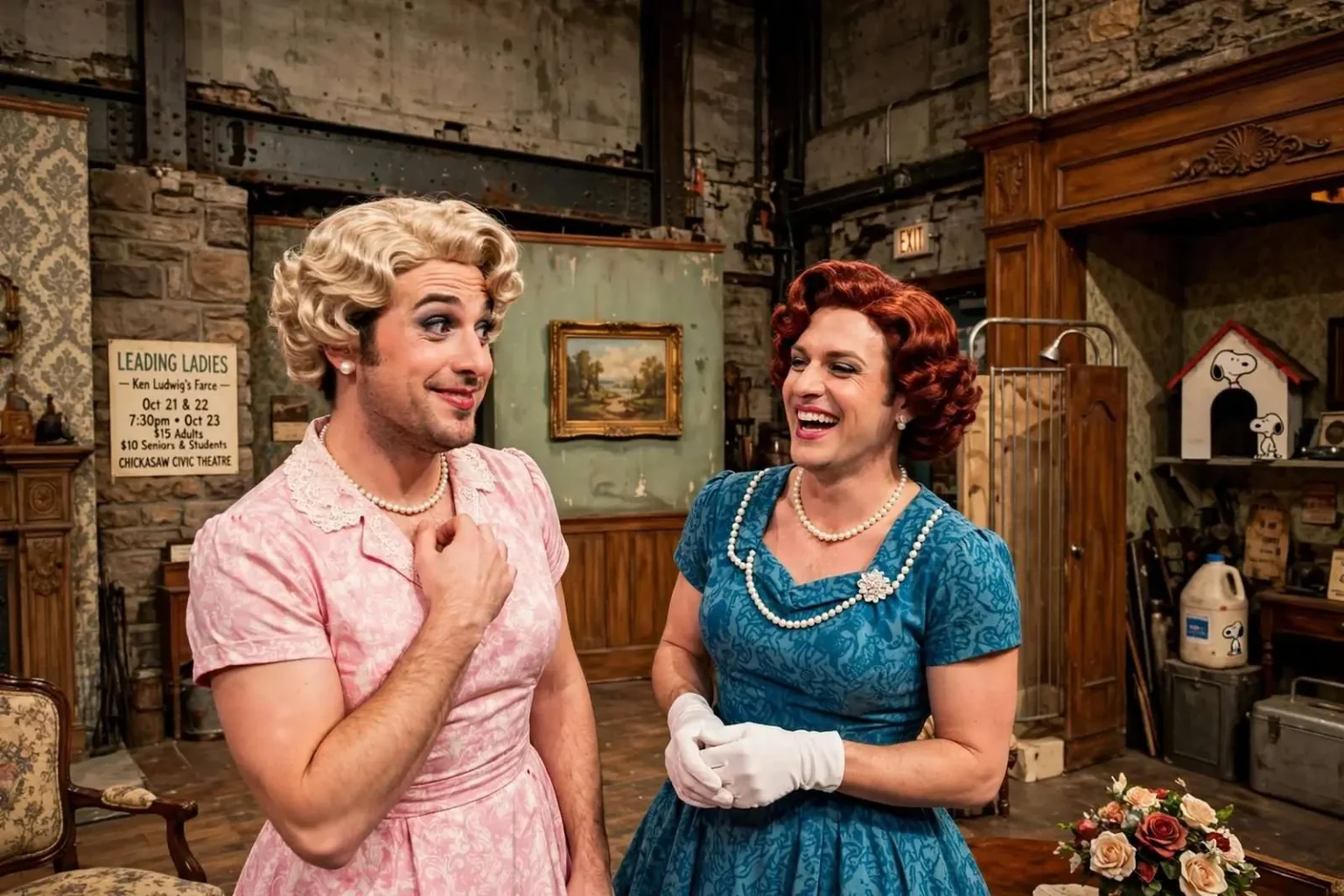
Chickasaw Civic Theatre closed its October 2011 run of Ken Ludwig’s comedy “Leading Ladies” with performances on October 21 and 22 at 7:30 p.m. and a Sunday, October 23 matinee at 2:30 p.m., with tickets at $15 for adults and $10 for seniors and students. The closing weekend capped a run that gave north Mobile County audiences one of the most reliably produced farces in the modern community-theatre repertoire, staged by a company whose volunteers have spent decades turning a former military building into one of the area’s most distinctive playhouses.
The 2004 farce follows two English Shakespearean actors, Leo Clark and Jack Gable, who — flat broke after being laughed out of a Moose Lodge on their tour of 1958 New England — impersonate the long-lost heirs of a dying heiress, only to discover the will names Maxine and Stephanie rather than Max and Steve. The plot premise sends the two performers into dresses, wigs and increasingly frantic improvisation as they try to keep the charade alive long enough to inherit, while romantic entanglements complicate the scheme in ways only a farce can arrange. Ludwig structures the show around the comic tension between the actors’ professional vanity and the absurdity of the situation they have chosen, letting each near-discovery of the truth ratchet the stakes higher.
Timothy Guy (Leo/Maxine) and J.C. Towns (Jack/Stephanie) led the cast, joined by Sarah Dunham as Meg, Steven Castle as Duncan, Don Bloom as Doc, E.A. Keeble as Florence, Justine Cauley as Audrey, Ryan Mouner as Butch and Nathan Harrison as Moose Frank, under director Leonora Harrison. The double-casting at the heart of the show demands a great deal from its two leads, who spend the evening switching between their male roles and their female impersonations, often within the same scene, and the supporting cast carries the family and romantic subplots that give the farce its emotional spine.
A theater inside an old armory
The production doubled as an introduction for newcomers to one of the area’s most distinctive playhouses: Chickasaw Civic Theatre resides in a former National Guard armory, where volunteers build every set in-house backstage. The building’s military origins give the theater qualities no purpose-built venue can replicate — thick walls that contain the loudest farce, a cavernous backstage area for scenery construction and storage, and a neighborhood institution whose roots in the Chickasaw community run deeper than most professional companies could claim.
The lobby doubles as a mini-museum of past productions, displaying memorabilia including Snoopy’s life-sized doghouse from “You’re a Good Man, Charlie Brown,” the wooden shower built for “South Pacific,” and the oversized milk jug, cooler and oven from “Cats” — the doghouse long a favorite photo spot for theatergoers. The collection serves as an informal archive of the company’s history, and longtime patrons browse it before curtain the way visitors to larger houses study lobby displays, except that nearly every artifact on the wall was built by a volunteer who may still be serving on the crew.
The stage is a traditional proscenium design with a working trapdoor, a rarity in community venues of its size. The trapdoor gives directors staging options most community stages lack — surprise entrances, comic disappearances and the kinds of sight gags that farce thrives on — and it is the kind of architectural detail that reminds audiences the building has been adapting to theatrical use for generations.
The playwright behind the farce
Ludwig, best known for the Broadway hit “Moon Over Buffalo” starring Carol Burnett, built “Leading Ladies” on the classic cross-dressing farce tradition of Shakespeare, trading on quick-witted one-liners and escalating disguise gags rather than plot depth — a formula the company’s cast played for steady laughs through the show’s happily-ever-after finale. The lineage is deliberate: Ludwig’s plots routinely put actors on stage playing actors, and “Leading Ladies” may be his most direct tribute to the theatrical tradition it spoofs, with its heroes quoting Shakespeare even as their situation spirals into pure vaudeville.
The cross-dressing farce has deep roots that stretch back centuries. Shakespeare’s own comedies — “Twelfth Night” most famously — built entire plots on women disguised as men and the romantic confusion that follows, and later generations of theatre reversed the device, putting men in dresses for comic effect from music hall through the classic Hollywood comedies that Ludwig grew up on. “Leading Ladies” layers the device twice: its actors impersonate women who are themselves impersonated figures, and the comedy compounds with each layer of pretense.
For community theatre companies, the show is an attractive property for practical reasons as well as artistic ones. It requires a manageable cast, one primary set — the heiress’s Pennsylvania estate living room — and comedy that does not depend on expensive effects. The laughs come from timing, physical commitment and the audience’s affection for characters who are clearly in over their heads, which makes the play a reliable crowd-pleaser for a volunteer company that depends on ticket sales to keep its doors open.
Community theatre in the Mobile area
The run also placed Chickasaw Civic Theatre within a broader network of community stages in the Mobile area, where volunteer companies have kept live theatre available at prices professional houses cannot match. The $15 adult and $10 senior-and-student ticket pricing reflected the economics of volunteer theatre — costs covered, buildings maintained and audiences cultivated rather than profits pursued — and for many families in north Mobile County, the company’s seasons have been their first and most regular exposure to live performance.
Companies like Chickasaw’s survive on the same formula season after season: local actors who rehearse at night after full-time jobs, volunteers who build and paint sets on weekends, and directors who commit months of evenings to a single production. The October 2011 production of “Leading Ladies” fit squarely in that tradition, with a cast drawing from across the area and a technical crew constructing the heiress’s drawing room in the armory’s backstage shops.
The choice of material said something about the company’s instincts as well. Farce demands the kind of ensemble trust that community companies build over years of working together, and it rewards companies with strong comic actors willing to commit fully to absurdity. In Guy and Towns, the production had two leads carrying roles that require sustained physical comedy and rapid character switching, supported by a cast balanced across the show’s romantic and comic subplots.
What the closing weekend meant
Closing weekends carry a particular energy in community theatre. By the final performances of a run, the cast has settled into the show’s rhythms, the laughs land where they were designed to, and the audiences for those last nights typically include the friends, families and longtime patrons who have followed the company for years. The Sunday matinee format — 2:30 p.m. on October 23 — gave the production a final audience of theatergoers who prefer daytime performances, including many seniors who take advantage of the discounted ticket price and the easier evening schedule it preserves.
The October 21 and 22 evening performances at 7:30 p.m. gave the run the standard community-theatre closing cadence: two Friday and Saturday night houses followed by the Sunday matinee. For a farce, closing weekends are often the strongest, because comedy improves as a cast grows comfortable enough to play moments at full speed without rushing past the reactions that make them land.
For the volunteers who had built the show — from the director through the cast to the crews who constructed and dressed the set — the closing marked the end of months of unpaid evenings and weekends. That arithmetic is the quiet engine of community theatre across the Mobile area: productions that run for a few weekends represent a commitment of hundreds of volunteer hours, all justified by the laughter of a full house and the renewal of season subscriptions for the shows that follow.
An institution worth the drive
Part of what makes the Chickasaw Civic Theatre worth the trip from Mobile or the surrounding communities is the building itself. A former National Guard armory converted to theatrical use is not the kind of venue a visitor forgets: the drill hall proportions, the industrial bones and the lobby museum of past productions together tell the story of a company that has grown up inside a building that was never meant for plays and made it home anyway. The Snoopy doghouse, the “South Pacific” shower and the oversized “Cats” props are conversation pieces, but they are also evidence — physical proof of productions staged, built and remembered across decades.
The working trapdoor on the proscenium stage speaks to the same tradition of practical ingenuity. Community companies rarely get to build from scratch; they adapt what they have, and a stage equipped with a functioning trap area gives each season’s directors a tool that most venues of comparable size would envy. For a farce like “Leading Ladies,” which thrives on entrances, exits and surprises, such staging options are not luxuries — they are part of the comedic machinery.
The 2011 production of “Leading Ladies” took its place, then, as both a popular comedy and a showcase for what the company does: name actors drawn from the local talent pool, a classic script staged with professional care, and a one-of-a-kind venue maintained entirely by volunteers. For audiences who discovered the theater through this run, the lobby memorabilia and the armory walls offered something beyond the performance itself — an invitation into a continuing local institution whose next production, like every one before it, would be built by hand backstage.