Chickasaw police search for person of interest in 6th Street shooting
Chickasaw police are searching for a person of interest after a woman was shot multiple times at a home on 6th Street near Telegraph Road.
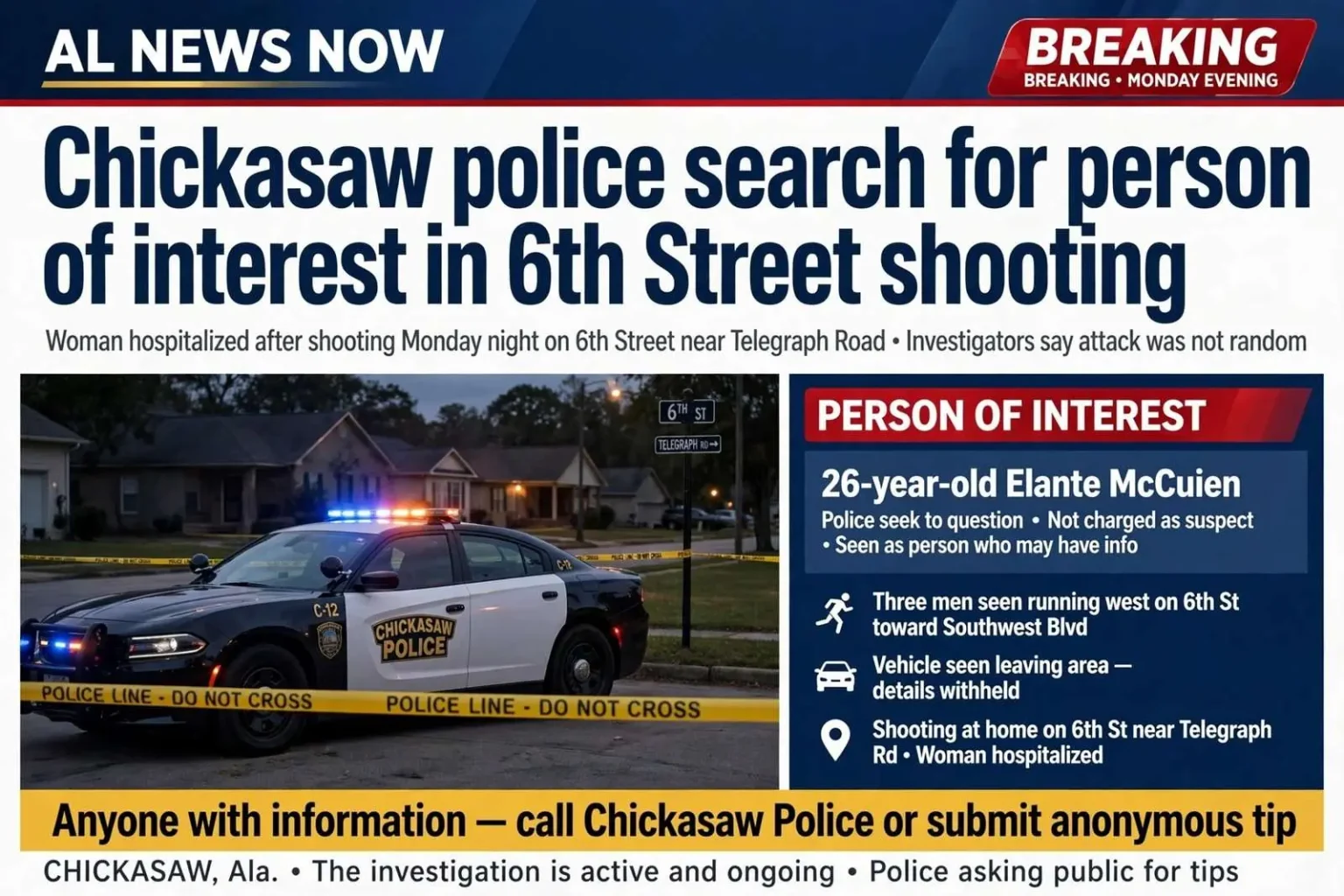
CHICKASAW, Ala. — Chickasaw Police are investigating a shooting that left a woman hospitalized after it happened Monday night at a home on 6th Street near Telegraph Road. Detectives said the victim was shot several times and taken to the hospital shortly after 6 p.m., where she was being treated for her wounds. Investigators believe the shooting was not random and are looking for a man they think may have information that could help the case. He has been identified as 26-year-old Elante McCuien, whom police have described as a person of interest rather than a charged suspect. After the shooting, three men were seen running west on 6th Street toward Southwest Boulevard, and detectives also have a description of a vehicle seen leaving the area, though further details have not been released. The investigation remained active as police worked to account for the people seen fleeing the scene and to establish what led to the gunfire.
The shooting occurred in a residential section of Chickasaw, a small city in Mobile County squeezed between Prichard to the south and Saraland to the north along U.S. Highway 43. Chickasaw incorporated as a city in 1946, carved out of a company town built around the Chickasaw Shipbuilding Village during World War I, and today it is a community of modest neighborhoods, its own school system, and a compact police department that handles the city’s calls for service. A shooting with multiple victims of gunfire at a home in the evening draws the department’s full investigative attention, because in a city Chickasaw’s size, detectives have a limited roster and every serious case competes directly with the daily workload of patrol and calls.
The detail that the shooting was not random changes the shape of the investigation. When detectives believe a victim was targeted, the investigative focus turns to the victim’s relationships, movements, and any disputes connected to the address where the shooting occurred. The woman’s condition after being shot several times was not detailed in the initial release, nor has her identity been made public. What police did ask the public for was help locating McCuien and any information about the men seen running from the area and the vehicle seen leaving it — the standard appeal in a case where investigators have a name and a direction of flight but have not announced an arrest.
How the Search for a Person of Interest Works
The distinction police drew between a person of interest and a suspect matters in how the case is described publicly. A person of interest is someone investigators want to locate and question because they may have information that could help the case; the label does not assert that the person committed the crime. That caution protects the investigation: naming someone a suspect before charges are filed can compromise the case and expose the agency to claims it prejudged the matter. It also reflects where the case stands — police had identified McCuien by name and age, believed he could help them, and were asking the public to come forward with information about where he might be, while stopping short of saying he fired the shots.
In cases like this one, detectives pursue several threads at once. The men seen running west on 6th Street toward Southwest Boulevard would be traced through canvassing of the neighborhood, since residents along the route may have seen them pass; the vehicle leaving the area would be run against descriptions from witnesses and any camera footage available along the corridor. Detectives also work the victim’s side of the case, reconstructing her evening and the circumstances at the home on 6th Street. None of those threads has produced a public result yet, and the department has held back the vehicle description and most other specifics, a practice that helps preserve the integrity of the investigation by keeping key details out of general circulation.
The geography of the scene matters to the canvas. 6th Street sits near Telegraph Road, one of the streets that threads through Chickasaw’s residential grid toward the commercial strip along U.S. 43, and Southwest Boulevard lies to the west — meaning the men seen fleeing were moving away from the highway corridor, deeper into the neighborhood. A short flight on foot through residential streets in the early evening is a route that neighbors may have witnessed, which is why departments publicize the direction of flight: someone’s porch camera or a passing driver’s memory can fix the time and direction in ways detectives cannot otherwise establish.
Gun violence of this kind places a small department in a familiar bind. Municipal police agencies in Mobile County’s smaller cities — Chickasaw, Prichard, Saraland, Satsuma, Creola — handle serious crimes with detective staffs numbering in the single digits, and they routinely lean on county and federal partners for major-case support. The Mobile County Sheriff’s Office, the Mobile Police Department’s crime lab and investigators, and federal agencies can all be drawn in when a case requires resources a small city cannot field alone. Victims of gunshot wounds are typically taken to the trauma center at University Hospital in Mobile, and the hospital’s ability to stabilize patients injured in surrounding communities is part of the regional safety net that small-city departments rely on every time a shooting occurs.
The timing of the shooting — shortly after 6 p.m. on a Monday, in the hours when residents are home from work and children are outdoors — shaped what witnesses were available. Evening gunfire in a residential block tends to generate multiple calls to dispatch, and each caller’s account adds a fragment: the number of shots, the direction they came from, whether voices were heard before, what was seen afterward. Detectives reconciling those accounts against the physical evidence at the home is the early work of any shooting investigation, and it is the reason departments ask the public to report what they saw even when it seems minor.
What Residents Are Being Asked
The public appeal in this case centers on three items: the whereabouts of Elante McCuien, the identities of the three men seen running west on 6th Street toward Southwest Boulevard, and any information about the vehicle seen leaving the area. Police have not said whether they believe the men seen fleeing were involved in the shooting or were witnesses to it, and they have not released the woman’s name or condition beyond confirming she was hospitalized. For residents of the neighborhood, the practical guidance in any such case is the same — do not approach anyone connected to the case, and pass what you know to investigators or through an anonymous tip channel, which allows people who fear retaliation to contribute without identifying themselves.
Anonymous tip lines are a working tool in Mobile County cases of this kind, and small departments depend on them heavily. In a city of Chickasaw’s size, people connected to a case are often known to witnesses personally, and the willingness of residents to come forward can turn on whether they can do so without exposure. Tips that give detectives a location, a tag number, or a name to check are matched against the evidence already gathered, and a single reliable tip has repeatedly proven the hinge on which otherwise stalled cases turn. The department has not announced any arrest in the case, and the status of the woman’s recovery has not been the subject of a further public update in the initial reporting.
For the community on 6th Street and the streets around it, the investigation’s early days carry the tension familiar to any neighborhood where shots have been fired: police presence, patrols, detectives knocking on doors, and the lingering question of whether the people responsible are still nearby. A targeted shooting, as investigators here describe it, does not put a neighborhood at random risk in the way a stray-bullet incident does, but it still leaves residents unsettled until an arrest closes the chapter. The department’s message in the initial release was directed at exactly that community — the people most likely to have seen the men running, the vehicle leaving, or the circumstances around the home before the shots were fired.
The Case Going Forward
Where the case goes from here depends on threads still being worked: locating McCuien for questioning, running down the vehicle description, and canvassing for anyone who saw the three men flee. Should investigators develop evidence establishing who fired the shots, the case would move to warrants and arrest, and the district attorney’s office would take up the prosecution; the charges in a multiple-shooting case of this kind could range from attempted murder, depending on the victim’s outcome, to related counts covering the events of the night. None of that has occurred in the public record yet, and police have been careful in their early statements to describe McCuien as someone who may have information — language that leaves the investigation’s conclusions open.
What the record does establish is a woman shot several times at a home on 6th Street near Telegraph Road, taken to the hospital shortly after 6 p.m. on a Monday night; a belief by detectives that the shooting was not random; three men seen running west toward Southwest Boulevard; a vehicle seen leaving the area whose description has not been released; and a named 26-year-old the department wants to find and question. For Chickasaw, a small city where the police department knows the community it serves, the appeal to residents is direct: anyone who saw something that night, or who knows where Elante McCuien can be found, is asked to come forward and help close the case.