Chikesia Clemons Granted Jury Trial in Appeal of Viral Waffle House Arrest Conviction
Chikesia Clemons wins a jury trial on appeal of her conviction from the viral Saraland Waffle House arrest; trial set for December.
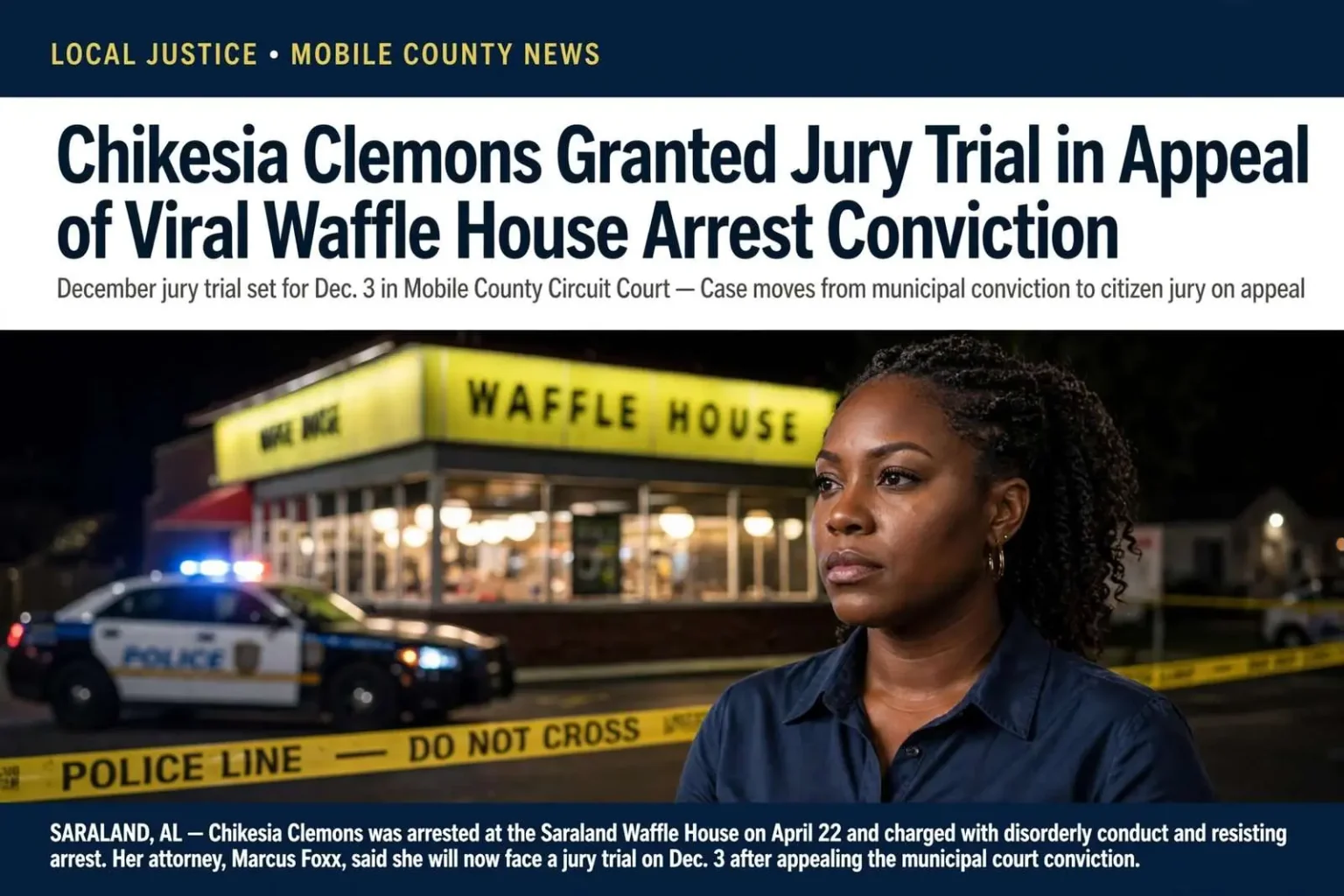
Chikesia Clemons, the woman at the center of a viral arrest video recorded at a Saraland Waffle House, has been granted a jury trial in her appeal of a municipal court conviction, moving her case from a judge’s ruling to a panel of citizens. The decision sets up a December hearing that will reexamine the arrest that drew national attention and made Clemons a fixture in debates over policing and race in the Mobile area.
Clemons was arrested at the Saraland restaurant on April 22 and charged with disorderly conduct and resisting arrest. A friend recorded the encounter and shared it on social media, where the video spread widely and drew national attention after civil rights activist Al Sharpton became involved in the case. The footage showed a confrontational arrest in the restaurant’s dining area, and viewers across the country weighed in on both the officers’ actions and Clemons’s conduct.
In July, Clemons had a bench trial in Saraland Municipal Court, where a judge found her guilty of both charges. She appealed the ruling to Mobile County Circuit Court, pleading not guilty in the new proceedings — a standard move that grants defendants a fresh start in the county’s higher court. Her attorney, Marcus Foxx, said a circuit judge agreed to hear the case before a jury, and the jury trial was scheduled for Dec. 3.
What the video showed
The arrest video, recorded on a phone by a friend of Clemons, circulated rapidly after it was posted. It captured officers confronting Clemons inside the Waffle House, an escalating exchange, and ultimately her removal in restraints. Portions of the footage showed Clemons questioning the officers’ authority and observers in the restaurant reacting as the situation intensified.
The recording followed a pattern familiar from a string of viral police encounters in recent years: a short clip, stripped of the context that preceded it, reaching millions of viewers who sort themselves quickly into opposing camps. Clemons’s supporters characterized the arrest as heavy-handed and racially motivated; police and the city of Saraland defended the officers’ conduct as justified by her behavior in the restaurant.
What preceded the arrest became a focal point of the dispute. Saraland police said officers were called to the restaurant over a dispute involving Clemons and Waffle House staff, and the department maintained that the arrest followed lawful instructions she refused to obey. Critics focused on the force used during the arrest itself and on the discrepancy between the minor charges and the aggressive optics of the encounter.
Al Sharpton’s involvement
National attention crystallized when the Rev. Al Sharpton, the longtime civil rights leader and founder of the National Action Network, became involved in the case. Sharpton’s entry signaled that Clemons’s arrest would be framed — by supporters at least — as part of a national conversation about the policing of Black Americans in everyday commercial settings, from Starbucks locations to BBQ restaurants to, in this case, a Waffle House on the Gulf Coast.
Sharpton called for accountability and pressed for the charges to be dropped, and his involvement brought news cameras to Mobile County and put Saraland, a city of roughly 14,000 just north of Mobile, in headlines it rarely seeks. Local officials pushed back against the national framing, maintaining that the case was a straightforward law enforcement matter being inflated by outside attention.
The municipal court conviction
The first legal chapter closed in Saraland Municipal Court in July, when a judge heard the case without a jury and found Clemons guilty of both disorderly conduct and resisting arrest. Municipal courts in Alabama handle ordinance violations and misdemeanors committed within city limits, and convictions there carry fines and, in some cases, jail time — but they also come with a guaranteed path of appeal.
That path is exactly what Clemons took. Under Alabama law, a defendant convicted in municipal court may appeal for a trial de novo — a completely new trial — in the county circuit court. The appeal is not a review of whether the municipal judge got it right; it is a fresh proceeding in which the defendant is again presumed innocent, the charges are tried from the beginning, and the defendant can choose a bench trial or a jury.
Why she chose a jury
Clemons’s decision, through her attorney Marcus Foxx, to take the case before a jury is the most consequential tactical choice available at this stage. Defendants weighing jury versus bench trials consider who their audience is. A jury drawn from Mobile County is a different body than a Saraland municipal judge — broader, more demographically varied, and insulated from the local municipal court relationship between the city’s prosecutors and its judiciary.
Jury trials also allow defense attorneys to present context that a concise municipal proceeding may not accommodate fully. Foxx can put the viral video in front of twelve citizens, question the officers at length about what led up to the arrest, and argue that the charges do not match what the footage actually shows. Prosecutors from the Mobile County District Attorney’s Office, which inherits misdemeanor cases on de novo appeal, will counter that the law turns on Clemons’s conduct toward the officers, not on the video’s afterlife on social media.
The stakes in a misdemeanor appeal are modest by the standards of criminal law — fines, and possible jail exposure that is rarely imposed at this level — but the reputational stakes for both sides are considerable. For Clemons, an acquittal would be a public vindication in a case that has followed her for months. For Saraland police, a conviction upheld by a county jury would validate the arrest that critics nationwide branded as excessive.
The December trial
The jury trial was scheduled for Dec. 3 in Mobile County Circuit Court. Misdemeanor trials of this kind typically last a day or two: jury selection, testimony from the arresting officers and any civilian witnesses, the video itself, closing arguments and deliberation. Whether Clemons testifies will be a decision for her and Foxx as the trial approaches.
The appeal process also resets the procedural clock in ways that matter for everyone involved. Witnesses who were easy to assemble for a municipal hearing months after the arrest must be summoned again for a circuit trial, and the passage of time can fray memories of a two-minute encounter. Meanwhile, the video evidence does not age at all — the same footage that inflamed public opinion will be the evidentiary centerpiece, played for jurors who will see it for the first time in a sterile courtroom rather than on a phone screen in the middle of a national argument.
Misdemeanor appeals of this kind are common in Mobile County’s circuit courts, which absorb de novo trials from every municipality in the county, but most resolve quietly. Clemons’s trial will be the rare exception where the gallery, the press list and the outcome all matter far beyond the two charges written on the complaint. Court watchers and civil rights advocates have already noted that a jury verdict either way will be cited in the ongoing debate over how police handle minor disturbances inside businesses.
Wider attention is likely to return to the courthouse when the trial begins, with reporters expected to cover jury selection and the verdict alike. The case sits at the intersection of several currents that defined its era of local news — viral video, national civil rights advocacy, and the day-to-day policing of suburban Mobile County. Its outcome, either way, will be read through all three lenses.
Saraland and the Waffle House case
Saraland is one of the fast-growing cities north of Mobile, a suburb that has seen substantial commercial development along Highway 43 and Interstate 65. Its police department, like those of comparable suburbs, handles a high volume of calls at the restaurants and retail sites that line its corridors, and Waffle House locations in the region are among the most active addresses for late-night police calls of all kinds — a fact of Gulf Coast hospitality culture that predates and will outlast this case.
The April arrest became Saraland’s most famous incident in years, and it produced the scrutiny that famous incidents bring. The department did not discipline the officers involved in the immediate aftermath, and the city defended the arrest publicly. Whether a jury agrees with that defense will be the last word in a case that began with a breakfast-table dispute and ended up in front of the whole country.
Clemons, for her part, has maintained throughout that she did nothing to justify the arrest, and her appeal gives her the forum to make that argument with the fullest protections the court system offers. The Dec. 3 trial will decide, finally, whether the two misdemeanor convictions stand.