Chikesia Clemons Sues Waffle House Over Viral Saraland Arrest
Chikesia Clemons sues Waffle House for discrimination and malicious prosecution over her viral 2018 Saraland arrest, with attorney Benjamin Crump.
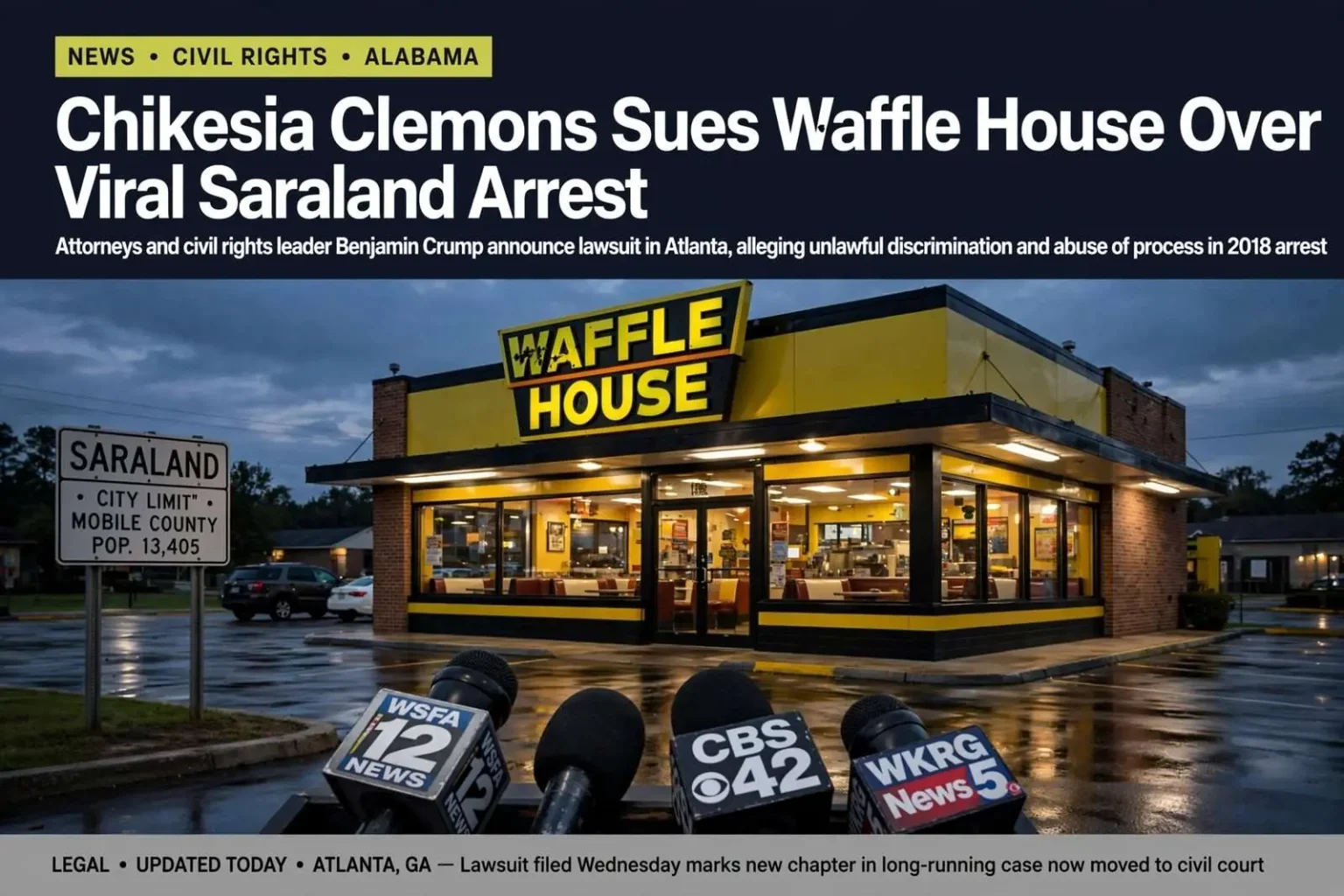
Attorneys for Chikesia Clemons have filed a lawsuit against Waffle House over the restaurant chain’s involvement in her 2018 arrest at a Saraland location, opening a new chapter in a case that drew national attention after cellphone video of the encounter spread widely online. The complaint targets the restaurant chain on claims of unlawful discrimination, intentional infliction of emotional distress, malicious prosecution and abuse of process. Civil rights attorney Benjamin Crump is representing Clemons along with a national women’s group, and the filing was announced at a Wednesday morning news conference in Atlanta.
The lawsuit shifts the focus of a long-running dispute from the criminal courts to the civil docket. For more than a year, the legal fight centered on charges brought after Clemons was taken into custody at the Saraland restaurant, with her defense team contesting the conduct of officers and the basis for the arrest. By naming Waffle House itself as a defendant, her attorneys are now arguing that the company and its workers played a direct role in setting the encounter in motion rather than serving as bystanders to it.
Crump, who has built a national practice representing families in high-profile cases involving police conduct and civil rights, appeared alongside representatives of the women’s group backing the suit. The Atlanta news conference gave the legal team a platform to lay out its theory of the case in public before the complaint begins moving through the courts, a pattern that has become common in civil rights litigation that draws broad attention.
Conflicting Accounts
Clemons was arrested at the Saraland Waffle House in April 2018. According to police, officers were attempting to remove her from the restaurant after she was drunk and threatened restaurant workers. Her attorney disputed that account, saying Clemons was only trying to obtain a corporate phone number so she could file a complaint about her treatment at the location, and that the force used against her was unnecessary.
Cellphone video recorded by a bystander showed the encounter escalating as officers moved to take Clemons to the ground. During the scuffle, her top came off, an image that circulated widely once the footage was posted online. The recording became the focal point of public debate about the arrest, with critics pointing to it as evidence that the response was disproportionate and supporters of the police account emphasizing the conduct described in the initial report.
Saraland, a growing city in Mobile County just north of Mobile, was thrust into the center of a national conversation almost overnight. The case arrived amid a broader stretch of scrutiny of how police respond to disputes inside businesses, and how quickly viral video can turn a local incident into a matter of national concern. Demonstrations followed the arrest, and the case drew visits from Crump and the Rev. Al Sharpton, two of the most prominent figures in national civil rights advocacy.
The Legal Claims in the Complaint
The lawsuit advances four distinct theories against Waffle House. The unlawful discrimination claim frames the company’s conduct as treating Clemons differently because of who she is rather than because of any legitimate business reason. The intentional infliction of emotional distress claim alleges that the conduct she experienced was so extreme that it caused serious psychological harm. The malicious prosecution and abuse of process claims go to the heart of the criminal proceedings, alleging that legal processes were set in motion improperly and then used for an improper purpose.
Those last two claims are significant because they target the machinery of the arrest and prosecution rather than only the physical encounter. Abuse of process generally concerns the misuse of legal procedure after it has been initiated, while malicious prosecution concerns the initiation of proceedings without proper justification. Together with the discrimination claim, they allow a jury to consider both how the episode began and how it was carried through the courts.
Waffle House has long occupied a distinctive place in Southern life, with its diners operating around the clock along highways and commercial strips across the region. The chain’s restaurants are frequently the only place open late in smaller communities, which means they routinely become the setting for disputes that spill over from the late-night crowd. That reality has repeatedly placed the company at the intersection of private business decisions and public policing.
The company’s role in calling for police assistance, and what its employees communicated to officers before the arrest, will likely be central to the litigation. In cases like this, plaintiffs must establish what the business said and did, and whether those actions fell outside the bounds of lawful conduct. The complaint’s four claims give Clemons’ legal team multiple paths to present that story to a jury.
From Municipal Court to a Jury
The criminal side of the case followed a path familiar to anyone who watches Alabama’s court system. After the April 2018 arrest, Clemons was prosecuted in Saraland’s municipal court, where a conviction came in July 2018. Municipal courts in Alabama handle misdemeanors and ordinance violations within city limits, and their proceedings move quickly compared with the circuit courts.
Clemons exercised her right to appeal, which under Alabama law gives a defendant a completely new trial before a jury in Mobile County Circuit Court. That de novo appeal erased the municipal conviction and reset the case for a full hearing on the evidence. In August 2019, the jury hearing the retried charges found her not guilty of disorderly conduct but guilty of resisting arrest.
The split verdict underscored how differently jurors can weigh the pieces of a single encounter. The acquittal on disorderly conduct meant the jury did not accept the prosecution’s account of her behavior inside the restaurant. The conviction on resisting arrest, however, reflected the jury’s view of her conduct toward the officers once the arrest was underway. The mixed result kept both sides claiming portions of the record, and it fed directly into the civil case now moving forward.
What the Civil Case Means Going Forward
A civil lawsuit operates on a different track from the criminal case that preceded it. The standard of proof is lower, the parties control the pacing through discovery, and the ultimate question is liability and damages rather than guilt or innocence. For Clemons, the suit offers a forum to argue that the entire episode, from the phone call to the arrest to the prosecution, was the product of unlawful conduct by the company.
For Waffle House, the filing represents the kind of litigation that major chains watch closely, because a verdict or settlement in a case with this profile can shape policies at thousands of locations. How employees are trained to handle disputes, when managers involve police, and what is communicated to responding officers are all the kinds of questions a case like this can force a company to examine.
The involvement of Benjamin Crump and the national women’s group also signals that the plaintiffs intend to keep public attention on the case as it moves forward. High-profile civil rights complaints often proceed on two tracks at once, with the courtroom record building in parallel with the public narrative. Both were visible at the Atlanta news conference, where attorneys framed the lawsuit as about more than one night in Saraland.
Local residents who followed the arrest, the protests and the retrial will now watch a familiar cast return to the courtroom with different roles. The criminal case is behind her, but the questions at the center of the dispute — how the encounter started, who bears responsibility, and what happened inside that Waffle House in April 2018 — will get another full airing as the civil claims move toward trial.
As with any newly filed complaint, the allegations remain contentions that the company will have the opportunity to answer in court. Waffle House has not yet laid out its defense in detail, and the litigation process, from responses to discovery to any motions, will unfold over months. What is certain is that the arrest that made Saraland a national talking point will remain in the public eye well into the future, this time in a civil courtroom rather than a criminal one.
The timeline of the litigation will depend on procedural steps that have not yet been taken. The company will file its answer, both sides will pursue discovery into what happened inside the restaurant and what was relayed to police, and either party may ask the court to rule on portions of the case before a jury ever hears it. Cases with this level of attention frequently take years to reach trial, and appeals can extend them further. For the residents of Saraland and Mobile County who watched the original case move through the municipal and circuit courts, the new complaint promises to keep the underlying questions alive for the foreseeable future.