Child Suffers Broken Leg After Being Struck by Golf Cart Near Dauphin Island Parade Route
A 4-year-old suffered a broken leg when a golf cart — not part of the parade — struck him near the Dauphin Island parade route, officials say.
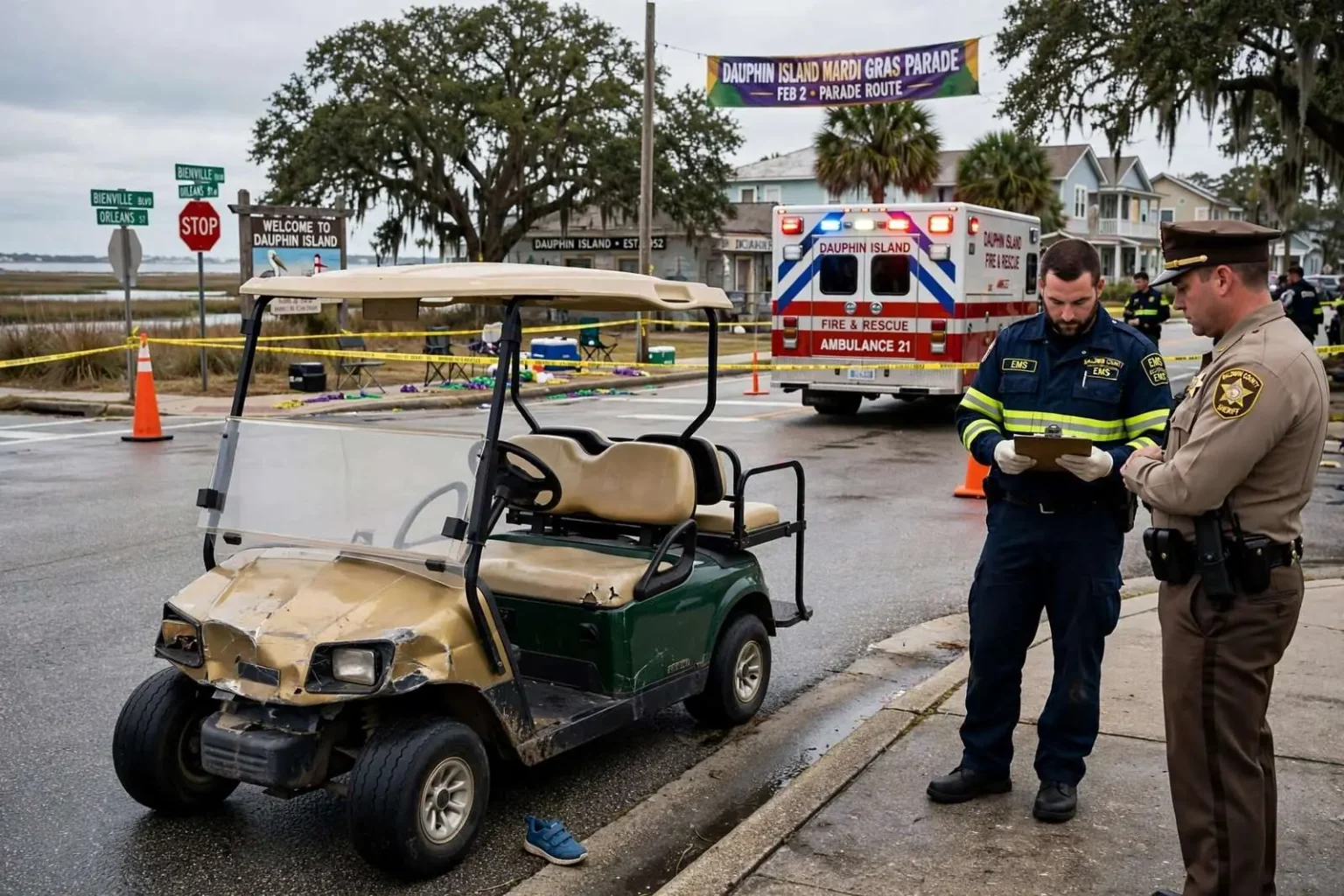
DAUPHIN ISLAND, Ala. — A 4-year-old boy was hospitalized with a broken leg after being struck by a golf cart during Dauphin Island’s parade on Saturday, Feb. 2, according to the child’s parents. The collision happened near the parade route before the parade had reached that point, and it cast a shadow over what is normally one of the small barrier island’s brightest annual traditions.
Dauphin Island Mayor Jeff Collier said the collision occurred at the three-way stop on the parade route before the parade had reached that point in its procession. The golf cart was not part of the parade. The boy’s mother said the cart was speeding down an empty stretch of road when it hit her son, a description of the moment that made clear the child was not caught up in the procession itself but struck in a stretch of street that was, at that moment, simply a road.
The Collision at the Three-Way Stop
The details officials and parents provided sketch a brief and straightforward tragedy. Parade day on Dauphin Island draws families to the route with chairs, coolers, and children — and golf carts are everywhere, the island’s favored mode of transport on streets that are short, flat, and slow. Sometime before the parade reached the three-way stop along its route, a golf cart moving faster than it should have came down an empty stretch of that road, and the 4-year-old was in its path.
The impact broke the child’s leg, and he was taken to a hospital for treatment. His parents described the scene and the moments after it, and their account — that the cart was speeding down an empty stretch when it hit their son — stands as the family’s characterization of what happened. Authorities did not announce charges or citations in the immediate aftermath, and the town’s attention turned to the boy’s recovery and to the questions his injury raised about how the island manages its parade-day streets.
Golf Carts and Island Life
Golf carts are woven into Dauphin Island daily life to a degree mainland visitors often underestimate. The town’s layout — a compact grid of streets near the beaches, the historic Fort Gaines at one end, and the Audubon bird sanctuary at the other — makes low-speed cart travel practical, and families use carts the way suburban families use second cars: for beach trips, errands, and the short runs between home and the marina.
That convenience carries a regulatory gray zone. Alabama state law generally does not permit golf carts on public roads except where municipalities have expressly authorized them, and even where local rules allow cart use, the carts are not designed for collision protection. A cart struck by — or striking — a child delivers the impact at the speed of the cart with none of the safeguards a vehicle’s body provides. On a normal day, island traffic is light enough that the risks stay manageable; on parade day, with crowds along the streets and carts threading between them, the margin narrows.
The Parade Tradition on the Island
Dauphin Island’s Mardi Gras parade is a small-town affair in the best sense: a procession organized by the community’s civic groups, rolling a route through the island’s main streets, with families lining the route in clusters. It is one of the first parades of the Gulf Coast’s Carnival season each year in its scheduled position among Baldwin and Mobile County events, and for the island’s children it is the local celebration — close enough to walk to, small enough that every float passes twice as slow.
The Feb. 2 parade that year drew that familiar crowd. What it also drew, as Mayor Collier’s account made clear, was the ordinary island traffic of golf carts moving through town before the procession arrived — a mix of routines that, on this Saturday, intersected badly.
Mayor Collier and the Town’s Response
Collier, the island’s longtime mayor, provided the official account of where and when the collision happened — the three-way stop on the parade route, before the parade reached that point — a detail that matters because it frames the incident as a golf cart accident in a crowded street rather than a parade-safety failure. The floats and marching units had not yet arrived; the child was struck by a cart moving independently of the event.
Small coastal towns handle incidents like this with the tools they have: statements from the mayor’s office, coordination with the county sheriff’s office, and the quiet institutional work of reviewing what can be done differently next year. Dauphin Island’s government is small — a mayor-council town of roughly 1,300 year-round residents that swells with visitors on weekends and holidays — and its parade-day infrastructure depends on volunteers, local businesses, and the small-town neighborliness of a community that staffs its own traditions.
The mayor’s emphasis on the timing — before the parade reached the stop — and on the cart’s status — not part of the parade — served the town’s need for accuracy about what failed. A parade is a managed event with a route, marshals, and a schedule; the streets around it, in the hour before it arrives, are just streets, and that is where the boy was hurt.
Speeding Carts and the Question of Enforcement
The mother’s account — that the cart was speeding down an empty stretch of road — raises the enforcement question that haunts golf cart communities: who watches the carts, and how? Dauphin Island’s police force is small, and on parade day its officers’ attention is rightly fixed on the route itself, not on every cart moving through town in the pre-parade hour.
Golf carts, moreover, do not come with speedometers most drivers consult or enforce. Their effective speed is set by habit and terrain, and an empty stretch of road invites the kind of casual acceleration that feels harmless until a child steps into it. The boy’s broken leg is the physical record of that arithmetic: a small body, a fast cart, and no protection on either side of the collision.
Parade-Day Safety on Alabama’s Small-Town Routes
Communities across coastal Alabama manage the same mix each Carnival season: crowds, floats, golf carts, and children who see a parade as a festival without rules. The standard safety guidance that officials repeat before every parade season is built for this environment — keep children close and behind the parade line, watch for vehicles including carts, secure pets, and stay off the route itself until the procession has passed.
The Dauphin Island collision violated none of those guidelines in the ways that matter most — the parade had not arrived, and the child was not darting between floats — which is what makes the incident instructive. The danger came from the street’s ordinary traffic moving faster than the occasion warranted. That is a harder problem to police than a parade route and a reason towns with cart cultures revisit their local rules after incidents like this one: where carts may travel, at what hours, and what speed means on a street filled with children waiting for a parade.
The Boy’s Recovery and the Family’s Account
What the family described publicly centered on the injury and the moment that caused it: their 4-year-old, struck by a speeding cart, hospitalized with a broken leg. A fractured femur or leg in a child that young typically requires immobilization and a healing period measured in weeks to months, and the family’s account of the incident stands as the most detailed public description of what happened, supplemented by the mayor’s framing of where and when the collision occurred. The boy remained in the hospital receiving treatment for the broken leg, according to his family.
The parents’ decision to speak about the incident served a purpose beyond their own case: it put a face and a consequence on the golf cart culture that island residents know intimately, and it invited the conversation about speed and enforcement that small cart towns inevitably have after a child is hurt.
Dauphin Island’s Character and Its Streets
The island sits at the end of Alabama 193, reached by a long causeway across Mississippi Sound, and its geography shapes its traffic. There is one main road through town, a handful of cross streets, and the constant presence of water on both sides. The three-way stop where the collision occurred is one of the nodes of that small network — a spot where the parade route and the island’s everyday circulation meet, and on parade day a spot where both were present at once.
The town’s scale is part of what makes incidents like this land so heavily. Everyone knows the family, everyone has ridden in the carts, and everyone will walk that three-way stop again. A broken leg suffered by a 4-year-old at the town’s annual celebration is not an abstraction in a community that size; it is a neighbor’s child, and the conversation about it happens over coffee and at the marina for weeks afterward.
Lessons Carried Into Next Season
The practical questions the incident left for the town are the ones parade organizers and elected officials in cart communities always face after a close call: whether to restrict cart traffic on the route in the hours around the parade, whether to station deputies at the route’s intersections before the procession arrives, and how to communicate to visitors and residents alike that parade day is not a normal day on the island’s streets.
None of those measures would undo the boy’s injury. But they are the concrete legacy that safety officials hope follows an incident like this one — the adjustments that make the next parade’s margins wider. Communities up and down the Alabama Gulf Coast have made similar changes after similar moments, and Dauphin Island’s tradition of a small-town parade has historically proven resilient enough to absorb them.
What Is Known, and What Remains Open
The established facts of the Feb. 2 collision are limited to what officials and the family provided: a 4-year-old boy struck by a golf cart during the town’s parade, hospitalized with a broken leg; a collision at the three-way stop on the parade route before the parade reached that point; a cart that was not part of the parade; and the mother’s account that the cart was speeding down an empty stretch of road when it hit her son. No charges or citations were announced in the immediate aftermath, and the details of any enforcement decision were not part of the public record.
What the incident left behind was the town’s collective attention: to a child’s healing leg, to the family’s account of a speed that should not have been, and to the question every cart town eventually confronts — how to keep the vehicles that make island life easy from making one afternoon tragic. The parade rolled on that Saturday, as parades do, and the boy’s hospital bed held the town’s reminder that the streets around a celebration are part of the celebration’s safety, too.