
Citronelle Firefighters Battle Early-Morning Mobile Home Fire; Everyone Escapes Safely
Citronelle firefighters entered through a bedroom window to fight an early-morning mobile home fire; all residents escaped with no injuries.
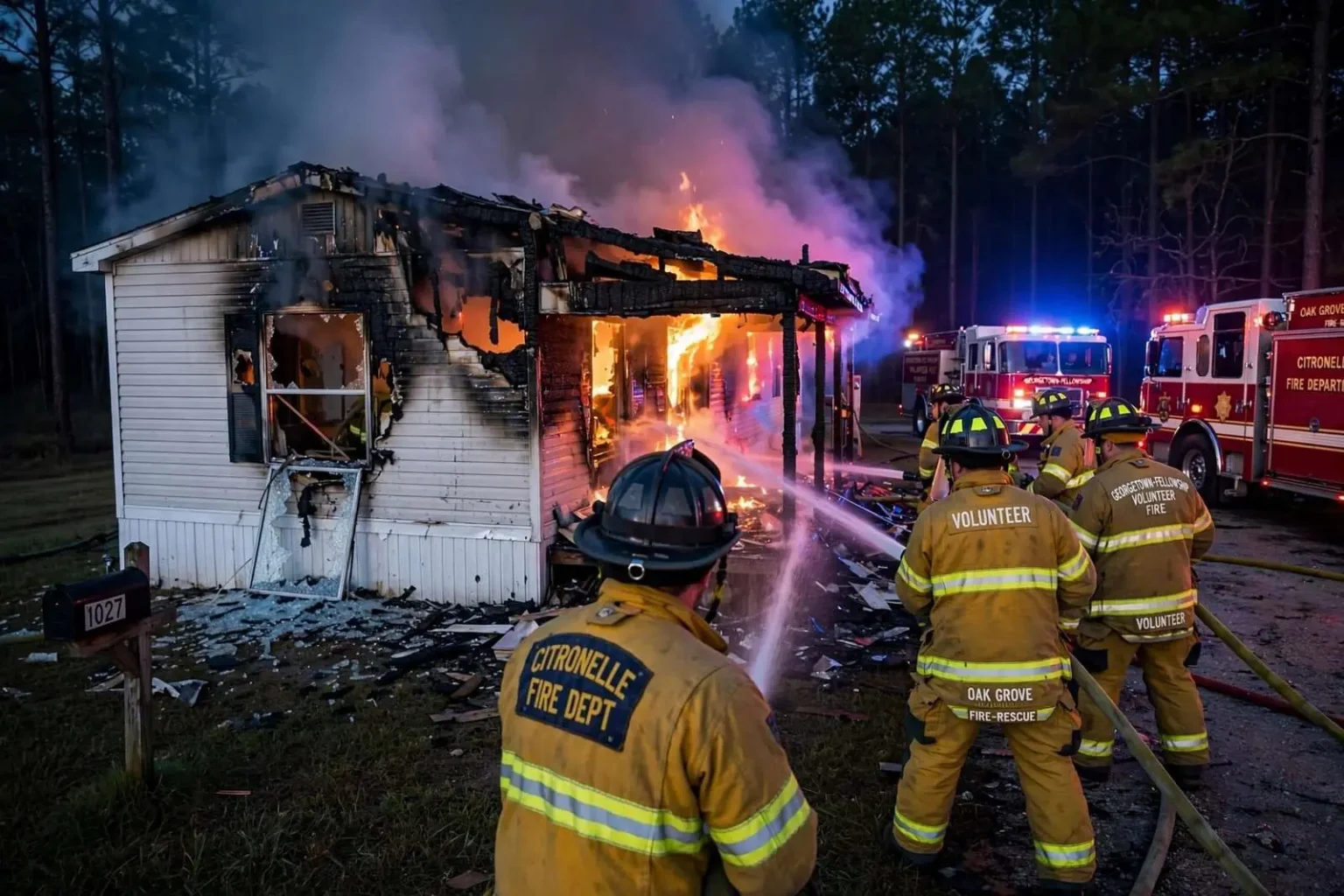
CITRONELLE, Ala. — Everyone inside a mobile home in Citronelle escaped safely after flames broke out at the residence around 1 a.m. Monday, June 22, according to officials. The Citronelle Fire Department responded to find fire burning on the front porch of the home.
With fire blocking the front of the residence, firefighters had to force entry through a bedroom window to attack the blaze. Crews from two neighboring volunteer departments were called in to help because of limited manpower, and the mobile home was ultimately declared a total loss. Officials confirmed there were no injuries.
The outcome — a family displaced and a home destroyed, but everyone alive — is the kind of ending firefighters in small towns across rural Alabama describe as the best available on a bad night. Fires that begin on or spread to the exterior of a mobile home can involve the entire structure in a matter of minutes, and an overnight blaze leaves residents with seconds, not minutes, to get out.
Details about the cause of the fire and how many people were inside were not released. Authorities also did not say whether the occupants were alerted by smoke alarms or by another means before escaping through the home.
Citronelle and its fire department
Citronelle sits in the far northern reaches of Mobile County, a city of roughly 4,000 people surrounded by pine forest and farmland near the Washington County line. Its fire department operates with a small paid core supported by volunteers, a staffing model common across rural south Alabama where municipalities cannot maintain round-the-clock crews at full strength and rely on residents who train and respond as they are able.
That staffing reality shapes how a night fire unfolds. A limited roster means the first-arriving crew must make quick decisions about where to attack the fire and what to protect first, and it means help from neighboring departments is not a courtesy but a necessity. Departments in the region operate under mutual aid agreements that let them request crews, equipment and water supply from one another without delay.
On June 22, Citronelle called on the Georgetown-Fellowship Volunteer Fire Department and Oak Grove Volunteer Fire-Rescue, both of which sent crews to the scene. Those departments cover nearby communities in northern Mobile County and routinely back each other up on structure fires, a network built over decades so that no single small department faces a working fire alone.
Why mobile home fires spread so fast
Fires in manufactured housing behave differently than fires in site-built homes. Mobile homes are typically built with lightweight materials and connected interiors, and once flames reach the underside of the structure or the wall cavities, fire can travel quickly through materials that provide less natural fire resistance than conventional construction.
A blaze starting on a front porch is especially dangerous because it attacks the main entrance before residents have a route out. In this case, the fire on the porch effectively closed the front of the home, which is why firefighters entered through a bedroom window instead — a reminder of how exterior fires can cut off the most familiar escape path and force people to use secondary exits they may never have rehearsed.
National fire-safety organizations have long urged mobile home residents to take particular care with exterior conditions: keeping porches and crawl spaces clear of combustibles, storing grills and fuel away from the structure, and maintaining electrical systems, since older wiring and extension cords under and around manufactured homes are frequent contributors to outdoor fires that spread inside. Officials had not determined what caused the Citronelle fire.
Escaping a fire in the middle of the night
Fires that break out in the early morning hours are among the deadliest because occupants are asleep and the body’s response to smoke and heat is slowed by darkness and disorientation. Fire-safety educators stress that residents may have as little as two minutes from the first alarm to get outside, which is why escape planning is repeated in every community fire-prevention campaign: know two ways out of every room, keep exits clear, and agree on a meeting place in the yard.
Working smoke alarms are the single most important factor in surviving an overnight fire, providing the early warning that sleeping residents cannot get any other way. Safety officials recommend alarms inside each bedroom, outside each sleeping area and on every level, tested monthly, with batteries replaced on schedule and units replaced entirely when they reach the end of their service life.
When the front door is blocked, as it was in Citronelle, a second way out becomes the difference between escape and entrapment. Bedroom windows can serve as emergency exits if they open easily and are not painted shut or blocked by security bars without a release, and residents in manufactured housing are advised to know which windows can serve that role before a fire ever starts.
Once outside, the guidance is absolute: stay out. Returning inside for pets, wallets or documents is a leading cause of injury among people who initially escape a house fire, and firefighters ask residents to tell arriving crews immediately if anyone or anything is still inside so a rescue is attempted with proper equipment and training.
How mutual aid works in rural Alabama
The system that brought Georgetown-Fellowship and Oak Grove crews to Citronelle that morning is the backbone of fire protection in south Alabama’s small towns. Mutual aid agreements are prearranged contracts between departments that allow an incident commander to request additional engines, tankers and manpower with a single radio call, and neighboring departments routinely cross lines to cover each other’s districts while crews are committed at a working fire.
Water supply is a particular challenge outside city limits. Many rural areas lack pressurized hydrants, so tankers shuttle water to the scene and portable drop tanks are set up on the roadside for engines to draft from. A structure fire in a small community can require far more water than a single department’s trucks carry, which makes mutual aid a matter of arithmetic as much as manpower.
The arrangement runs in both directions. When Citronelle’s crews are tied up at a fire, the neighboring departments’ volunteers may stand by to cover Citronelle’s own district for the next call, an invisible exchange that happens nightly across the region and rarely makes the news unless something goes wrong.
After the flames are out
A total-loss fire leaves a family without housing, clothing and documents in a single night, and the response typically falls to a combination of family, neighbors, churches and aid organizations. Residents displaced by house fires in the region commonly turn to organizations such as the American Red Cross, which provides emergency lodging and immediate necessities to families after residential fires, while local congregations and community groups often organize clothing and furniture donations.
Fire officials also urge families to keep copies of insurance information and key documents somewhere fire-safe or digitally, since proving identity and coverage becomes far harder when the paper copies burn. Renters and mobile-home owners are frequently underinsured or carry no coverage at all, which compounds the loss when a structure is declared total.
Investigators with the fire department and, where warranted, the state fire marshal’s office will work to determine where and how the Citronelle fire started, a process that can take days or weeks. Whatever the finding turns out to be, the department’s account of the night carries a simple bottom line: a home was lost, but everyone who lived there walked away, and in an early-morning fire that is the outcome every crew hopes to deliver.
The fight to keep the fire from spreading
A porch fire presents arriving crews with two problems at once: knocking down the visible flames and keeping them from extending into the home’s attic space, where fire can race across a structure unseen. Crews attack from the exterior first when flames are on the outside of a residence, then move inside to check for extension and search for anyone still inside — which, in this case, meant entering through a bedroom window because the front of the home was burning.
Forcing entry through a window is a common tactic when the main entrance is compromised. Firefighters break or remove the glass, enter low beneath any heat and smoke, and stretch a hose line inside to reach hidden fire. The maneuver is physically demanding and slow compared with walking through a door, but it keeps crews working while residents are already safe outside.
Overnight calls also strain small rosters in ways daytime calls do not. Volunteers responding at 1 a.m. may have been asleep, and departments lean on automatic aid and mutual aid to fill the gap while members drive to the station. The two volunteer departments that answered Citronelle’s call that morning did exactly what the regional system is designed to do.
The toll of a total loss
By the time the fire was knocked down, the mobile home was beyond saving. Declaring a structure a total loss is rarely a close call in manufactured housing once fire reaches the interior, and crews shifted from suppression to overhaul — pulling ceilings and walls to find hidden hot spots so the fire could not reignite after everyone left.
Structure fires draw crowds in small towns, and they draw neighbors with offers of help. In communities the size of Citronelle, the family’s immediate needs in the first days — a place to sleep, clothes for school and work, a meal — are typically met by people they know before any agency paperwork is filed, and that informal network is one of the quiet strengths of rural south Alabama.
The investigation into the cause will proceed in the background. Fire investigators look first at the area of origin — here, the porch — and work outward, examining electrical service, heating equipment, smoking materials and anything else that could have supplied heat, fuel and oxygen. Findings are shared when they are conclusive, and officials had not indicated how long the Citronelle review would take.
For the rest of the community, the fire leaves behind the usual lessons that small-town departments hope residents take from seeing a neighbor’s home burn: test the smoke alarms this week, clear the exits, and remember that in the middle of the night there is no time to figure it out on the spot. Everyone inside got out of this home alive. The department’s message is to make sure that next time the warning comes even earlier.