
City of Mobile to recognize heroes from Serenity Apartments fire
The City of Mobile will recognize three civilians who helped more than 20 people escape a three-alarm fire at the Serenity Apartments on May 20, 2020.
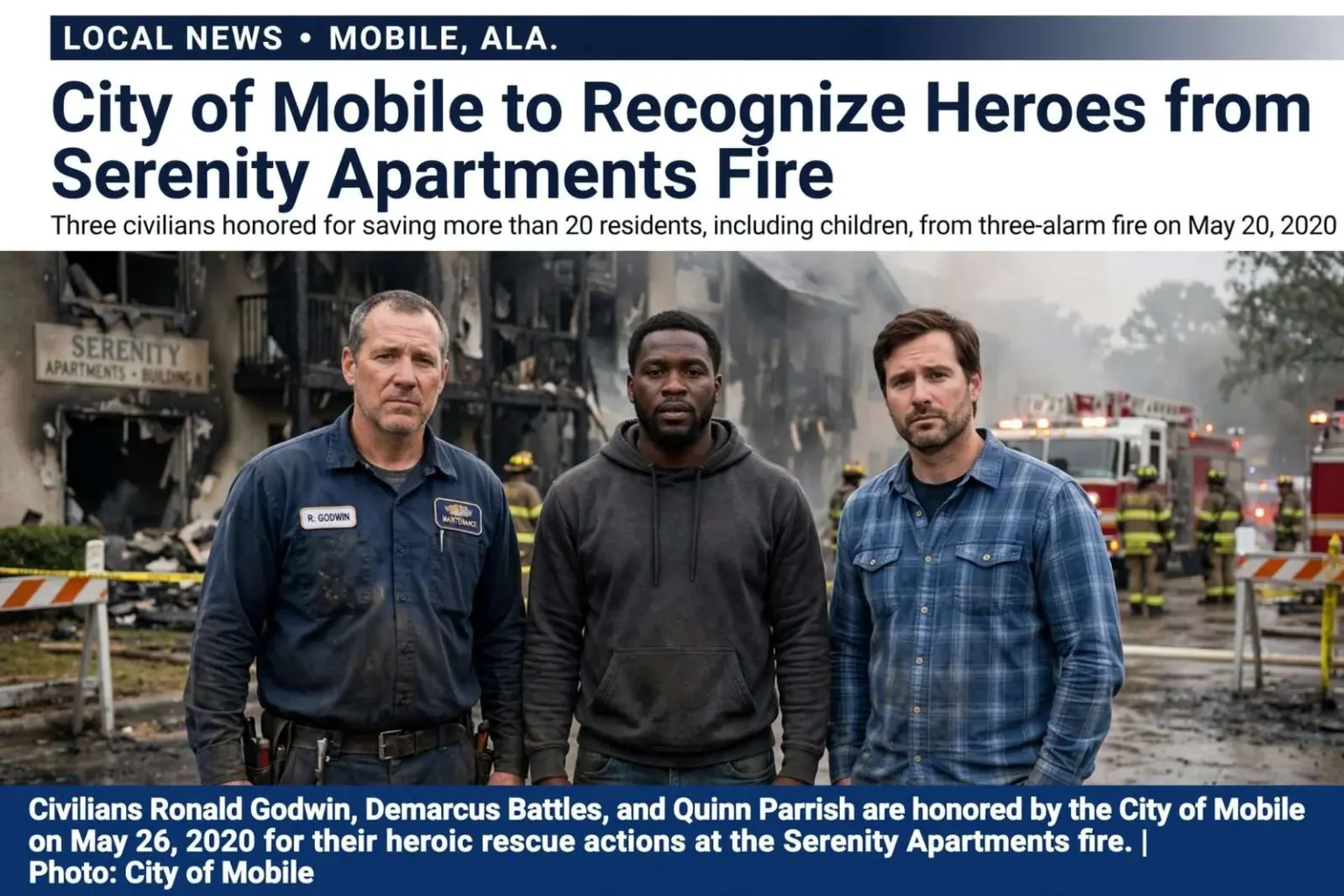
MOBILE, Ala. — The City of Mobile will recognize citizens who helped save more than 20 people, including children, from a three-alarm apartment fire that consumed a building at the Serenity Apartments complex. Mobile Fire-Rescue said it tracked down three civilians responsible for ensuring residents escaped the burning building after the Wednesday, May 20, 2020, fire, and the city plans a special recognition with the council to honor what they did before firefighters ever reached the upper floors.
Mayor Sandy Stimpson highlighted one resident, Quinn Parish, who helped save a woman from the Summer Place Apartments, as a citizen hero to be honored alongside the others. The recognition grew from firefighters’ accounts of the scene, where crews arriving on the multiple-alarm response found residents already being brought out by the men who had gone into the smoke without equipment, training or any guarantee of coming back out themselves.
Update (May 26, 2020): The Mobile City Council made good on that promise, giving a standing ovation to Ronald Godwin, Demarcus Battles and Quinn Parrish and presenting plaques to each man at Tuesday’s meeting. The three pulled more than a dozen people from the burning building — among them children and at least one elderly woman who her family had been told was beyond rescue.
Who the Rescuers Were
None of the three was a professional rescuer. Godwin, the complex’s maintenance man, and Battles, a resident, were joined by Parrish, who happened to be passing by when the fire broke out. Together they became the reason more than a dozen of their neighbors were alive to see the next morning, entering the building repeatedly as smoke and flame spread and carrying people down and out.
Their work filled the gap between the first call and the full arrival of a three-alarm response — the minutes when an apartment fire moves fastest and the people still inside have the fewest options. Fire officials noted that civilians who escape a burning building and then go back in are extraordinarily rare, and that most fire-safety messaging is built entirely around preventing exactly what these men chose to do.
“They Said They’d Given Her Up for Dead”
Among those brought to safety was the aunt of Jennifer Wright, whose family had been told no one inside was still alive. “They said they’d given her up for dead,” Wright said. “And my little cousin said ‘my grandmother’s in there.’ And these guys went back and brought her down and we’re extremely grateful for that.”
The rescue of Wright’s aunt became the defining story of the morning — a woman written off in the chaos of the evacuation, found because a child kept insisting his grandmother was still inside, and carried out by men the family had never met. For the council members presenting the plaques a week later, it was the account that drew the longest applause in the chamber.
The men themselves described the decisions in plain terms. “We just saw what needed to be done and acted on it,” Godwin said. “I was lucky to have these gentlemen on my side.” Battles said the scene was frightening but instinct took over: “The main thing was not to panic and just take control of the situation.”
A Three-Alarm Fire in West Mobile
A three-alarm designation puts a fire among the most serious responses a department can call, pulling in additional engines, ladder trucks, medics and command staff from across the city. For a residential building, it means heavy fire conditions, the likelihood of victims on upper floors, and a scene that overwhelms the resources of a first-alarm assignment. The Serenity Apartments fire met that scale within minutes, with smoke showing from the structure and residents still inside a building that firefighters knew would be a fight.
Apartment fires carry particular dangers that stand-alone house fires do not. Units share walls, attics and utility chases, so fire and smoke travel between homes invisibly; a single building can hold dozens of households; and residents on upper floors have no escape route except interior stairs that fill with smoke first. Children, elderly residents and people with mobility limits are the most vulnerable, which is why the rescue of more than 20 people — including children — stood out so sharply to the firefighters who responded.
Mobile Fire-Rescue, the city’s fire and EMS agency, responded with the full multi-alarm assignment, and crews worked the scene into the morning. The department said afterward that its personnel tracked down the three civilians responsible for the rescues — a step the department does not always get to take, since people who leave a fire scene are often never identified. The city’s decision to honor them publicly grew directly from the accounts firefighters gave of what they found when they arrived.
The City Steps Up to Honor Its Citizens
The plan for recognition moved quickly from the mayor’s office to the council chamber. Mayor Sandy Stimpson’s decision to highlight Parish as a citizen hero framed the event in the city’s own terms: residents acting for neighbors, without being asked and without waiting for the fire department. The City Council’s formal presentation of plaques at the Tuesday, May 26 meeting put the three men’s names into the official record, with the standing ovation from the chamber and the gallery marking the city’s gratitude in public.
Civic honors of this kind serve a purpose beyond the ceremony. Fire departments across the country spend enormous effort on public education aimed at keeping people out of burning buildings, and the first instruction of fire safety — get out, stay out — exists because re-entry kills. Honoring men who broke that rule successfully puts the city in an unusual position, and officials handled it by celebrating the outcome while letting the rescue professionals describe what the men actually faced.
No Injuries, and an Investigation Underway
Against the scale of the fire, the outcome was remarkable: no injuries were reported, neither among the residents pulled out nor among the rescuers themselves. Fires of that magnitude in occupied apartment buildings typically produce a casualty list, and the absence of one owed as much to the men on the stairs as to anything else that morning.
The cause of the fire remained under investigation in the days after the blaze, with fire investigators working to determine where and how it started. Investigators typically examine the area of origin, interview residents and review any available footage before reaching a determination, a process that can take weeks in a multi-family building. The apartment complex’s other residents, meanwhile, faced the immediate reality of displacement — units burned, smoke-damaged or without power — while the complex and support agencies sorted out where they would stay.
What remained settled was the account of what happened in the fire’s first minutes. A maintenance man, a resident and a passerby went into a burning building and brought out more than a dozen of their neighbors, including a grandmother her family had been told was gone. The plaques the City Council placed in their hands said what the city meant to say: Mobile noticed.
The Minutes That Decide Who Lives
Fire safety professionals describe the first several minutes of a residential fire as the window in which most survivable rescues happen. Smoke, not flame, is what kills most victims — it fills rooms from the top down, disorients sleeping residents and blocks stairwells within minutes of ignition. When a fire starts in an occupied apartment building at a time when people are home and asleep or settling in, the occupants inside depend on whoever can reach them before the smoke does.
That is the context in which the actions of Godwin, Battles and Parrish should be read. They did not have the protective gear, air supply or radio coordination that arriving Mobile Fire-Rescue crews carried, and they did not have the department’s knowledge of the building’s layout. What they had was proximity, willingness and, in Godwin’s case, a maintenance man’s familiarity with every unit in the complex. In practice, that combination put them inside the building ahead of the first hose lines, and the more than a dozen people they brought out were people the first-arriving companies would not have reached in time.
The accounts the men gave afterward reflected how improvised the work was. Battles’ description — the scene was frightening, but instinct took over, and the main thing was not to panic and take control of the situation — matched what rescuers and survivors describe in nearly every case of this kind: a stretch of minutes where fear has to be set aside long enough to think in terms of doors, stairs and voices. Godwin’s framing was the same in different words — seeing what needed to be done and acting on it, with the luck, as he put it, of having the other men on his side.
What Mobile Fire-Rescue Found When It Arrived
By the time the full three-alarm assignment was on scene, the building was an active structural fire with a large-scale rescue already underway inside and around it. Fire-Rescue crews took over the interior attacks, searched units the civilians had not reached and accounted for residents at the exterior. The department’s later statement that its personnel “tracked down” the three civilians responsible for the residents’ escape indicates how central their actions were to the outcome — and how deliberately the department set out to identify and credit them once the scene was stable.
Departments distinguish sharply between the civilians they must warn away from a fire and the rare ones who, like these three, are already engaged in rescues when crews arrive. Once Mobile Fire-Rescue units took control of the scene, the men’s role ended; the survival of everyone they had pulled out depended then on the standard machinery of a multiple-alarm response — searches, triage, medical evaluation and the accounting process that confirms every resident is out. That accounting closed with no injuries reported, an outcome that a building fire of that size almost never produces on its own.
A Standing Ovation in the Council Chamber
The May 26 council meeting turned the rescue into a civic moment. The Mobile City Council’s presentation of plaques to Godwin, Battles and Parrish — each man standing as the chamber rose in a standing ovation — put the city’s official gratitude on the record a week after the fire. Council meetings routinely pass resolutions and move through agenda items without much public emotion; this one stopped for the story of Wright’s aunt, the little cousin who kept insisting his grandmother was inside, and the men who went back for her.
The ceremony also closed the loop on the mayor’s initial announcement, which had promised a special recognition and singled out Parish before the full picture of the rescue was public. By the time the plaques were handed over, all three men were named, the count of people saved was attached to the record, and the family whose grandmother came down the stairs had spoken publicly about what the rescue meant. For a city that had spent the spring of 2020 absorbed in the disruptions of the pandemic, the meeting offered a rare, uncomplicated reason to applaud.
The Serenity Apartments fire ultimately entered Mobile’s record as a fire that could have been a mass-casualty event and wasn’t — because three men without equipment did what they could in the minutes that mattered, and because a fire department arrived in time to finish what they started. The investigation into the cause continued; the gratitude, the city made clear, was already settled.