Clarke County High Class of 1980 Gives to Wilson Hall Students
The Clarke County High School Class of 1980 donated $20 per member to help cover school fees for students at Wilson Hall Middle School in Grove Hill.
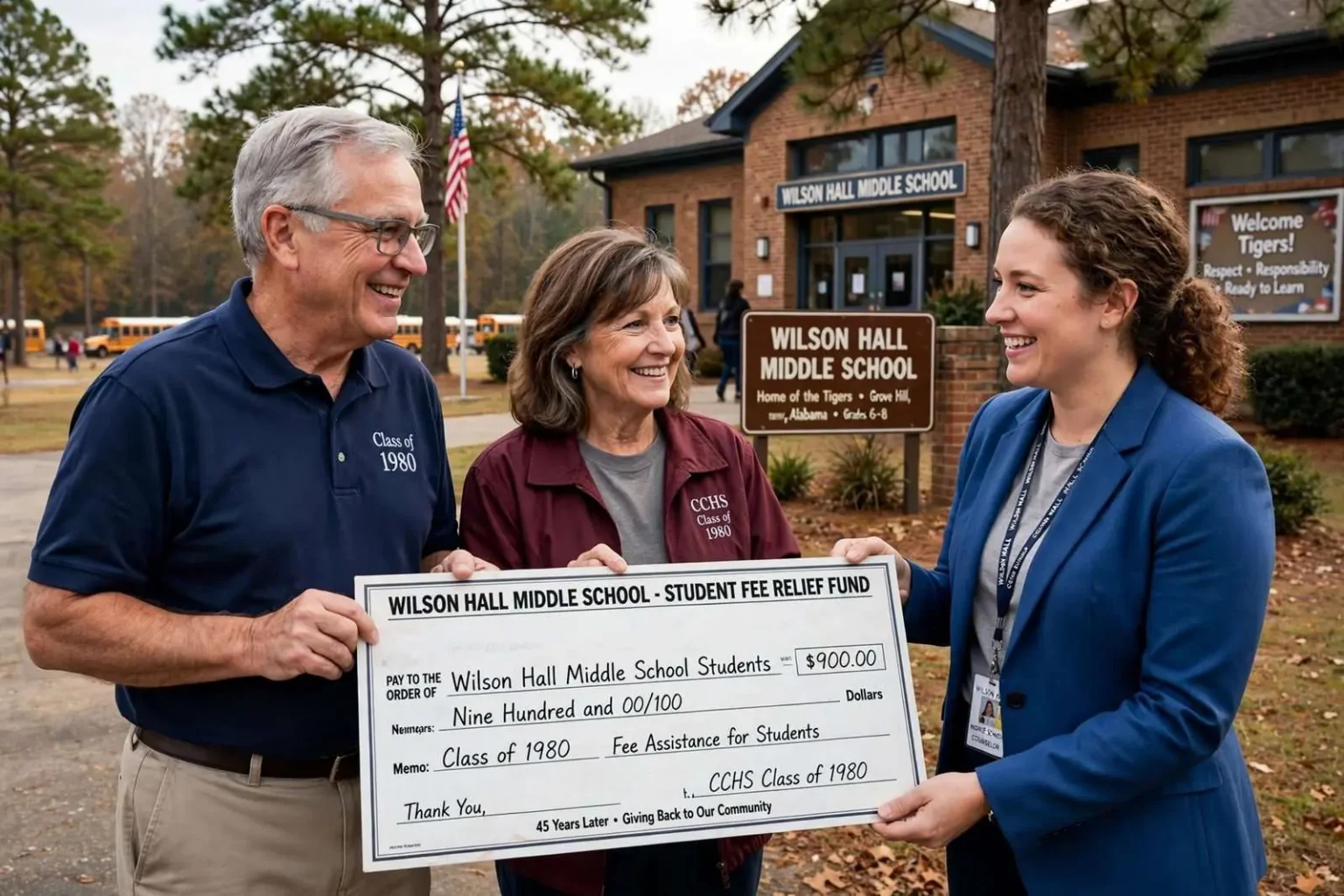
GROVE HILL, Ala. — Members of the Clarke County High School Class of 1980 have contributed funds to benefit students at Wilson Hall Middle School in Grove Hill, turning a class reunion spirit of giving into direct help for a new generation of Clarke County students. Each participating class member donated $20 toward the children of Wilson Hall Middle School, with the money applied directly to students’ school fee accounts — a form of assistance that reaches families at one of the most practical pressure points of the school year.
The gift reflects a tradition common among Alabama high school classes as reunions approach: pooling modest individual contributions into a collective donation that carries far more meaning than any single check. Forty-five years after walking across the stage at Clarke County High School, the members of the Class of 1980 chose to invest in the community that raised them, targeting the middle school where today’s students are laying the groundwork for their own high school years.
Why School Fees Matter in a Small County
In Alabama public schools, instructional costs are covered by state and local funding, but students and families routinely face a list of smaller fees that accumulate through the year: registration and instructional fees, locker fees, laboratory fees in grades where they apply, and charges tied to specific courses or activities. For a family with several children, those amounts can add up quickly, and for families already stretched by the demands of the household budget, an unpaid fee balance can linger as a quiet source of stress.
That is what makes the Class of 1980’s approach significant. Rather than donating equipment or a one-time program, the class applied its money directly to students’ school fee accounts, clearing obligations that would otherwise fall to the families. A fee balance that goes unpaid can, in some districts, affect a student’s participation in certain activities or their ability to receive records on schedule, so paying down accounts has an immediate, practical effect on the students it touches.
The Schools Behind the Story
Wilson Hall Middle School serves students in Grove Hill, the county seat of Clarke County, in Alabama’s southwestern piney woods region. The school carries a name with deep roots in the community, and it sits in a county where the public school system — organized around schools in Grove Hill, Jackson, and Thomasville-adjacent communities — serves one of the state’s more rural student populations. Clarke County spans a broad, timber-rich landscape along the Tombigbee and Alabama rivers, and its schools anchor community identity in towns where Friday night games and school fundraisers still draw whole neighborhoods.
Clarke County High School, the alma mater of the donating class, has served Grove Hill-area students for generations, and its graduating classes have scattered across the country in the decades since 1980 while retaining the ties that reunions rekindle. Classes that mark milestone anniversaries often look for a way to leave something behind in the community, and school-based giving — whether scholarships for seniors or fee assistance for younger students — has become a favored vehicle because it is local, transparent, and immediately felt.
Middle school, in particular, is a stage of a student’s career where support of this kind pays quiet dividends. Students in the middle grades are forming the academic habits that carry them into high school, and families facing fee balances during those years are also navigating adolescence, scheduling, and often the first tastes of organized athletics and band. Removing even a small financial irritant during those years can keep a student’s focus where it belongs, and school counselors in rural districts consistently describe fee relief as one of the simplest, highest-impact forms of community support available.
A Model Other Classes Have Followed
The $20-per-member contribution model is notable for its accessibility. By setting the ask low enough that every class member could participate, the organizers maximized participation rather than relying on a few large donors. The approach mirrors efforts seen across rural Alabama, where alumni classes band together to fund scholarships, purchase classroom supplies, or, as here, wipe out fee balances for students who could use the help. The cumulative effect of many small gifts can be substantial, and the spirit of the gesture often matters as much as the dollars. A classmate who cannot attend the reunion can still be part of the gift; a classmate watching his budget just as carefully as the families next door can still give.
For the students at Wilson Hall Middle School, the donation carries a message beyond its monetary value: that people who once sat in Clarke County classrooms, decades before they were born, are invested in their success. Educators in small districts often say that community support is the difference between a school that merely operates and one that thrives, and a gift of this kind — unprompted, personal, and aimed at easing real burdens — is exactly the kind of support they mean.
Questions About Student Accounts
Families with questions about their students’ school fees, or about whether their children’s accounts were affected by the donation, can contact Wilson Hall Middle School directly at (251) 250-2140. School office staff can review individual fee accounts, explain what balances remain, and discuss options for families managing multiple obligations. Parents who want to stay ahead of fee notices are encouraged to check their students’ accounts at the start of each semester, when registration and course fees are typically posted, and to keep the school’s contact information handy so that questions can be resolved before they become problems.
The Class of 1980’s contribution will not appear in any box score or honor roll, but its effects will register in the school’s fee ledgers and in the households it touched. In Grove Hill, where community and school have always been intertwined, a class of graduates returning — in spirit and in dollars — to help the children now filling their old classrooms is a familiar and welcome story, and one that other classes across the county may well choose to emulate in reunion seasons to come. The members of the Class of 1980 left Grove Hill forty-five years ago; the example they have just set for the students of Wilson Hall Middle School will be around considerably longer.
The Broader Culture of School Giving in Rural Alabama
Across Alabama’s rural counties, school giving takes forms shaped by local economics. In communities without large corporate donors, the burden of supplemental support falls to alumni, churches, civic clubs, and small businesses, and the results are often inventive: benefit fish fries funding athletic equipment, memorial scholarships endowed in modest amounts, and class reunions that adopt service projects alongside their social calendars. Clarke County’s timber and paper heritage built a middle class that, across generations, has repeatedly reinvested in its schools, and the Class of 1980’s donation sits squarely in that lineage. It is the kind of gift that rarely makes headlines beyond the county line, but it defines how small-town school systems survive lean budget years.
Educators note that fee assistance carries a particular dignity when handled the way this donation was structured. Because the money went directly to student accounts rather than through a public application process, families received help without having to ask for it or document hardship in front of neighbors — a consideration that matters enormously in small towns where everyone knows everyone. The anonymity of the assistance protects the students’ privacy while still delivering the full benefit, and school staff handle the mechanics quietly as accounts are credited, without assemblies, announcements, or any public accounting of who received what.
The timing of such gifts also matters in the rhythm of a school year. Fee notices typically go out early in the fall semester, and balances that remain unpaid by midyear can compound into larger frustrations for families and front-office staff alike. A class donation that lands partway through the year can clear a wave of those balances at once, freeing office staff from collection follow-ups and freeing families from a bill they may have been juggling alongside utilities, groceries, and the rest of the household load.
For other classes considering similar gifts, the mechanics are simple: coordinate with the school’s administration, designate the purpose, and let the office staff apply the funds where they are intended. Wilson Hall Middle School’s office at (251) 250-2140 can field questions from families and from any alumni group that wants to follow the Class of 1980’s example. Forty-five years on, the members of that class have shown that the distance between a graduating class and its community can be measured not in years, but in the willingness to give back promptly and generously when the call comes home.