Clarke County Schools Go Virtual on Wednesdays in March for Staff Vaccinations
Clarke County Schools scheduled virtual learning every Wednesday in March 2021 so employees could receive both doses of the COVID-19 vaccine.
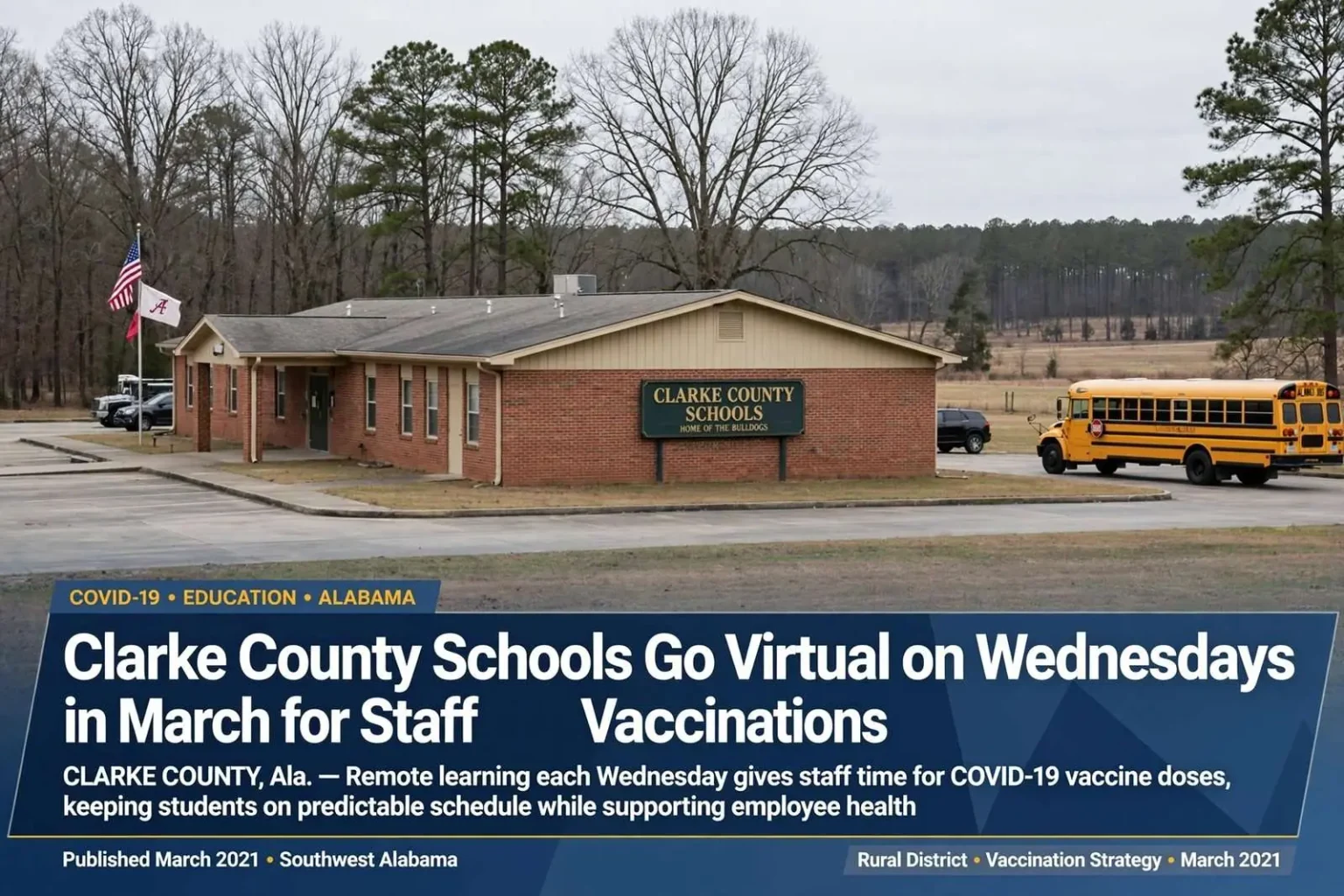
CLARKE COUNTY, Ala. — Clarke County Schools said students would learn remotely every Wednesday in March so employees who want the COVID-19 vaccine could receive both doses, turning a scheduling adjustment into a vaccination strategy for the small southwest Alabama district. The plan let school employees attend vaccination appointments without sacrificing instructional days, while keeping students on a predictable weekly rhythm their families could plan around.
The district said the goal was to give every interested employee the chance to complete vaccination. The two-dose vaccine schedule that dominated the early months of the national rollout created a logistics problem for school systems everywhere — appointments, side effects, and the waiting periods between doses rarely lined up neatly with a school calendar — and districts responded with a range of workarounds, from vaccination clinics on campus to modified schedules like Clarke County’s.
Remote Wednesdays offered a middle path. Students would still learn, teachers would still teach, and the buildings would be quiet enough for employees to get to appointments and recover from the dose days that for some recipients brought fatigue, headache or fever. The district said it was hoping that March brings a continued decline in COVID-19 cases across the county, a hope shared by health officials across southwest Alabama as the pandemic’s waves shifted through the winter.
The district behind the decision
Clarke County Schools serves a rural county wedged between the Tombigbee and Alabama rivers in southwest Alabama, with communities including Grove Hill, Thomasville and Jackson anchoring the district’s attendance zones. Rural systems like Clarke County’s faced distinct challenges during the pandemic: longer bus routes, fewer substitute teachers, families spread across wide geographic areas, and healthcare access that required travel that a vaccination appointment could complicate.
The district’s decision to give employees a standing window every week — rather than one-time leave — reflected the two-dose reality of the vaccines available to school staff at the time. An employee needed an initial dose, a second dose three or four weeks later depending on the vaccine, and time to recover from each. A single day off might cover one appointment; a weekly remote day covered the whole sequence without forcing teachers to choose between their health and their classroom.
Rural Alabama districts also watched their staffing closely through the pandemic. A single quarantined teacher in a small school can strain a building’s coverage capacity in ways that larger suburban systems absorb more easily, and superintendents across the region weighed those realities when they set their schedules. Clarke County’s plan aligned employee health protection with operational stability in one move.
How remote learning fit the calendar
The current plan called for a return to the traditional weekly schedule in April and May, which framed March’s remote Wednesdays as a bridge rather than a new normal. Districts that used midweek remote or hybrid days during the pandemic often built them around practical needs — deep cleaning, planning time, small-group interventions — and Clarke County’s version had a clearly defined purpose: complete the vaccination of employees who wanted it, then get back to the traditional schedule.
For families, the weekly pattern had the advantage of predictability. Parents and guardians could arrange childcare or work schedules for one known day each week, rather than absorbing the last-minute class closures that quarantine-driven disruptions had produced throughout the school year. Students learned from home midweek, then returned to buildings for the other four days.
The approach also matched the public health guidance of the period, which emphasized vaccination as the leading path out of pandemic disruptions for schools. Health officials had consistently identified teachers and school staff among the groups whose vaccination would keep classrooms open, and districts that moved employees toward full vaccination were, in effect, investing in attendance for the rest of the year.
A school year of quarantines, few positive cases
In a statement, the district thanked school personnel and parents, saying that despite many teachers and students quarantining because of exposure, the system had seen very few positive cases during the school year. That distinction — between quarantines and cases — was the defining arithmetic of pandemic-era schooling. Quarantines sent students and staff home for stretches of days after potential exposures, whether or not anyone actually tested positive, and the disruptions accumulated even where the virus itself was not spreading inside buildings.
For a rural district, very few positive cases amid many quarantines was a meaningful record. It suggested that whatever spread occurred was happening outside school buildings rather than within them, a finding that health officials used to argue for keeping schools open when the politics of closures grew heated. Districts across Alabama reported similar patterns during the period: widespread quarantine churn, comparatively little documented in-school transmission.
The district’s gratitude in the statement ran to both sides of that record. School personnel had kept classrooms running through staffing strains, and parents had absorbed the schedule changes and home learning that quarantines forced. A district statement thanking both groups reflected the cooperative tone many rural systems struck with their communities through the period — smaller systems, where schools function as community anchors, tend to communicate in those terms.
Vaccination and the road back to normal
By March of that school year, the national vaccination campaign had been moving through priority groups, and school employees across Alabama had become eligible as states opened the line to educators. Districts that scheduled around vaccination — as Clarke County did — were working the tail end of that process, ensuring that employees who had not yet completed their doses had a realistic path to do so before the school year closed.
The two-dose schedule meant completion, not initiation, was the operative goal. Public health guidance held that protection built over the weeks following each dose, and the district’s framing — give every interested employee the chance to complete vaccination — tracked that reality. A weekly remote day in March covered both doses and the recovery days between them for employees on either vaccine schedule.
The hoped-for continued decline in county cases was the other half of the equation. Case trends determined how much quarantine disruption the district would face in the spring, and a declining curve meant fewer students sent home, fewer teachers out, and a smoother path to the April and May return to the traditional schedule that the district had already planned.
What the schedule meant for students
Remote Wednesdays asked something of students and families, particularly in a rural district where internet access varies across the countryside. Alabama school systems had spent the previous year building remote capacity — devices, connectivity workarounds, take-home packet options — and Clarke County’s midweek schedule drew on that infrastructure. Younger students needed adult supervision at home on remote days; older students managed assignments with less oversight.
The trade-off, from the district’s standpoint, was a manageable one: one structured remote day per week in exchange for keeping buildings open four days a week, protecting employees, and completing vaccination before the final months of the year. Districts that lacked such plans faced the alternative — unscheduled closures and quarantine churn that no family could plan around.
Clarke County’s plan stood as an example of the small, practical adaptations rural Alabama districts made during the pandemic. A weekly schedule adjustment, tied to a defined purpose, with a return date attached — the current plan called for a return to the traditional weekly schedule in April and May — offered employees vaccination access, families predictability, and the district a route through March toward a normal spring.
Clarke County and its schools
Clarke County sits in southwest Alabama, a rural county of forestland and river towns where the school system is among the largest employers and most visible public institutions. Grove Hill, the county seat, Thomasville to the north and Jackson to the south anchor communities whose identities run through their schools — football Fridays, graduations and school news travel quickly in towns of this size, which is why district statements about schedules and health draw broad attention.
Rural districts across the Black Belt and southwest Alabama navigated the pandemic with the same toolkit and the same constraints as Clarke County: limited staff depth, wide bus routes, and communities where a school closure touches nearly every household. The region’s systems alternated between in-person, hybrid and remote arrangements as case waves moved through, and each adjustment required the same family-by-family logistics that Clarke County’s Wednesday plan presumed.
The district’s communication style reflected that closeness. A statement thanking school personnel and parents, reporting quarantine and case numbers honestly, and laying out the April and May return plan is the kind of messaging rural superintendents used to keep communities oriented — plain language about what was happening and what would happen next.
The bigger picture of school vaccination efforts
Clarke County’s remote-Wednesday plan joined a family of adaptations Alabama districts used as vaccines reached school employees. Some systems hosted on-campus clinics through partnerships with county health departments and hospitals; others built employee vaccination days into their calendars; still others relied on the state’s mass vaccination sites that required staff to travel. In a rural county, where the nearest large vaccination site could be a significant drive, a standing weekly window carried particular value.
The stakes were instructional. Every disruption in a school year compounds — lost days for quarantines and closures mean lost ground in reading and math — and superintendents spoke through the period about protecting instructional time as the governing priority. Vaccination of employees, in that frame, was an instructional investment: healthier staff, fewer substitutions, more days in buildings.
By the time April and May arrived, the district intended to be back on its traditional weekly schedule, with employees vaccinated and a school year of quarantine churn behind it. The March plan — remote learning every Wednesday, employees completing their doses, families planning around a known calendar — was the bridge to that finish, and the district’s message closed with the same two notes it had carried all year: thanks to the people who kept the schools running, and hope for a spring of declining cases in Clarke County.