
Clarke County’s Renee Smith Named Alabama 4-H Volunteer of the Year
Renee Smith of Clarke County has been named an Alabama 4-H Volunteer of the Year for southwest Alabama, among honorees recognized statewide.
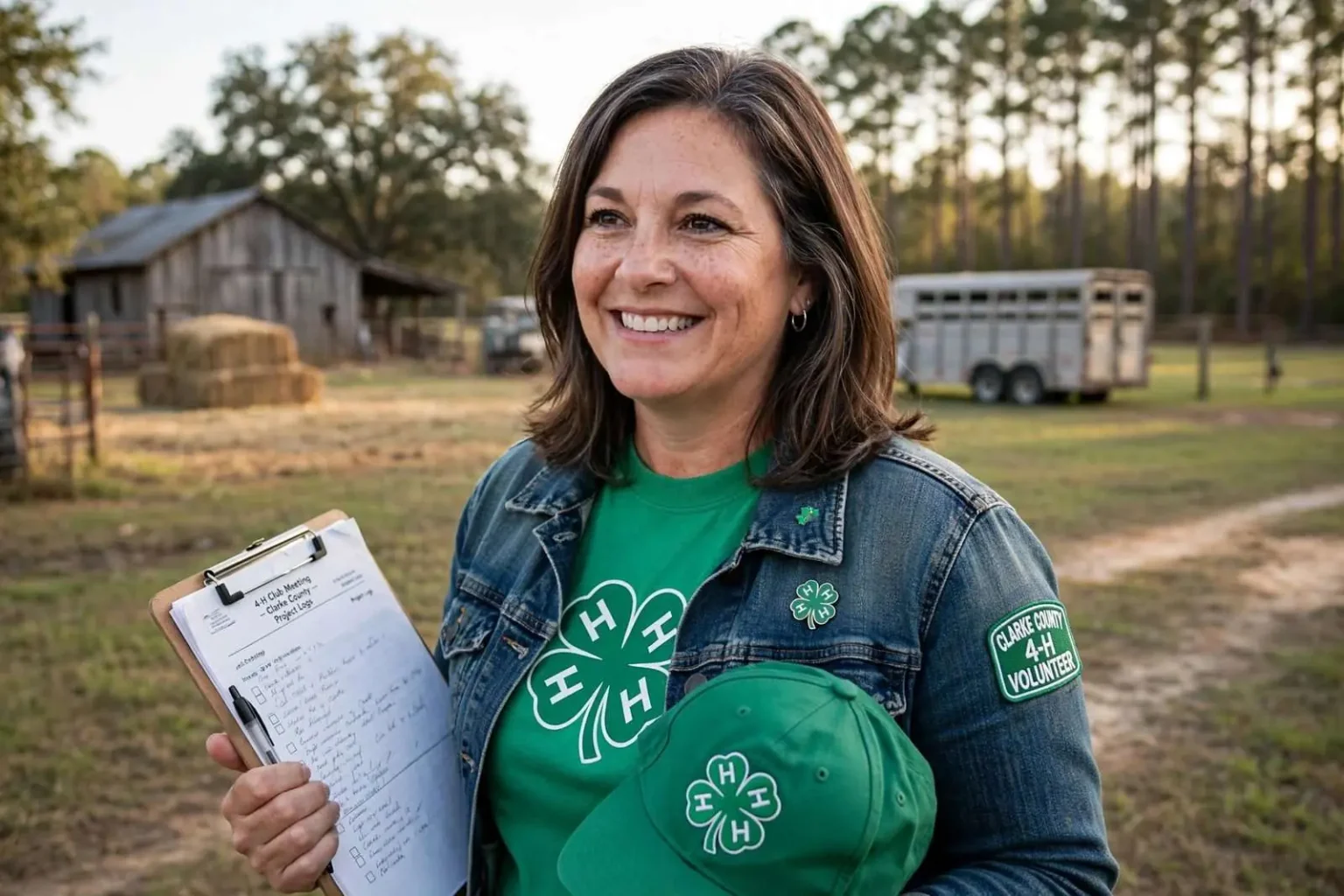
Renee Smith of Clarke County has been recognized as an Alabama 4-H Volunteer of the Year, earning the honor for the southwest Alabama region.
Smith was among a slate of volunteers celebrated across the state for their work with young people in the 4-H program. The other honorees included Dwight McCay of Lawrence County, Renee Adams of Marshall County, Jan Beavers of Tuscaloosa County, Fran Johnston of Autauga County and Jenny Foster of Crenshaw.
4-H volunteers play a central role in the development of local youth, supporting members by hosting meetings, hauling livestock and leading club programs throughout the year.
What the 4-H Volunteer of the Year recognizes
The Alabama 4-H Volunteer of the Year honors are awarded to adult volunteers who give their time and effort to sustain local 4-H clubs, often behind the scenes and without pay. The program spans the state by region, so that a volunteer such as Smith, recognized for the southwest Alabama region, is celebrated alongside peers serving other parts of the state. The other honorees – Dwight McCay of Lawrence County, Renee Adams of Marshall County, Jan Beavers of Tuscaloosa County, Fran Johnston of Autauga County and Jenny Foster of Crenshaw – reflect the geographic spread of that volunteer network, from north Alabama counties such as Lawrence and Marshall to the west-central and south-central parts of the state.
What 4-H is
4-H is the youth development program of the nation’s Cooperative Extension System, delivered in Alabama through Alabama A&M University and Auburn University and their partner county offices. The name stands for head, heart, hands and health, the four pillars represented in its clover emblem. Although the program began more than a century ago with a focus on agriculture and rural life, it now reaches young people in urban, suburban and rural communities alike, offering projects in science, healthy living, civic engagement and leadership in addition to its traditional livestock and gardening work.
In Alabama, 4-H serves tens of thousands of young people each year through school clubs, camps, after-school programs and competitive events. The program is organized county by county, which is why volunteers are so essential: each county relies on adults who can keep a club meeting regularly, transport animals and equipment, and mentor members through projects that may run for an entire school year.
The work of a local volunteer
Smith’s recognition points to the kinds of tasks that keep a 4-H club alive in a place like Clarke County. Hosting meetings means providing a dependable place and time for members to gather, whether at a community center, a church, a school or a volunteer’s own property. Hauling livestock is a literal part of the job for clubs with animal projects: members who raise market goats, lambs, hogs or steers must get their animals to weigh-ins, clinics and county and state fairs, and many families depend on volunteers with trailers and trucks to make those trips possible. Leading club programs means guiding members through record books, public speaking contests and project work that builds toward regional and state competitions.
Clarke County, in southwest Alabama, is the kind of rural community where these volunteer contributions are especially visible. Its county seat is Grove Hill, and the surrounding area includes towns such as Jackson, Thomasville and Coffeeville, with an economy historically tied to forestry, agriculture and the Tombigbee River corridor. In such communities, a 4-H club can be one of the few structured extracurricular options for young people, which raises the stakes of simply showing up week after week.
Why the recognition matters
Statewide, Alabama 4-H relies on a large base of volunteers to function, and the annual Volunteer of the Year list is one way the organization names and thanks the adults who make that possible. For a regional honoree like Smith, the award also draws attention to Clarke County’s young people and to the local adults investing in them. The other honorees from Lawrence, Marshall, Tuscaloosa, Autauga and Crenshaw counties represent the same principle applied across very different communities – a reminder that 4-H’s footprint depends less on any single paid staff member than on residents willing to host a meeting, load a goat and lead a club.
How 4-H shapes youth development
Research on youth development programs of this kind consistently points to the value of sustained, supportive adult relationships. A volunteer who meets with the same members across months and years becomes a steady presence in those young people’s lives, modeling planning, responsibility and public communication. The livestock projects in particular teach record-keeping and long-term care, while public speaking and demonstration contests build confidence in front of an audience. For volunteers, the payoff is watching members carry those skills into school, careers and, often, into volunteering themselves once they are old enough – the cycle that keeps a county club going from one generation to the next.
The competitive path for members
For many 4-H members, the year builds toward competition. County clubs feed into regional and state events where young people present livestock, demonstrate skills and test their knowledge against peers from across Alabama. The Alabama 4-H program runs events such as project achievement competitions, livestock shows and the Alabama 4-H Science School at the 4-H Center on the Coosa River, where members camp, canoe and take part in environmental education. A volunteer’s role in this pipeline is practical: helping a member choose and complete a project, checking that record books are filled out, and making sure the child and the animal or exhibit actually arrive at the venue. That logistics-heavy support is exactly what the Volunteer of the Year honors are meant to acknowledge, because without it many members would not be able to participate at all.
Clarke County’s place in southwest Alabama
Clarke County sits in the south-central part of Alabama, bordered by the Tombigbee River to the west and the Alabama River to the east, with Grocery Hill – more formally Grove Hill – as its county seat. The land is heavily forested, and timber has long been central to the local economy alongside farming. Communities such as Jackson, on the Tombigbee, and Thomasville, along Interstate 65, give the county both river and highway connections. In a county of this character, youth programs depend on volunteers who are willing to drive, organize and host, since distances between towns can be significant and paid staffing is thin. Smith’s recognition for the southwest Alabama region places her among the volunteers holding that structure together.
A tradition with deep Alabama roots
4-H in Alabama traces back to the early 1900s, when county agents with the Cooperative Extension Service began organizing boys’ and girls’ corn and canning clubs to demonstrate improved farming and home-economy methods. Over the decades those clubs grew into the modern 4-H program, and Alabama’s version became known for its livestock shows, its camping program and its emphasis on public speaking. The volunteers honored this year – Smith in Clarke, McCay in Lawrence, Adams in Marshall, Beavers in Tuscaloosa, Johnston in Autauga and Foster in Crenshaw – are the latest link in that century-long chain, carrying forward a model in which adult volunteers, not institutions alone, keep the program running in their home communities.
Recognizing the quiet work
The Volunteer of the Year designation is, in the end, a way of making visible work that rarely gets noticed. Hauling livestock before dawn, setting up folding chairs for a meeting, driving an hour to a contest – these are the recurring, unglamorous tasks that determine whether a club meets at all. By naming Smith and her fellow honorees, Alabama 4-H places a spotlight on the adults whose steady effort lets thousands of the state’s young people take part in something that builds skills well beyond the clubhouse. For Clarke County’s members, that recognition belongs as much to the community that supports them as to the volunteer who received the plaque.
How a year in 4-H unfolds
The rhythm of a 4-H year gives shape to a volunteer’s commitment. Clubs typically organize in the fall, when schools resume, and meet through the spring, building toward county events and, for qualifying members, project achievement competitions at the regional and state level. Along the way, volunteers help schedule activities, coordinate with parents and sometimes travel with members to camps and contests. For animal projects the calendar is tighter still: market animals must be selected, fed and weighed on a schedule that culminates at a show, and a volunteer who can transport a steer or a hog may be the difference between a member exhibiting and sitting out.
That behind-the-scenes labor rarely earns applause, but it is what the Volunteer of the Year awards are designed to surface. By naming a honoree for each region, Alabama 4-H makes sure that recognition reaches beyond the large, well-known clubs to the smaller counties – places like Clarke – where a single dependable volunteer can sustain an entire program. Smith’s honor for southwest Alabama is a recognition of exactly that: the steady, recurring effort that keeps a club meeting, a project moving and a young person engaged.
The broader value of youth volunteering
Programs built on adult volunteers carry a double benefit. Young people gain mentors and structured activities, while the volunteers themselves remain connected to their communities and, often, to the 4-H experience they had as members. Many of today’s leaders in Alabama agriculture, education and local government trace a line back to a 4-H club and to the volunteer who ran it. In that sense the annual honors list is less a trophy case than a roster of the people quietly reproducing civic life county by county – one meeting, one trailer load of livestock and one club project at a time.