Coast Guard Air and Sea Crews Rescue Two Kayakers After One Capsizes Near Dauphin Island
A capsized kayak and a missing paddler prompted a Coast Guard air and sea search off Dauphin Island. Both kayakers were found safe.
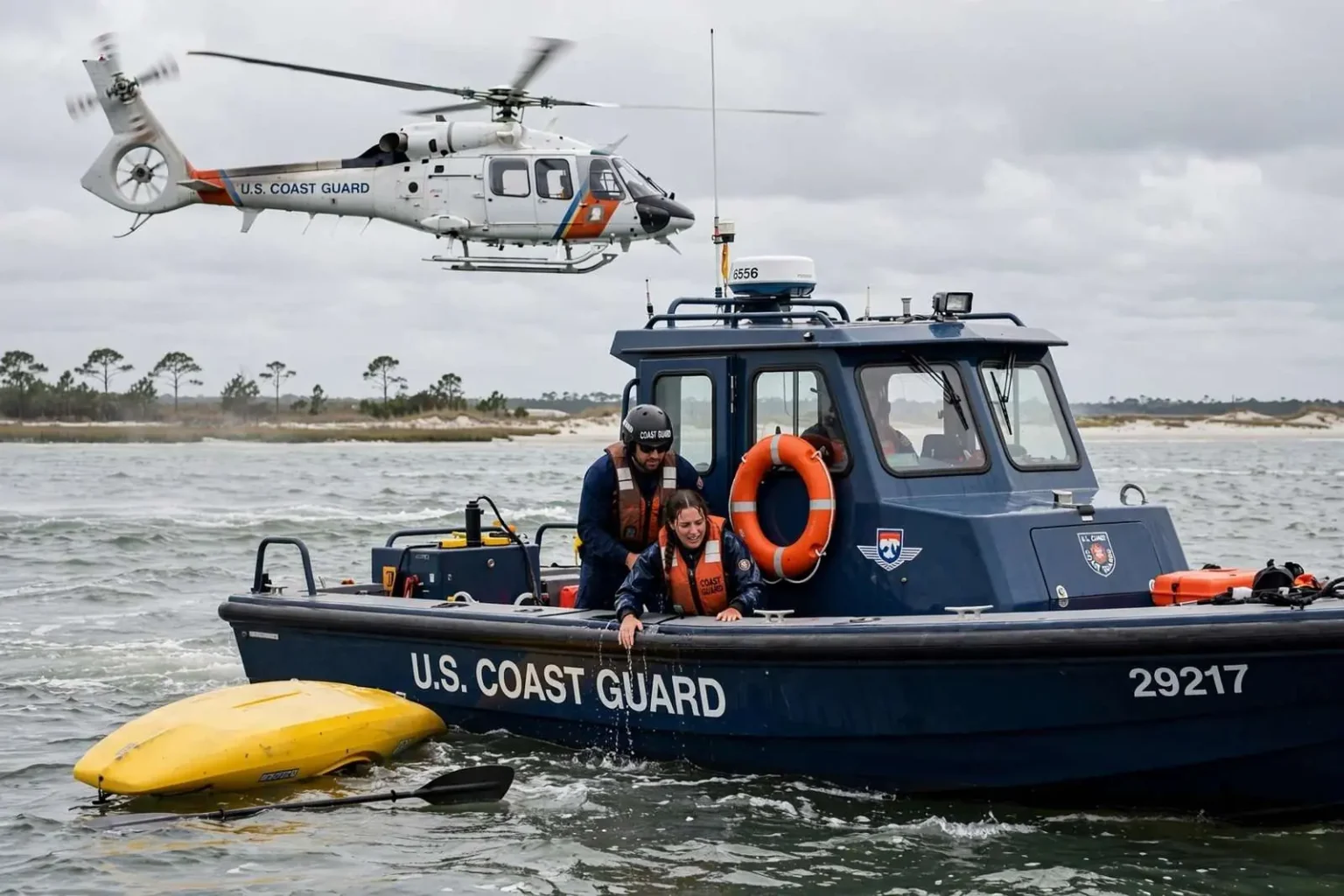
Two kayakers who found themselves in trouble off Dauphin Island owe their lives to quick action by Coast Guard air and boat crews — and to the life jackets they were wearing. Sector Mobile received the call at 2:16 p.m. on May 24. A kayaker reported that his companion’s boat had overturned in rough water and he had lost sight of her after both ended up in the Gulf. He had managed to swim to shore and raise the alarm.
The call set in motion a response that spanned the water, the air and a stretch of the Alabama coast that has long been one of the busiest recreational boating environments on the northern Gulf. Dauphin Island, a barrier island guarding the entrance to Mobile Bay, draws kayakers, anglers and paddlers throughout the warm months, and its surrounding waters can turn hostile quickly when wind and current align against a small craft. What begins as a calm morning paddle can become a survival situation within minutes.
That is precisely the scenario rescue crews train for, and on this afternoon the pieces came together in time. Watchstanders launched a 29-foot Response Boat from Coast Guard Station Dauphin Island, the first-response asset positioned just minutes from the reported trouble area. An MH-65 Dolphin helicopter crew from Air Station New Orleans lifted off to join the search, and an HC-144 Ocean Sentry plane was also diverted to the area.
A Multi-Asset Search in Open Water
The layered response reflects how the Coast Guard covers the central Gulf Coast. Station boats provide fast, close-in search capability, but their visibility is limited by the height of the waterline and the speed of the seas. Aircraft change that equation entirely. A helicopter can sweep wide grids of open water with a crew trained to spot a single head above the waves, while a fixed-wing Ocean Sentry can cover hundreds of square miles and coordinate assets below.
The search ended the way rescuers always hope it will. The response boat crew located the missing kayaker and brought her to Station Dauphin Island. Both kayakers were wearing life jackets, which officials said was almost certainly the decisive factor in the positive outcome.
In water with even a modest chop, a person without flotation can slip below the surface long before a rescuer arrives, and searchers are left looking for a person who has drifted or gone under. A paddler in a properly fitted life jacket, by contrast, remains at the surface — visible, breathing and conserving strength — no matter how tired, cold or disoriented she becomes. That difference between floating and sinking is what separates most of these cases into rescues or recoveries.
Life Jackets Credited with Saving Lives in Open-Water Capsize
“This case highlights the importance of utilizing essential life-saving equipment while boating,” said Petty Officer 1st Class Christopher Moore, a Sector Mobile command duty officer. “The fact that both kayakers were wearing life jackets was most likely a huge factor in the positive outcome of this case.”
Moore speaks from a watchstander’s vantage point. Command duty officers at Sector Mobile are the ones who take the initial distress call, weigh the reported conditions, and decide which assets to launch and where to send them. From that desk, the difference between a survivable capsize and a tragedy is often visible in the first thirty seconds of the call — whether the people in the water had flotation on when they went in.
The incident underscores a reality that Coast Guard crews see repeatedly: small craft on open water offer little margin for error when conditions change. A kayak sits low in the water, is easily swamped by a passing wake or a wind-driven chop, and offers no deck to stand on and no cabin to shelter in. Paddlers who set out in the morning calm of Mobile Bay or the protected waters behind the island can find themselves in Gulf conditions that overwhelm a human-powered boat within minutes.
Federal regulations require recreational vessels to carry enough life jackets for everyone aboard, but carrying them and wearing them are different things, and the Coast Guard has spent years urging boaters to put them on rather than stow them. The agency’s data has consistently shown that drowning is the leading cause of death in recreational boating fatalities, and that in a large share of those deaths, a life jacket was aboard but not worn. For kayakers, canoeists and paddleboarders — who are often in the water involuntarily and cannot grab a stowed jacket in the moment — wearing one from launch is the only meaningful option.
Why Flotation Buys Critical Time
A properly worn life jacket keeps a person at the surface even if they are exhausted, injured, or disoriented, buying critical time for rescuers to arrive. In this case, that time was measured in minutes rather than hours, because the survivor who made it to shore was able to give rescuers a starting point quickly. But on the open Gulf, a drifting person in a life jacket can stay afloat for hours — long enough for an aircraft search pattern to find them — while the same person without flotation would have needed recovery, not rescue.
The Value of a Float Plan
Moore also noted that filing a float plan — telling someone on shore where you are going and when you expect to return — can dramatically speed the response when something goes wrong.
A float plan costs nothing and takes moments to prepare. At its simplest, it is a note left with a family member, friend or marina listing the route, the launch point, the expected return time and a description of the vessel or craft. Rescuers say the information is often the difference between a search that starts in the right place and one that has to find the needle before it can look in the haystack. When a boater is reported overdue with a known route, watchstanders can vector aircraft and boats directly to the last expected position; without one, they must work from guesswork.
In this incident, the survivor’s ability to reach shore and call for help served the same function a float plan normally does: it fixed the search area and started the clock early. Officials stressed that paddlers cannot count on making it to shore themselves, which is why the plan — plus a whistle, a waterproof light and a phone or radio in a waterproof pouch — remains the standard advice for anyone launching a small craft into coastal waters.
Dauphin Island’s Demands on Small Craft
The waters around Dauphin Island present a particular set of hazards that local paddlers come to respect. The island fronts the open Gulf on its southern side, while its northern shore looks across the sound toward the mainland. Passes between the barrier islands funnel tides and can generate strong currents, and the shallow bars offshore can turn a modest swell into breaking waves. Afternoon sea breezes during the warm months routinely build a chop that is manageable for powerboats but punishing for a kayak trying to make headway.
Experienced paddlers on the island and across the Gulf Coast generally recommend checking marine forecasts before every trip, staying within sight of shore when conditions are uncertain, paddling with a partner, and dressing for the water temperature rather than the air temperature. None of those precautions removes risk; they buy margin. The two kayakers rescued this week had the most important one on when they needed it.
How the Search Unfolded
From the watchstander’s perspective, the sequence ran with the efficiency that training is meant to produce. The call came in at 2:16 p.m., the station boat was underway within minutes, the helicopter was airborne from New Orleans, and the Ocean Sentry was re-tasked from wherever it had been flying. Each asset brought a different capability to the same grid of water, and the boat crew — the ones who could actually pull a person aboard — found the missing kayaker while the aircraft kept watch from above.
A Reminder as the Season Continues
The rescue closed without serious injury, and both paddlers were accounted for by evening. Sector Mobile used the case to repeat the message it delivers after nearly every such incident: wear the jacket, tell someone the plan, and carry a means of communication that works when wet. Crews from the station, the New Orleans air station and the Ocean Sentry fleet will respond again — that is their job — but watchstanders would rather get the call that ends with a conversation at the dock than one that ends with a search that finds nothing. On this afternoon, everyone went home.