Cold Weather Closes Schools Across the Clarke County Area
Cold weather closed schools across the Clarke County area, including Thomasville City Schools, Clarke Prep and Jackson Academy, with classes resuming the.
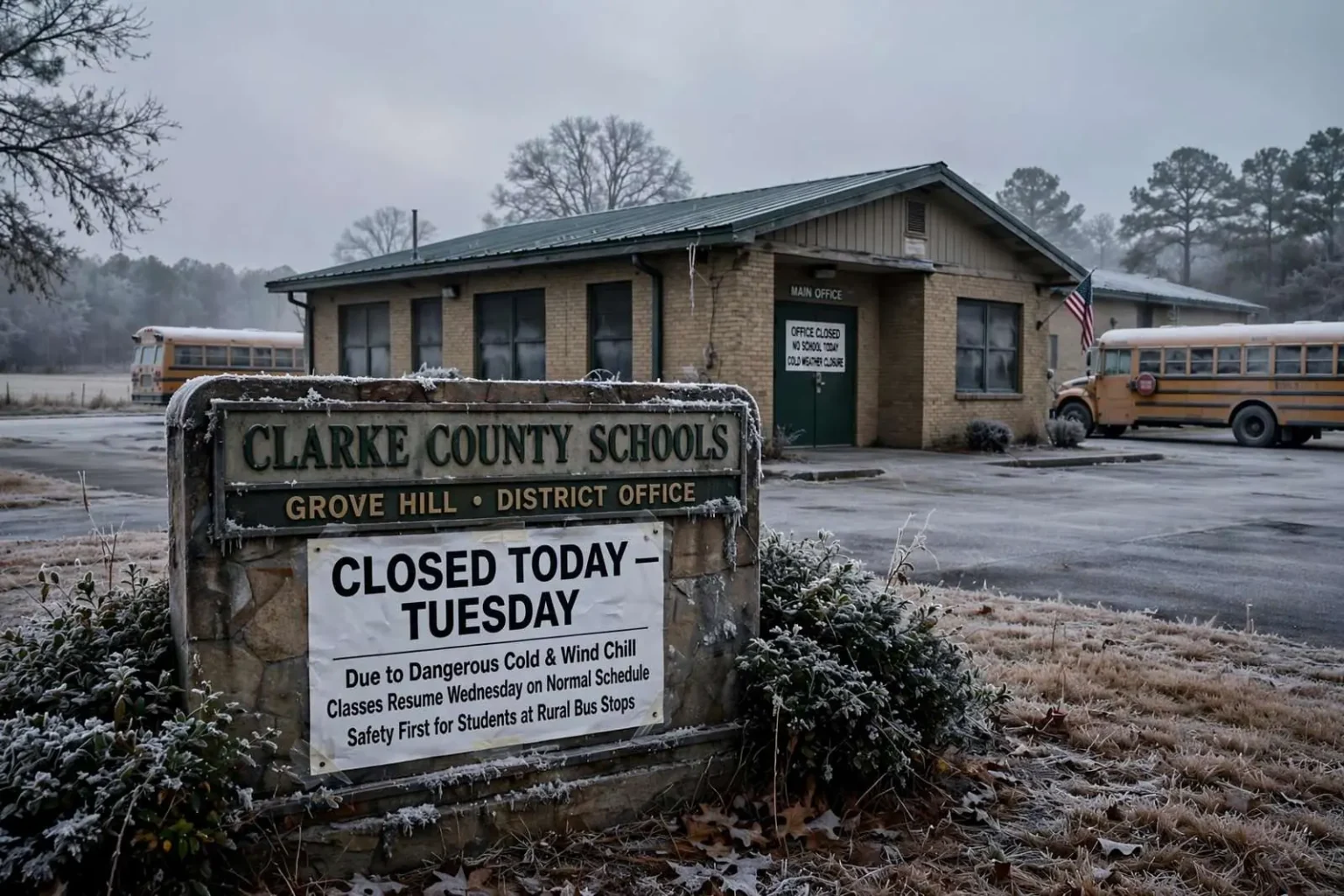
CLARKE COUNTY, Ala. — Bitterly cold weather swept through the Gulf Coast region and forced school systems across the area to shut their doors for a day, giving students from the counties along the Alabama River to the Mobile Bay suburbs an unexpected day out of the classroom.
Clarke County schools closed Tuesday as the cold blast settled over Southwest Alabama, and district officials planned for classes to resume on the normal schedule Wednesday once the worst of the cold passed. The one-day closure reflected the district’s judgment that sending students — many of them waiting at rural bus stops long before sunrise — into dangerously cold conditions posed risks not worth taking.
Thomasville City Schools also closed in response to the weather, keeping students home in one of Clarke County’s two independent city districts. The area’s private schools made the same call: Clarke Prep, the private school in Grove Hill, and Jackson Academy, the private school in Jackson, both announced closures, meaning that virtually every classroom in Clarke County — public and private alike — went dark for the day.
The coordinated closures illustrated how deeply a single weather system can reach into daily life in rural Alabama, where the school calendar bends not to snow, which rarely falls here in quantity, but to cold itself.
Why Cold, Not Snow, Closes South Alabama Schools
School closures in the Deep South follow a logic that differs sharply from the snow-day calculations of northern states. In Clarke County and across the Gulf Coast, the roads rarely become impassable from snow or ice. What closes schools is the cold itself — and specifically the combination of overnight low temperatures, wind chill values, and the reality of how students get to school in a largely rural county.
Bus transportation is the decisive factor. Clarke County’s public school district covers hundreds of square miles of rural territory between the Tombigbee and Alabama rivers, and its bus routes begin in the pre-dawn darkness, with students waiting at the ends of rural driveways and crossroads stops for buses that may take forty-five minutes or more to complete their morning loops. When overnight temperatures plunge into the teens or low twenties and wind chills drop below that, the exposure those students face waiting at stops becomes a genuine health concern, particularly for the youngest children.
District administrators weigh those risks against the instructional cost of a lost day. There is no fixed temperature threshold in Alabama state law that mandates closure — the decision rests with each local superintendent — but the general practice across South Alabama is to err on the side of safety when wind chill values threaten exposed skin and when the morning wait at a bus stop could become dangerous. A one-day closure with a return to normal schedule, as Clarke County planned, is the standard outcome.
Who Closed and Why It Mattered
The closure map across Clarke County told the story of the area’s education landscape. The Clarke County public school system, headquartered in Grove Hill, the county seat, operates campuses serving communities including Grove Hill, Jackson, and Thomasville’s surrounding rural areas. Thomasville City Schools, an independent district serving the city of Thomasville in the county’s northeastern corner, made its own decision and also closed.
The county’s private schools followed the same path. Clarke Prep, an independent school in Grove Hill that competes in the Alabama Independent School Association, closed Tuesday, as did Jackson Academy in Jackson. The parallel decisions meant that families across the county faced the same logistical puzzle regardless of where their children attended school: finding supervision for a school day that suddenly vanished from the calendar.
For working parents, an unexpected closure is more than an inconvenience. Rural counties have limited options for drop-in child care, and many households rely on the school day’s predictable schedule. Cold-weather closures thus ripple outward — grandparents get called, workplaces accommodate late arrivals, and older students help mind younger siblings. Communities in Clarke County have long since absorbed these routines; a cold day in the Deep South is a known disruption, if an unwelcome one.
The Cold Blast and the Gulf Coast
The weather system behind the closures was the kind of Arctic outbreak that reaches the Gulf Coast a handful of times each winter. Cold air masses that build over central Canada and the northern Plains sometimes drive south all the way to the Gulf of Mexico, and when they do, a region accustomed to mild winters experiences several days of temperatures far below its norms.
South Alabama feels those outbreaks acutely. Homes in the region are built for heat and humidity rather than sustained cold, and many lack the insulation and heating capacity that northern houses standardly include. Pipes freeze in exposed crawl spaces. Livestock and outdoor pets need extra care. And the region’s vegetation — citrus in home gardens, tender landscape plants, winter vegetables — suffers damage when temperatures fall below levels the plants evolved to tolerate.
School systems are only the most visible institutions to respond. Community centers, government offices, and churches across the region sometimes open warming stations during the coldest nights, and utility crews brace for the demand spike that comes when heating systems run flat out. For a day or two, the routine of Gulf Coast life reorganizes itself around staying warm — and the school calendar is the first institution to move.
The School Districts of Clarke County
The closure highlighted the unusual structure of public education in Clarke County, which is served by three separate school systems. The Clarke County School District operates the countywide system, while the cities of Thomasville and — historically — Jackson have each maintained independent city school districts, a legacy of the municipal school systems that many small Alabama cities established in the late nineteenth and early twentieth centuries.
Each district makes its own closure decisions, but in a county as small and compact as Clarke, the weather is the same everywhere, and the districts typically arrive at the same conclusion. Tuesday’s closures were no exception: public county schools, the Thomasville city system, and the private schools all shut down together, and all planned to return to normal operations as the cold moderated.
That coordination matters for families with children in different systems and for the county’s overall rhythm. When every school closes, the community understands that the day is lost to the weather; when the decisions diverge, confusion follows. Southwest Alabama’s school leaders, who have managed hurricanes, freezes, and the occasional rare snow event over the years, generally stay in close communication during weather events, and their aligned decisions reflect that practice.
By Wednesday, the plan was for everything to return to normal — buses running their rural routes, cafeterias serving breakfast, and classrooms back in session across Grove Hill, Thomasville, Jackson, and the county’s smaller communities. The cold blast would have cost the region a single instructional day, a modest price that local superintendents have always considered worth paying when the alternative is children standing in the dark, in the cold, waiting for a bus.
The one-day closure pattern also reflects the way Alabama school districts handle missed instructional time. Unlike northern districts that build generous snow-day cushions into their calendars, South Alabama systems typically lose few days to weather, and a single closure can often be absorbed without altering the academic calendar. Should closures accumulate during an unusually severe winter, districts can use built-in make-up days or seek flexibility from the state, but the common outcome of a cold-weather closure like Tuesday’s is a seamless return with no calendar consequences at all.
How Cold-Affected Mornings Unfold for School Operations
Behind the closure decision lies a checklist of operational concerns that school administrators run through when Arctic air arrives. Bus fleets are the first consideration: diesel buses start reluctantly in extreme cold, and several of the region’s districts take precautions — block heaters, early starts, and fuel additives — when temperatures threaten the morning routes. A fleet that cannot start cannot run routes, and the risk compounds when the cold is severe enough to disable vehicles at their rural depots.
School buildings themselves present the next set of concerns. Older campuses across rural Alabama have heating systems that struggle in temperatures beyond their design range, and exposed plumbing can freeze in classrooms, gyms, and cafeterias. A district that opens school into a building with burst pipes creates problems far worse than a lost day. Custodial and maintenance staff typically walk the buildings before dawn on cold mornings to confirm that systems are functioning before students arrive.
Student safety at bus stops and on the roads completes the picture. South Alabama drivers encounter cold-weather hazards they rarely practice — patches of black ice on bridges and overpasses, frost on windshields, and the unfamiliar handling of vehicles in near-freezing morning conditions. Rural roads in Clarke County wind through low areas where cold air settles and moisture lingers, and the school buses that serve those roads share them with commuter traffic during the same early hours.
The Communities Behind the Closures
The geography of Tuesday’s closures traced Clarke County’s communities and their schools. Grove Hill, the county seat, anchors the central part of the county and hosts the county school system’s administrative offices along with Clarke Prep. Thomasville, the county’s largest city in its northeast, operates its own city schools, whose closure decision echoed those across the county line. Jackson, the county’s southern hub and its industrial center, is home to Jackson Academy, whose closure extended the day off to the county’s private-school families.
Each of these communities has a school culture that runs deep. Friday night football, homecoming traditions, and generations of families who attended the same campuses give the county’s schools a central place in local life — which is precisely why a closure day registers so broadly. The absence of school buses on rural roads, of students at the county’s football fields and gyms, and of the morning traffic around each campus changes the texture of the whole county for a day.
Cold Weather and the Gulf Coast’s Infrastructure
A bitter cold snap stresses far more than school schedules. Across the Gulf Coast, the infrastructure is lightly winterized because hard freezes are infrequent, and each cold outbreak tests that vulnerability. Water systems deal with frozen lines and main breaks. Roads departments stand by with sand in case ice forms on bridges. Power demand surges as heat pumps run continuously, and utilities ask customers to conserve during peak hours.
Agriculture feels the cold in ways that shape the region’s economy. Clarke County’s forests, cattle operations, and small farms weather most winters easily, but a hard freeze can damage winter forage, stress cattle, and require extra labor to keep water sources from icing. Home gardeners across the county cover or harvest what they can and wait out the cold.
Back to Normal by Wednesday
For Clarke County, the plan announced with Tuesday’s closure was the simplest possible: schools would reopen on the normal schedule Wednesday. The one-day interruption preserved the instructional week, spared families a longer scramble, and let the region’s school systems treat the cold blast as what it was — a brief, sharp visitor rather than a sustained emergency.
The episode served as a reminder of how weather governs life along the Gulf Coast in ways that differ from the rest of the country. Where northern districts stockpile snow days and cancel school for accumulations on the roads, South Alabama systems watch the thermometer and the wind chill chart, weigh the minutes their students stand in the dark at rural bus stops, and make a decision that puts safety first. On this Tuesday, every district in Clarke County — public and private, county seat and city alike — reached the same conclusion, closed the same doors, and planned to open them again together the next morning.