
Common Sense Campaign and FM Talk 106.5 Team Up for Alabama Senate Candidate Debate
The Common Sense Campaign's live Senate candidate debate airs Tuesday at noon on FM Talk 106.5's Midday Mobile, with listener questions welcome.
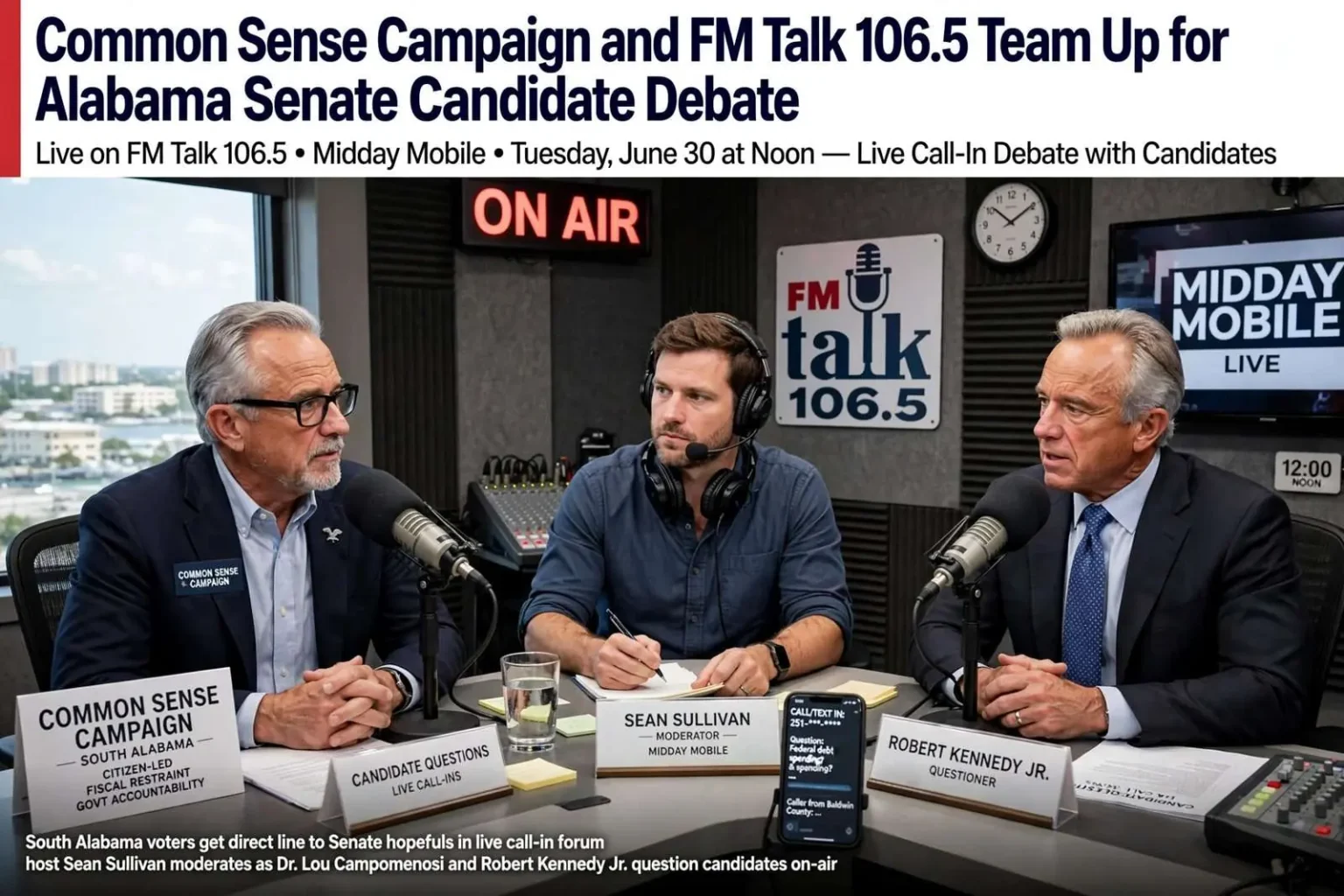
Alabama Senate candidates were set to square off in a live radio debate Tuesday, June 30, at noon, hosted by the Common Sense Campaign of South Alabama in conjunction with FM Talk 106.5. The hour-long forum aired live on the station’s Midday Mobile program, moderated by host Sean Sullivan, and put the candidates in front of a broadcast audience across the Mobile area during the lunch hour.
Dr. Lou Campomenosi of the Common Sense Campaign joined Robert Kennedy Jr. in posing questions to the candidates. Organizers made audience participation a centerpiece of the format, inviting listeners to call or text their questions in for consideration during the broadcast — an unusually direct line from voters to candidates for a Senate forum.
An Unscripted Format
The format set the debate apart from the staged candidate events that dominate campaign seasons. Rather than a chamber of party regulars submitting questions in advance, the Midday Mobile forum handed the question queue to the audience: listeners calling into the station, and texts arriving at the studio, were to be screened and read to the candidates live. For the hopefuls, that meant no prepared answers and no advance knowledge of what the afternoon’s pressure points would be.
Live radio imposes its own discipline on a debate. There is no editing, no break to consult advisors, and a sixty-minute clock that forces candidates to be concise if they want to be heard at all. Moderators of call-in forums like this one typically rotate among audience questions, follow-ups, and time checks, keeping any single candidate from dominating the hour. Sean Sullivan’s role as moderator was to keep that machinery moving while the panel of questioners pressed for specifics.
The Common Sense Campaign’s involvement gave the event a grassroots organizing spine. The group, active in south Alabama politics as a citizen-led organization focused on fiscal restraint, constitutional questions, and government accountability, has built its reputation on hosting candidate events that emphasize direct questioning rather than campaign speeches. Its partnership with FM Talk 106.5 — Mobile’s news and talk station, whose Midday Mobile program reaches listeners across the central Gulf Coast — extended that reach to a broadcast audience that campaign appearances alone would not touch.
A Pivotal Election Year
The debate landed in the middle of a pivotal election year in Alabama, giving South Alabama voters one of their few chances to hear Senate hopefuls answer unscripted questions on live local radio rather than in staged campaign appearances. Senate races in Alabama draw crowded fields in primary years, and candidates spend most of their time at fish fries, county party meetings, and Chamber luncheons — settings where the questions are friendly and the format favors prepared remarks. A call-in debate strips that protection away.
For voters in the southern counties, the practical value of the forum was accessibility. Montgomery-centered campaigns concentrate their events in the capital and the Huntsville and Birmingham media markets, and Mobile-area voters often see Senate candidates only in paid advertising. A noon broadcast on a Mobile talk station reversed that pattern for an hour, putting the candidates on the region’s own airwaves and taking questions from its own listeners.
The radio format also matches how Alabama politics is actually consumed. Talk radio remains a powerful channel in the state, particularly among the primary voters who decide Senate races in a state where the general election is rarely competitive. A candidate who handles a hostile caller badly on live radio, or who dodges a straightforward question about taxes or the federal debt in front of an audience of engaged listeners, absorbs damage that a campaign ad cannot repair. The reverse is equally true: a strong live performance — quick, specific, and unflappable — travels by word of mouth among the activists who matter most in a primary.
The Questioners
Dr. Lou Campomenosi brought to the panel the perspective of the activist organization he leads. The Common Sense Campaign has made a practice of grading candidates on substance rather than party loyalty, and its leader’s questions historically focus on the federal debt, the size and reach of government, and the specific commitments a candidate is willing to make — and be held to — after election day. His presence signaled to the candidates that the audience would include the most engaged grassroots voters in the region, the ones who show up for every forum and remember every dodge.
Robert Kennedy Jr. joined him in the questioning panel, adding a second voice to the candidate interrogation. Multi-questioner formats like this one are designed to prevent a debate from becoming a duet between one moderator and the frontrunner; with two questioners rotating, candidates face different styles and different lines of inquiry within the same hour, and the audience hears a fuller range of the field than a single-moderator event usually produces.
For the candidates themselves, the strategy questions began before the broadcast did. Participating in a call-in debate carries risk — any candidate can be blindsided — but skipping a live forum on the region’s principal talk station carries its own cost with the exact audience a primary campaign most needs. In crowded Senate fields, the candidates with the most to gain are typically the challengers, who need moments of contrast, while frontrunners weigh the value of visibility against the chance of a bad afternoon. The noon Tuesday slot put the choice in front of every campaign in the race.
South Alabama’s Political Stage
Mobile’s talk radio infrastructure has long made the city a distinctive stop on Alabama campaign itineraries. FM Talk 106.5’s lineup gives statewide candidates a sustained platform in the state’s second-largest metro, and its hosts’ audiences include the county party officials, business owners, and activists whose endorsements and energy shape primaries in the southern counties. A candidate forum on the station’s flagship midday program is, in effect, a campaign event inside the region’s political living room.
The June 30 timing placed the debate in the closing stretch before the summer’s election calendar, when undecided voters begin paying attention and campaigns begin making their final television buys. Debates in that window tend to produce the contrasts that the rest of the campaign inherits: a sound bite from a live exchange can define a challenger, or force a frontrunner onto defense, in ways that months of advertising cannot.
For the Common Sense Campaign, the event continued its model of citizen-run candidate accountability. The organization has positioned itself between the party structures and the voters, hosting forums where questions come from the people rather than from a media panel, and the partnership with the station gave that model its widest audience yet. Whether the afternoon produced a moment that echoed through the rest of the race depended on the candidates; the format was built to make sure that if one of them stumbled, or shined, the region’s voters heard it happen live.
The hour ended where it began: with the audience. Listeners who called or texted their questions into the Midday Mobile studio got something rare in a Senate race — their own words read to the candidates on live radio, and their own region deciding what the debate would be about.
What Listeners Got That Ads Can’t Provide
Debates on live radio occupy a distinct place in campaign communication because of what they cannot be: rehearsed into irrelevance. A television ad is a controlled message, scripted, tested, and paid for, and even traditional debates allow candidates to prepare for a known question set. A call-in forum changes the variable. The questions come from the audience’s actual concerns — gas prices, the VA hospital backlog, farm policy, federal spending, the issue a caller has been waiting an hour to raise — and the candidate hears them for the first time on the air.
Political professionals in Alabama have long treated the state’s talk radio circuit accordingly. Campaigns schedule their candidates for call-in appearances not as favor to the stations but because the format’s audiences are self-selected for engagement: a person who listens to an hour of midday political talk and then picks up the phone is the definition of a likely primary voter. Winning over a few hundred such listeners can matter more in a close race than a week of television reach, because those listeners talk — to their churches, their workplaces, and their county committees.
The text-in option broadened that participation beyond callers who are willing to speak on air. Many listeners will text a question they would never voice on the radio, and the screening process that turns texts into live questions gives organizers a wide sample of what the electorate actually wants to know. For the campaigns, the aggregate of those questions is a free and unusually honest poll of the region’s concerns.
The Venue and the Region
FM Talk 106.5 broadcasts from Mobile with a signal that reaches across the central Gulf Coast, from the Mississippi line into the Florida Panhandle, giving the debate a footprint that covers the southern third of Alabama plus a strip of neighboring listeners who follow Alabama politics closely. The station’s talk format carries state and national politics through its daily lineup, and Midday Mobile’s noon slot catches the shift break audience — workers on lunch, drivers on the road, and the retirees who make up much of the daytime radio audience.
The hour-long length was itself a statement. Most candidate events are truncated by venue schedules or television windows; an uninterrupted sixty minutes on radio allows the moderator and panel to circle back, to test an evasive answer with a follow-up, and to give every candidate in the field genuine time. Listeners who stayed with the whole hour heard each candidate under sustained questioning rather than in the ninety-second fragments that bigger forums often allow.
The debate also reflected the practical realities of campaigning for statewide office in Alabama, where geography and media markets shape everything. A Senate candidate who can appear live on Mobile talk radio for an hour reaches the region’s voters without the expense of a television buy, and the appearance generates clips and commentary across the political social networks of the coast. Events like this one fill the space between the big-money advertising war and the county fish fries — the middle layer of a campaign where arguments are actually made.
Accountability Between Elections
The Common Sense Campaign’s forums, of which this debate was a part, reflect a broader reality of Alabama politics: in a state where one party dominates general elections, the meaningful competition happens in primaries, and the organizations that question candidates hardest are often citizen groups rather than party committees. Grassroots-hosted debates force candidates to commit to positions before the primary, when those commitments can still cost them votes, rather than after, when they would cost nothing.
For the Senate hopefuls who faced the phones on June 30, the afternoon’s value would be measured in the weeks that followed — in whether their answers became the quotes that supporters repeated and opponents clipped. For the listeners, the forum delivered what the format promises: candidates answering the questions their region chose to ask, live and without a script, on the station that reaches the Gulf Coast’s political households every day at noon.