Commuters Brace for Wallace Tunnel and Bayway Tolls: ‘It Would Completely Ruin’ My Budget
Planned $3-$6 tolls on Mobile's tunnels and Bayway could cost daily drivers thousands per year, and Baldwin County commuters are not happy.
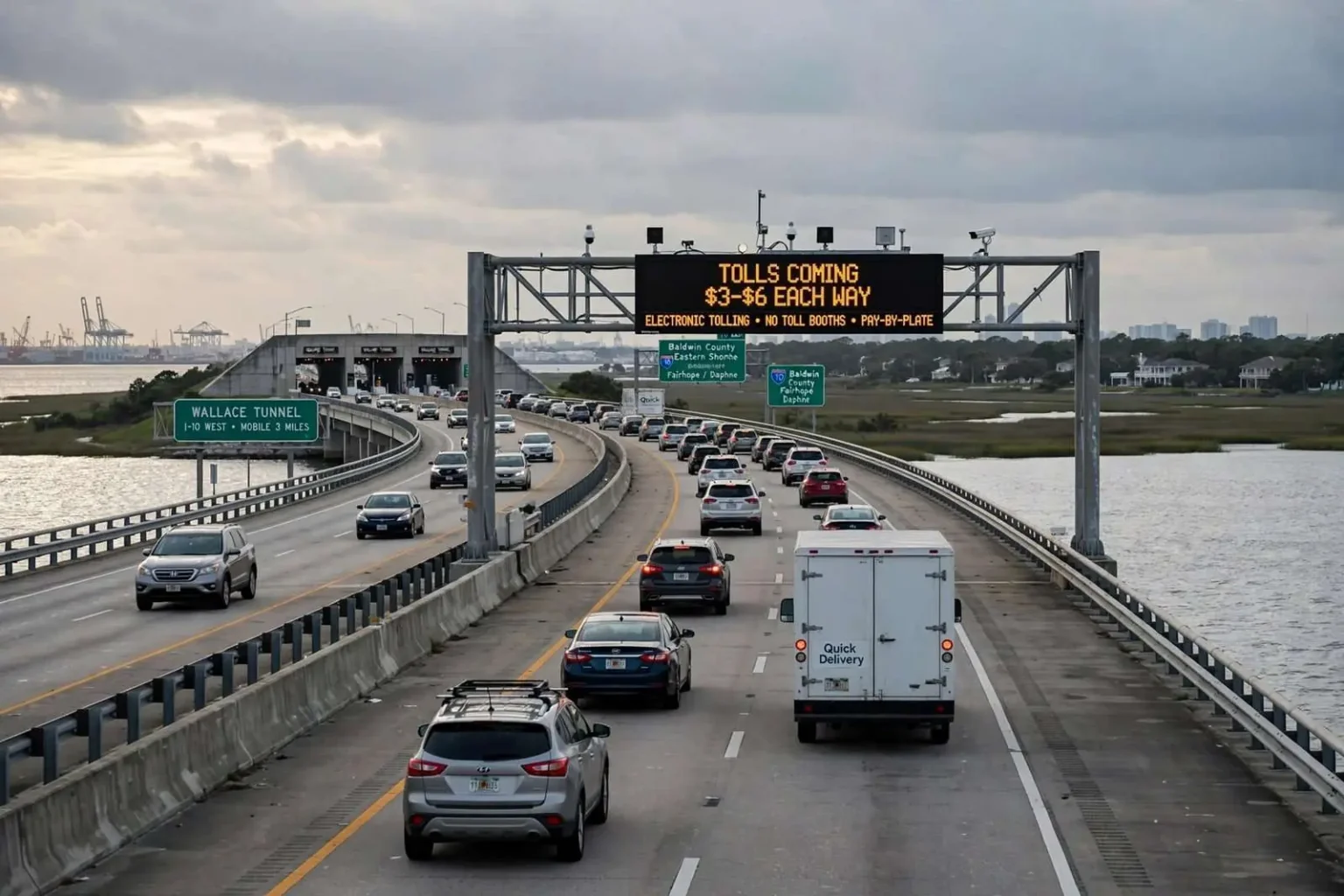
Plans to toll two of the Gulf Coast’s busiest commuter crossings are drawing sharp pushback from the families and small businesses that cross Mobile Bay every day. The Mobile River Bridge and Bayway project would place tolls on the Bankhead and George Wallace tunnels and the Bayway — the I-10 corridor linking Mobile with Baldwin County’s Eastern Shore — and residents on both sides of the bay say the charges would reshape their household and business budgets overnight.
Under the proposal, a single commute could run $3 to $6 each way. For a daily round trip, that adds up to roughly $1,500 to $3,000 a year — the equivalent of a car payment or a season of utility bills, drawn directly from the budgets of the workers, students and retirees who move between Mobile and Baldwin County’s fast-growing Eastern Shore communities.
Families feel it first
Ashlyn Hale, a Baldwin County resident who drives across the bay every day for work, said the money is already tight in her household. Asked what the tolls would do to her budget, her answer was blunt: “completely ruin it.” She said she would probably have to take a second job just to absorb the cost — a calculation, she noted, that trades time at home for the privilege of getting to work the same way she always has.
Her situation is a common one. Thousands of Eastern Shore residents commute west every morning into Mobile for jobs, medical appointments and school runs, and the reverse flow brings Mobile residents to Baldwin County’s businesses and beaches each day. The Bayway and the two river tunnels are the only direct interstate links between the two counties, leaving commuters with no untolled interstate alternative.
Commuters describe the arithmetic in stark terms. At the upper end of the proposed range, a year of round-trip tolling approaches three thousand dollars — for many working families, the difference between covering an emergency expense and falling behind on one. Opponents say those figures fall hardest on workers whose jobs do not come with relocation flexibility: nurses, dockworkers, teachers and service employees whose wages are set long before a tolling schedule would arrive.
Small businesses pass costs along
The burden doesn’t stop at commuters. Delivery companies that shuttle trucks back and forth across the Bayway daily face far larger totals, with commercial toll rates and multiple daily crossings multiplying the per-trip charge into a substantial annual expense.
Michael Bernard of Quick Delivery said his company would have little choice but to pass the expense on: “We have to raise freight costs on shipping.” For businesses built on thin margins, the toll becomes a line item that eventually reaches every customer — grocers, restaurants, contractors and retailers who would absorb higher delivery fees on goods crossing the bay.
Business owners on both sides of the bay worry about the competitive effect as well. Baldwin County’s growth has fed Mobile’s economy and vice versa, and merchants fear that a tolled crossing would push shoppers toward destinations on their own side of the water — splitting a commercial relationship that has historically treated the two counties as one market.
What the project would build
The Mobile River Bridge and Bayway project is the Alabama Department of Transportation’s answer to a corridor that has outgrown its mid-century infrastructure. The George Wallace and Bankhead tunnels, bored under the Mobile River generations ago, funnel interstate traffic through narrow twin tubes with limited heights, while the Jubilee Parkway — the Bayway — carries I-10 on a low-lying bridge span across the northern edge of Mobile Bay.
ALDOT’s proposal calls for a new river crossing with far greater clearance, wider lanes and expanded capacity along the Bayway, aimed at breaking the congestion that chokes the corridor during rush hour, port surges and Mardi Gras weekends. Planners argue that the bridge’s cost cannot be covered by conventional highway funding alone, making tolls the mechanism to finance construction and maintain the expanded route.
Tolling officials have pointed to electronic tolling and pay-by-plate passes as ways to keep traffic moving, arguing that free-flowing toll collection avoids the cash plazas and queueing that older toll systems created. Under the design described, vehicles would pass under gantries that read transponders or photograph plates, with no stopping required.
The congestion problem is real
Residents acknowledge the corridor’s problems even as they reject the proposed remedy. The crossings already back up at rush hour — a frustration the new charges would only compound, critics say, if tolled traffic pushes other drivers onto local streets and detours around the bridges. Exhaust idling in the tunnels, fender benders in the congestion and the daily unpredictability of the crossing have been documented complaints for years.
Eastern Shore officials have watched the corridor’s growth outpace its capacity as Baldwin County’s population climbs. Daphne, Spanish Fort and Fairhope have absorbed decades of suburban expansion while their residents’ employment and healthcare ties to Mobile deepened, making the I-10 crossing a daily necessity rather than an occasional route.
Opponents counter that a solution designed to fix congestion should not depend on pricing out the workers who create it. They argue that tolling would split the corridor into paid and free users, with those least able to pay forced into the same old tunnels the project was meant to relieve — only now with heavier volumes of diverted traffic.
The timeline ahead
The project targeted implementation of the tolls within about six years, a window that gives commuters and businesses time to plan but does little to soften the sticker shock. For families like the Hales, the question is not whether the bridge gets built but what the crossing will cost by the time the first toll gantry goes live.
The proposed rates — $3 to $6 each way — would place the Mobile Bayway among the more expensive toll crossings in the Southeast, and critics note that regional planners elsewhere have used lower commuter rates, discount programs or toll caps to cushion daily users. Whether Alabama’s program would include such accommodations remained a central question for the households the tolls would touch most.
Public hearings on the plan have drawn the kind of crowds that signal a defining local issue. Eastern Shore residents, Mobile businesses and trucking interests have lined up to question the rates, the revenue projections and the fairness of financing a public corridor through charges on its heaviest users.
What the tolls would mean for the region
The stakes extend beyond individual budgets. The I-10 corridor is the commercial spine of the central Gulf Coast, carrying freight from the Port of Mobile, beach traffic from Florida, and the daily interchange between Alabama’s second-largest metro area and its fastest-growing county. Any change to how that corridor is priced ripples through shipping rates, tourism decisions and commuting patterns across two counties.
Supporters of the project frame the toll as the price of a modern crossing the region cannot otherwise afford — congestion relief, hurricane evacuation capacity and safety improvements funded by those who use the road most. Opponents frame it as a tax on a daily habit, one that would fall unevenly on working families while through-traffic and freight pay their share and move on.
For now, the debate continues with the timeline running. Within about six years, the corridors that carry Ashlyn Hale to work and Michael Bernard’s trucks to their customers would begin charging for the passage they now provide free — and the households and businesses of coastal Alabama are already counting what that passage would cost them.
A corridor built generations ago
The infrastructure at the center of the debate dates to a different era of Gulf Coast transportation. The Bankhead Tunnel opened under the Mobile River in the early 1940s, a landmark of its time that carried U.S. routes beneath the river’s shipping channel. The George Wallace Tunnel followed decades later as part of the interstate build-out, twin bores that connected I-10 across the river and became as recognizable to Mobile drivers as any skyline.
The Jubilee Parkway, known to every local driver as the Bayway, extended the interstate across the bay to Baldwin County on a low concrete span named for the rare “jubilee” phenomenon that sometimes drives sea life ashore on the Eastern Shore. Together, the tunnels and the span formed the only interstate path between Alabama’s two coastal counties — and for nearly half a century they have carried far more traffic than their designers imagined.
That history explains both the congestion and the cost of fixing it. Crossing a working river with a busy port means building either deep tunnels or a high bridge, and both carry price tags in the hundreds of millions of dollars. The proposed Mobile River Bridge would clear the port’s ships by design, replacing the constraint of tunnel heights with a crossing tall enough for the largest vessels that call at Mobile.
How neighbors elsewhere have handled it
Gulf Coast commuters can look to neighboring states for previews of tolling debates. The region’s larger metros — New Orleans, Tampa, Jacksonville — have lived with tolled crossings for decades, and their experiences shape the arguments on both sides here: tolls financed new crossings and maintained old ones, but discount programs and exemptions became the political currency that made tolling tolerable to daily users.
That precedent cuts both ways. Toll authorities elsewhere have offered resident discount plans, transponder incentives and frequent-user caps, accommodations that Alabama’s program could adopt. Critics of the Mobile River Bridge plan say those details matter more than the headline rates, and they have pressed officials to commit to commuter protections before construction begins rather than after.
Trucking and freight interests, meanwhile, calculate the effect differently: commercial tolls on the corridor would touch nearly everything that moves through the Port of Mobile or between the two counties by road. Bernard’s point about raising freight costs reflects an industry reality — tolls are never absorbed quietly, and every carrier that crosses the Bayway daily will reprice its routes accordingly.
Between now and the first toll
The six-year implementation window leaves room for the plan to evolve — through hearings, legislative attention and the financing decisions that will set the final rates. Commuters have already begun organizing around the issue, and the households that would pay the most have made their position plain in every forum where the project has been discussed.
For Ashlyn Hale and drivers like her, the proposal reduces to a weekly bill where none exists today: five days of round trips at rates that could reach twelve dollars a day. For Michael Bernard and his competitors, it is a new cost of doing business on a corridor with no detour that avoids it. And for the planners who proposed the project, it is the financing mechanism for the largest transportation fix the region has seen in generations.
The crossings will remain free until the tolls arrive, and the debate over what happens then — who pays, how much, and with what relief — will continue in city halls, public hearings and driver’s seats across the bay until the first gantry switches on.