
Conde Cavaliers Bring the Parade to Students Who Can’t Make It to Mardi Gras
Before Friday night's parade, the Conde Cavaliers brought Mardi Gras to Augusta Evans School students who can't attend downtown.
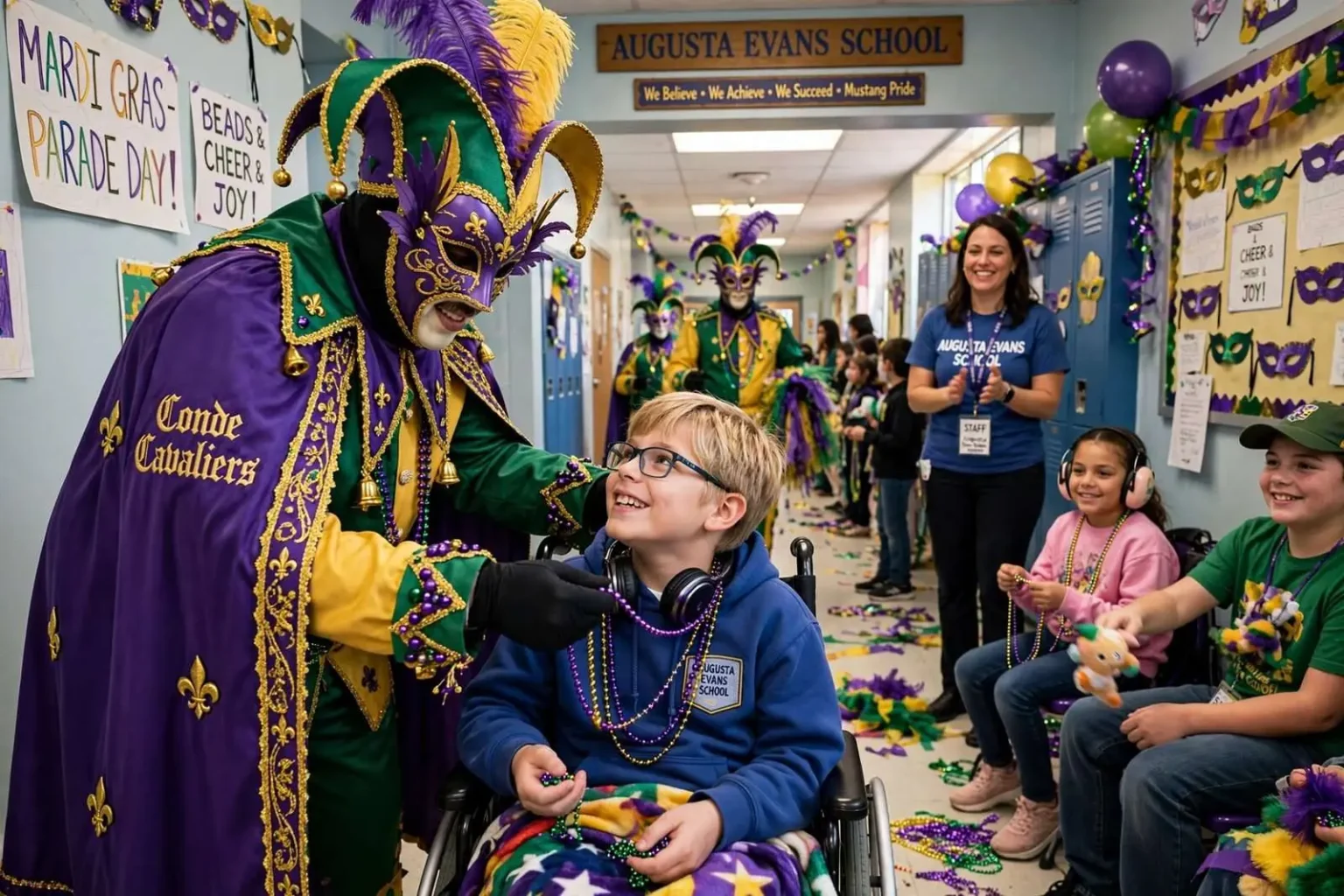
Hours before their Friday night parade rolled through downtown Mobile, the Conde Cavaliers staged a much smaller procession — through the halls of Augusta Evans School, parading for students who might never get to see them downtown.
The mystic society has made the visit an annual tradition, bringing the parade to the school’s special needs students so that every child gets a taste of carnival season, beads and all. Masked members in costume walked the school’s corridors, throwing throws to students lined up along the hallway, accompanied by the music and energy that fills the streets on parade nights downtown.
The tradition of bringing Mardi Gras to the school
“This means everything for us,” said one masked member. “This is why a lot of us do this, to give back to the community. These babies can’t go to Mardi Gras. We want to come to them and spread the cheer.”
That sentiment captures why the visit has become a fixture on the Conde Cavaliers’ calendar. Augusta Evans School serves Mobile County students with significant intellectual and physical disabilities, and for many of them the sensory intensity of a downtown parade — the crowds, the noise, the crush of people along Government Street — makes attending unrealistic. The in-school parade compresses the experience to its essentials: masks, music, colors, throws and the delight of catching beads from someone in costume.
Augusta Evans School
Augusta Evans School has served Mobile County’s special needs students for decades, operating as the district’s dedicated center for children whose needs exceed what traditional campuses can support. The school’s students range widely in age and ability, and its programs focus on life skills, communication and individualized instruction. School-wide events like the carnival visit give students the shared cultural experiences that other students pick up through ordinary community life — experiences that require adaptation for Evans’ population.
The hallway parade format is that adaptation. Teachers and aides position students where each can see and participate, the procession moves at a pace every student can follow, and the throws come directly to each child rather than arcing over a crowd. Staff members describe the excitement building through the morning, with students wearing beads and costumes of their own.
The Conde Cavaliers
The Conde Cavaliers are one of Mobile’s longstanding mystic societies, part of the carnival tradition that Mobile claims as the oldest in the United States — predating New Orleans by more than a decade and a half. The society parades downtown on the Friday night before Mardi Gras, rolling through the downtown streets with floats, masked members in costume and throws. Its membership, like that of Mobile’s other societies, is made up of Mobilians who spend the year preparing for a few weeks of parades.
Societies across Mobile have developed their own community traditions beyond the parades themselves — visits to hospitals, schools and children’s organizations — reflecting the carnival season’s deep roots in the city’s civic life. The Cavaliers’ annual stop at Augusta Evans is among the most established of these, and members describe it as among the most rewarding stops of the season, precisely because the audience receives the parade so completely.
Mobile’s carnival season
Mobile’s Mardi Gras season stretches from weeks before Ash Wednesday through Fat Tuesday, with dozens of parades staged by mystic societies across the city and the surrounding communities. The season is the city’s signature cultural event, drawing families downtown nightly during its peak and anchoring a tradition of mask societies, floats and throws that goes back to the early 18th century. Schools teach the history, families claim their spots along the routes years in advance, and the societies’ preparations run all year.
For the students of Augusta Evans, the hallway parade is their piece of that season — timed for the hours before the Cavaliers’ downtown roll, so the members travel from one kind of parade to another in a single evening. The contrast is stark: downtown, thousands of people compete for throws; at the school, each throw lands in the hands of a child who has been waiting for it all morning.
What the visit means
The members’ own words explain the tradition’s endurance. Giving back to the community, spreading the cheer, coming to children who cannot come to the parade — these are the reasons members give for spending an afternoon in masks inside a school hallway before an evening in the streets. For the school’s students and staff, the visit delivers the season’s excitement in a form they can receive fully, and for the society, it delivers the purest version of what the parades are for.
The Friday night parade downtown followed on schedule, as it does every year. But the smaller parade that preceded it — beads, masks and all, through the halls of Augusta Evans — remains, for the Cavaliers and the school alike, one of carnival season’s most meaningful moments.
The Cavaliers’ visit also sits within a broader understanding of what special education events can accomplish. Educators at schools like Augusta Evans design experiences that give students participation in community life rather than observation of it, and the parade’s structure — repetition, music, predictable sequence, direct interaction — fits what their students respond to best. Sensory-friendly adaptations of community events have become standard practice across the country, and Mobile’s version of it happens each year when a mystic society decides its carnival tradition belongs to everyone in the city.
The annual rhythm matters as much as the event itself. Students who experience the parade in kindergarten, first grade and beyond come to know it as part of their year, something to anticipate and remember. Teachers build the day into classroom activities — counting beads, choosing colors, making masks — so the visit becomes an extension of instruction as well as celebration. Families hear about it from their children, and the school community marks carnival season with the same excitement any Mobile school does, adapted to its students.
How the visit unfolds
On parade morning, the school’s hallways become the route. Members arrive in costume and mask, some accompanied by music, and process from one end of the building to the other as students line the halls with their classes. The throws — beads, cups, plush toys, the staples of every Mobile parade — come hand to hand rather than through the air, so every child catches something. Staff take photographs, students wave, and the members high-five and pose their way down the line.
The entire visit runs on the scale the school’s students can absorb: shorter than a downtown parade, quieter than a float route, but complete in its essentials. Members describe the students’ reactions as the reward — the laughter, the outstretched hands, the children who want to touch the mask or hold onto a member’s gloved hand. For a society whose members spend the season behind masks, the school visit is where the costume does its gentlest work.
Mystic societies and civic giving
Mobile’s mystic societies have long histories of civic contribution beyond their parades. The societies fund scholarships, support local charities, open their balls for community fundraising, and schedule appearances at hospitals, schools and senior centers throughout the season. The pattern reflects the societies’ place in Mobile society: they are civic institutions whose membership spans the city’s business, professional and family life, and their carnival season activity has always carried a public-spirited dimension alongside the celebration.
The Augusta Evans visit embodies that dimension. The society’s members give their afternoon, their costumes and their throws to an audience that can never fill a downtown balcony or fight for beads on Royal Street. In exchange, the members say, they receive the visit’s meaning — the reason many of them joined a society in the first place.
Carnival season as a shared inheritance
Mobile treats carnival as a shared civic inheritance, and events like the Cavaliers’ school visit extend that inheritance to every corner of the city. Children who grow up in Mobile absorb the season regardless of their circumstances: the parades pass their neighborhoods, the schools teach the traditions, and societies like the Cavaliers bring the celebration to those who cannot come to it. The result is a season that belongs to the whole city, not only to the crowds downtown.
For Augusta Evans’ students, the beads they carry home on parade day are the same throws their neighbors catch on Government Street — a small object with the same meaning, received in the place where they learn. That equivalence is the visit’s whole point, and the reason the tradition has lasted as long as it has.
Hours later, the Conde Cavaliers rolled downtown as scheduled, masks and floats and throws under the Friday night lights. But the day’s first parade had already done its work across town, spreading the cheer where it was brought — hall by hall, bead by bead, to students who could not go to Mardi Gras, so Mardi Gras came to them.