
Councilman’s Delay Holds Up $200,000 for New 15 Place and Waterfront Rescue Mission Shelter
A councilman's delay held up $200,000 in federal money for a new joint 15 Place and Waterfront Rescue Mission shelter near Broad Street.
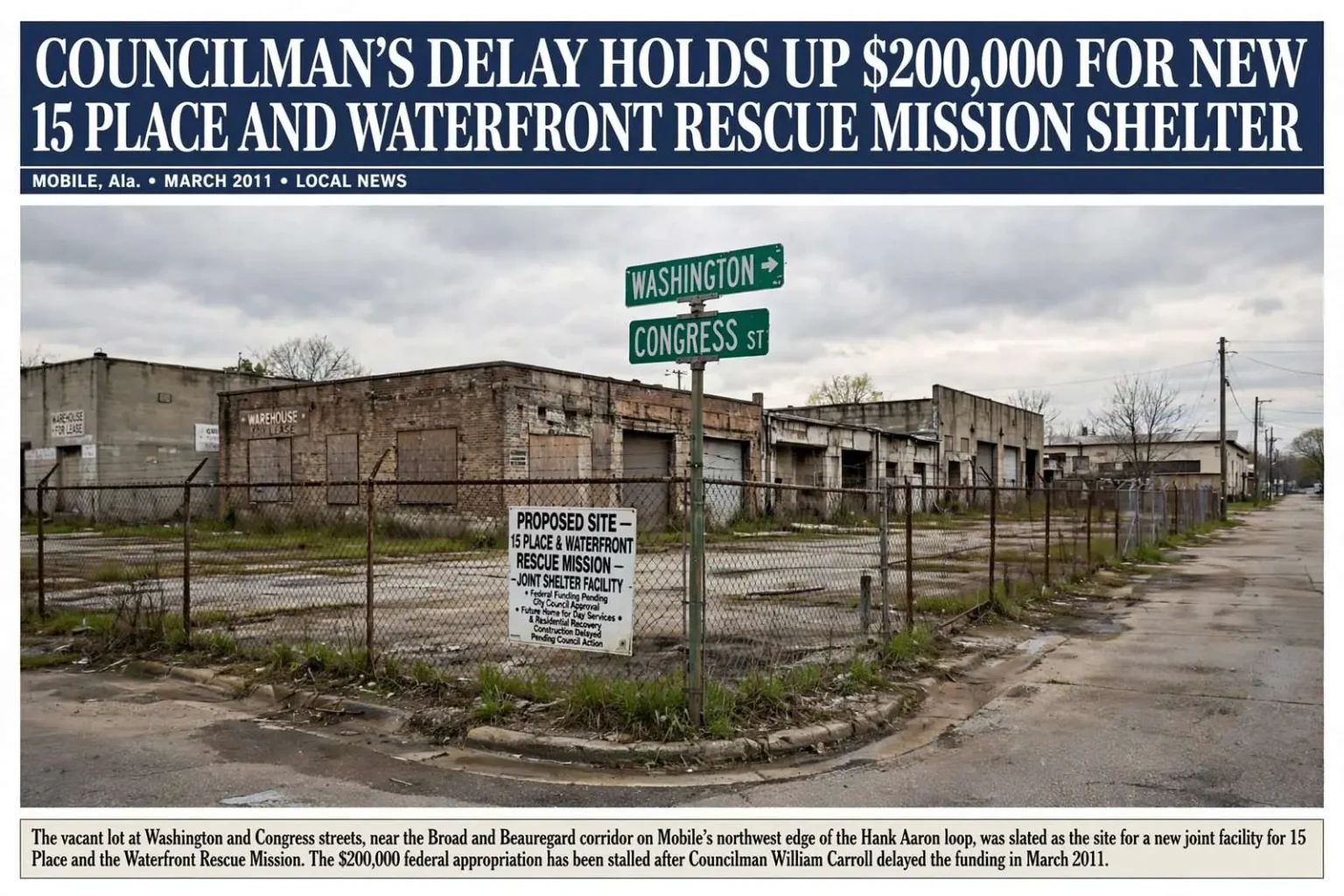
MOBILE, Ala. — A plan to build a new joint facility for two of Mobile’s frontline homeless service providers, 15 Place and the Waterfront Rescue Mission, stalled in March 2011 after Councilman William Carroll delayed a $200,000 federal appropriation for the project, according to reports in Lagniappe and the Press-Register. The delay left a project that had been years in the making suspended between city hall politics and the daily realities of the people both organizations serve.
The proposed purpose-built shelter was slated for Washington and Congress streets, near the Broad and Beauregard corridor on the northwest edge of the Hank Aaron loop. The site was chosen deliberately. Both organizations said their existing quarters were inadequate, and each for a different reason that illustrates the awkward position homeless services often occupy in a city’s geography.
Two Agencies, One Shared Problem
15 Place, the city-supported day center for people experiencing homelessness, operated out of overflow space never designed as a shelter. Its location sat just off Dauphin Street in the heart of the LoDa entertainment district, where the Saturday-night foot traffic of bars and restaurants collided with the daytime realities of a homeless services center. The mismatch put strain on the organization and on its neighbors alike, and it made the case for relocation that advocates had been making for years.
The Waterfront Rescue Mission, a faith-based ministry that has served the Gulf Coast for generations, provides beds, meals, and recovery programs for men in need. Its own facilities carried similar limitations. By combining forces on a single purpose-built facility, the two organizations aimed to pool their strengths: the mission’s residential and recovery work alongside 15 Place’s daytime services and connections to benefits, identification, and housing programs.
Joint facilities of this kind have become a common strategy for mid-sized cities like Mobile. Rather than scattering services across downtown, a consolidated campus lets a client see a caseworker, take a shower, eat a meal, and meet with a housing specialist in one trip. For people without transportation, that consolidation is often the difference between getting help and falling through the cracks.
A Site Chosen for Work, Not Nightlife
The Washington and Congress streets location reflected that service philosophy. The new site would have put the facility closer to industrial employers and temporary job agencies — the first rung on the ladder for many people coming out of homelessness — and farther from downtown bars. Planners and service providers have long argued that proximity to day labor and entry-level employment matters more to a shelter’s success than almost any other siting factor, because the path out of homelessness usually runs through a paycheck.
Little else bordered the site but vacant industrial buildings, a fact that would later become part of the debate. To the organizations and city planners, the emptiness was a feature: services would be near jobs without sitting next to schools, churches, or residential blocks. To critics, the site’s surroundings became a talking point about concentrating services in a part of town that lacked residential voices to push back.
The Objection That Stalled the Money
Carroll’s delay came after area residents, including the Dearborn YMCA, said they had not been adequately notified of the project — despite prior coverage in the Press-Register and announcements on city and neighborhood websites. The objection was procedural rather than substantive on its face, but in municipal politics, process disputes are often where projects live or die.
The $200,000 in question was federal money appropriated for the project, the kind of community development funding that flows through city budgets and requires council action to move. A councilman who objects to a project has limited formal tools, but delay is one of them, and Carroll used it. A one-week delay, on its own, drew little objection from supporters of the shelter; the concern, expressed openly at the time, was that a short pause would stretch into something indefinite, the way many contested projects in the city had before it.
The Dearborn YMCA’s involvement in the objection underscored the sensitivities around siting homeless services. Institutions that serve neighborhoods invest heavily in their surroundings, and they argue — not without reason — that they have a stake in what opens next door. Service providers, for their part, countered that facilities like the planned shelter are good neighbors by design, operating with staff, security, and schedules in a way that abandoned industrial buildings never do.
15 Place itself carried a history worth remembering in the debate. Created as a partnership among city government, churches, and social service agencies, the center grew into the central intake point for homeless services in the city. Over the years it had helped clients obtain identification documents, apply for disability and veterans benefits, connect with mental health treatment, and find their way into transitional and permanent housing. The Waterfront Rescue Mission’s roots ran deeper still, its rescue-mission model of beds, meals, and ministry dating back generations along the Gulf Coast. Between the two organizations, Mobile’s safety net for people on the street had more institutional memory than most cities of comparable size, even if its buildings told a different story than its mission statements.
The Mayor Draws a Line
Mayor Sam Jones, however, said the project would move forward regardless of the council dispute. The mayor’s position put the weight of the administration behind the shelter, signaling that the city saw the relocation not as a favor to a particular district but as part of a broader strategy for how Mobile handles homelessness.
That stance mattered because cities across the country were rethinking homeless services in this era. Federal policy had been shifting for years toward the “housing first” model and toward regional coordination, pressing communities to move people into shelter and housing quickly rather than managing them on the street. Mobile’s shelter capacity, and where that capacity sits, were pieces of that larger puzzle. A purpose-built joint facility was intended to be a step up in both quality and dignity from overflow space never meant for the purpose.
The dispute also illustrated a recurring tension in city government: money for homeless services is usually popular in principle and contested in placement. Every council district wants the services delivered; few want the facility sited on their block. When the district in question is represented by a councilman willing to slow the appropriation, the project’s schedule becomes hostage to that negotiation.
What Happens Next
The City Council was scheduled to revisit the matter at its Tuesday meeting, giving the project a near-term test of whether the delay would indeed prove to be the one-week pause supporters were willing to accept, or the indefinite stall they feared. The outcome would determine whether design and construction work could proceed on the Washington and Congress streets site or whether the organizations would have to keep making do with inadequate quarters.
For the people 15 Place and the Waterfront Rescue Mission serve, the stakes were concrete. A day center in the wrong location shapes a person’s entire routine: where they eat, where they sleep, how far they walk to a job interview, and how they are treated on the street where the facility sits. Advocates for the project argued that moving services closer to employers and away from the entertainment district was not a concession to anyone’s comfort but a straight improvement in the odds that clients find work and housing.
For the broader Mobile community, the episode was a case study in how local government balances process and urgency. Notification requirements exist to give neighborhoods a voice, and the Dearborn YMCA and area residents were within their rights to demand one. But the providers and the mayor’s office argued the notification had effectively already happened — in the newspaper, on the city’s website, and through neighborhood associations — and that re-litigating it served mainly to delay help for people with none to spare.
Whichever way the council went on Tuesday, the underlying facts were not in dispute: Mobile’s two frontline homeless organizations were operating in facilities never built for their work, a suitable site had been identified near the jobs their clients need, and federal money had been secured to build. The open question was political — whether a single councilman’s delay would hold up $200,000 that had already been appropriated, and what that would say about how Mobile welcomes both its service providers and the people they serve.
As the council prepared to take the matter up again, supporters of the shelter had a simple ask: let the project move. Opponents wanted nothing more elaborate than a genuine hearing. Between those two positions sat a vacant, industrial stretch of Washington and Congress streets, waiting to find out whether it would become a doorway back to stability for the people it was meant to serve — or remain, like so much around it, empty.


