Crescent Theater to Host 2014 Student Film Showcase During Arts Alive
The Crescent Theater hosts the 2014 Student Film Showcase on April 12 with screenings at noon and 4 p.m. during Mobile's Arts Alive Festival.
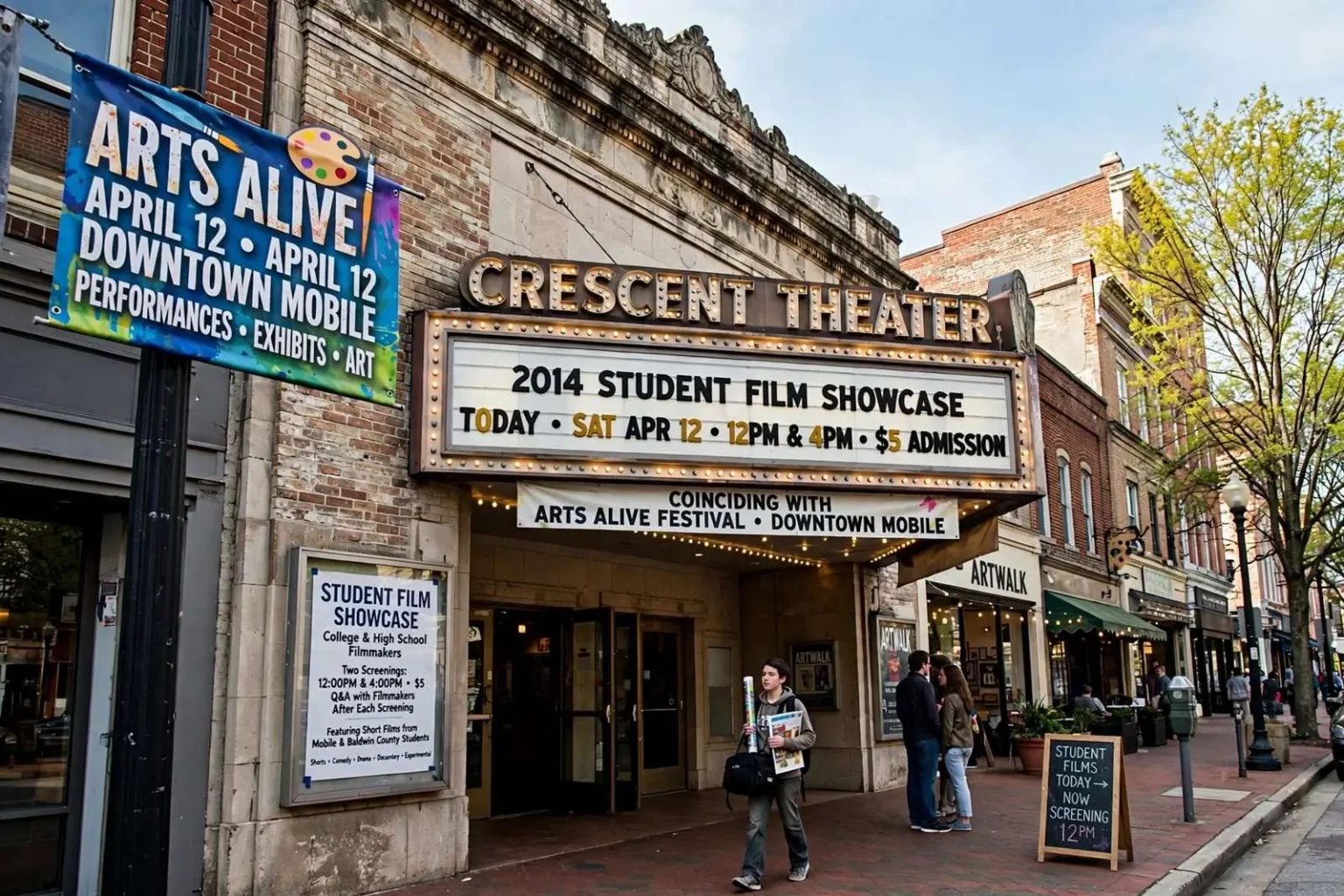
The Crescent Theater will host the 2014 Student Film Showcase on Saturday, April 12, giving area student filmmakers a rare chance to see their original work projected on the big screen in downtown Mobile. Screenings are scheduled for noon and 4 p.m., and admission is $5. The event coincides with the Arts Alive Festival, the annual celebration that fills downtown Mobile with performances, exhibits and interactive art each spring, and it offers film lovers a full day of programming built entirely around the work of students from colleges and high schools across the region.
The showcase grew out of a simple problem: student filmmakers in the Mobile area produce short films every semester, but few venues exist where that work can be seen outside a classroom. Campus screenings draw fellow students, and online uploads reach scattered audiences, yet neither experience matches the reaction a film draws from a packed theater. By opening the Crescent’s doors to student work, organizers created a professional setting with proper projection and sound, complete with an audience of strangers, friends and family members whose responses are the truest test of whether a story lands.
Submissions came from both college and high school filmmakers, a mix that gives the program an unusual range. Older students tend to bring more technically polished work, often produced with crews of classmates and equipment from university media programs. High school entries are frequently scrappier, but they often carry the raw ambition that festival programmers find appealing. Programming the two age groups into a single showcase allows an afternoon audience to watch the progression from first experiments to more assured storytelling, and it gives younger filmmakers a visible target to aim for as they keep working.
A Theater With Deep Roots in Downtown Mobile
The Crescent Theater has long been a fixture of Dauphin Street, the main artery of downtown Mobile’s entertainment district. Located in the heart of the historic Lower Dauphin commercial district, the theater has built a reputation as an independent cinema willing to book films that multiplexes ignore: documentaries, regional productions, festival acquisitions and repertory favorites. For a city whose downtown was steadily rebuilt over the past two decades, the Crescent is a signature part of that story, proving that a small art house can survive and thrive between the bars, restaurants and galleries that draw crowds on weekends.
That character makes the theater a natural partner for the Arts Alive Festival. The event spreads artists and performers across downtown venues each year, and the Crescent’s single-screen intimacy suits the student showcase format well. Unlike a sprawling multiplex, the Crescent puts nearly every seat close to the screen, so a short film’s comedic timing, quiet dialogue or unsettling imagery registers with the whole room at once. Filmmakers scheduled to attend the screenings typically introduce their work and answer questions afterward, turning the program into a conversation about craft rather than a passive viewing experience.
The $5 admission price keeps the event accessible, an intentional choice for a showcase tied to student work. Organizers want families, classmates and curious passersby walking along Dauphin Street during Arts Alive to feel they can step inside without a second thought. The modest ticket also supports the theater’s role as a community venue, the kind of operation that depends on steady local attendance rather than national studio blockbusters to keep its doors open.
Why Student Showcases Matter to a Regional Film Scene
Showcases like this one serve as an early rung on a ladder that matters more than many residents realize. Alabama’s film production activity has grown in recent years, aided by state incentives designed to bring productions to locations across the Gulf Coast, and every growing production economy needs experienced local crew, actors and writers. The path to that experience begins with students finishing their first short films, submitting them to festivals, and learning how their work plays in front of a live audience. Regional showcases feed that pipeline, and Mobile’s proximity to New Orleans and Atlanta’s larger production markets makes the timing especially meaningful for students weighing whether to stay in Alabama and build a career.
For the filmmakers themselves, seeing a film in a theater changes how they understand their own work. Classroom viewing compresses images onto laptops and mutes sound design into earbuds, hiding the choices a director made about framing, color and audio. A theatrical screening restores those elements. It also teaches the harder lessons: jokes that die in a room full of strangers, pacing that feels slow on a big screen, or the opposite thrill of a story that holds the crowd completely still. Those lessons are difficult to simulate and inexpensive to learn at a student showcase.
The April 12 date also puts the showcase at the center of Arts Alive, when downtown foot traffic is at its heaviest. Visitors moving between mural sites, gallery pop-ups and stage performances can catch either the noon or the 4 p.m. screening without reshaping their day. For families with high school students interested in media production, the earlier screening doubles as an informal recruiting event, letting them talk with college-level filmmakers about programs, equipment and the practical realities of making films in south Alabama.
What to Expect at the Screenings
Audiences attending the student showcase can expect a varied program rather than a single genre. Student short-film compilations typically mix comedy, drama, documentary and experimental pieces, partly because submissions vary and partly because variety keeps the pace brisk. Shorts run from a few minutes to perhaps twenty, so no single weak entry drags down the program, and strong pieces often leave the audience wanting more from a director whose name they are seeing for the first time. The two screening blocks, at 12 p.m. and 4 p.m., give attendees a choice between an afternoon session and a late-afternoon program before the evening’s Arts Alive activities take over the street.
The showcase also functions as a snapshot of the region’s creative health. When students from Mobile and Baldwin County schools, along with area colleges, submit films year after year, it signals that media education programs are producing work worth showing and that a local infrastructure exists to show it. Venues like the Crescent, festivals like Arts Alive, and events like the student showcase form a modest but real ecosystem: a place to learn, a place to screen, and an audience willing to pay five dollars to watch hometown students take their first bow. For one Saturday in April, the big screen on Dauphin Street belongs entirely to them.
The Business of Keeping an Indie Theater Alive
Behind the showcase’s friendly atmosphere sits a harder reality that anyone who follows downtown Mobile understands: independent theaters survive on thin margins. National chains negotiate studio terms at scale, while a single-screen house like the Crescent depends on concessions, careful programming and community partnerships to cover the basics of rent, projection maintenance and staffing. Hosting events like the student showcase does more than fill seats on a Saturday afternoon; it introduces the theater to patrons who may not otherwise venture inside, some of whom return for the foreign films, documentaries and independent releases that anchor the Crescent’s regular schedule.
Downtown Mobile’s revival has been a slow, deliberate project spanning decades. City leaders and private investors pushed to restore historic storefronts along Dauphin Street, attract restaurants and live music venues, and convince residents that the city center was worth visiting after dark. Cultural anchors played an outsized role in that effort. The Saenger Theatre draws touring acts, galleries along the street open for ArtWalk nights, and the Crescent supplies the cinema experience that a walkable entertainment district needs. Each institution reinforces the others: dinner before a screening, a film before a show, a stroll past murals and storefronts in between.
Educators in the region have watched that growth with interest. Media production courses at area colleges and career-tech programs in the public schools have expanded as digital cameras and editing software have become affordable, which means more students than ever are capable of producing complete short films. What those programs cannot supply on their own is a public. A short film finished for a grade plays to a teacher and a handful of classmates; a short film finished for a showcase plays to hundreds of ticket buyers over two screenings. That difference is why teachers and professors encourage submissions, and why the Crescent’s partnership matters to schools well beyond downtown.
A Tradition of Arts Alive Energy
The Arts Alive Festival has grown into one of downtown Mobile’s signature spring events, pairing visual artists with live music, dance, theater and hands-on activities across multiple venues. Its programming philosophy has always emphasized access: most events are free or low-cost, artists demonstrate their processes rather than simply displaying finished work, and the schedule deliberately mixes established professionals with emerging talent. The student film showcase fits that philosophy exactly. It charges less than a movie ticket, runs at family-friendly hours, and treats students not as a novelty act but as working artists whose films deserve the same attention as any gallery piece.
That framing matters for the students involved. Presenting work at a real cinema during a citywide festival gives them a credit line they can carry into applications, portfolios and future festival submissions. A line reading “screened at the Crescent Theater during Arts Alive” tells a reviewer that the work passed a public test, not just a classroom one. For students considering film school or careers in the region’s growing production community, such early credentials compound over time.
For the broader audience, the showcase is simply one of the most distinctive events on the Arts Alive calendar. Between the noon and 4 p.m. screenings, visitors can explore the rest of the festival, then return to compare notes on which films stood out. The $5 price makes it easy to attend both sessions. And in a media environment where algorithms decide what most people watch, there is something quietly valuable about sitting in a darkened room on Dauphin Street, watching stories made by the students who live a few miles away, and being part of the applause they will remember.