Crews Battle Large Fire at Clarke County Landfill
Multiple fire departments battled a large landfill fire near Jackson in Clarke County, shuttling water to the scene as the cause remained undetermined.
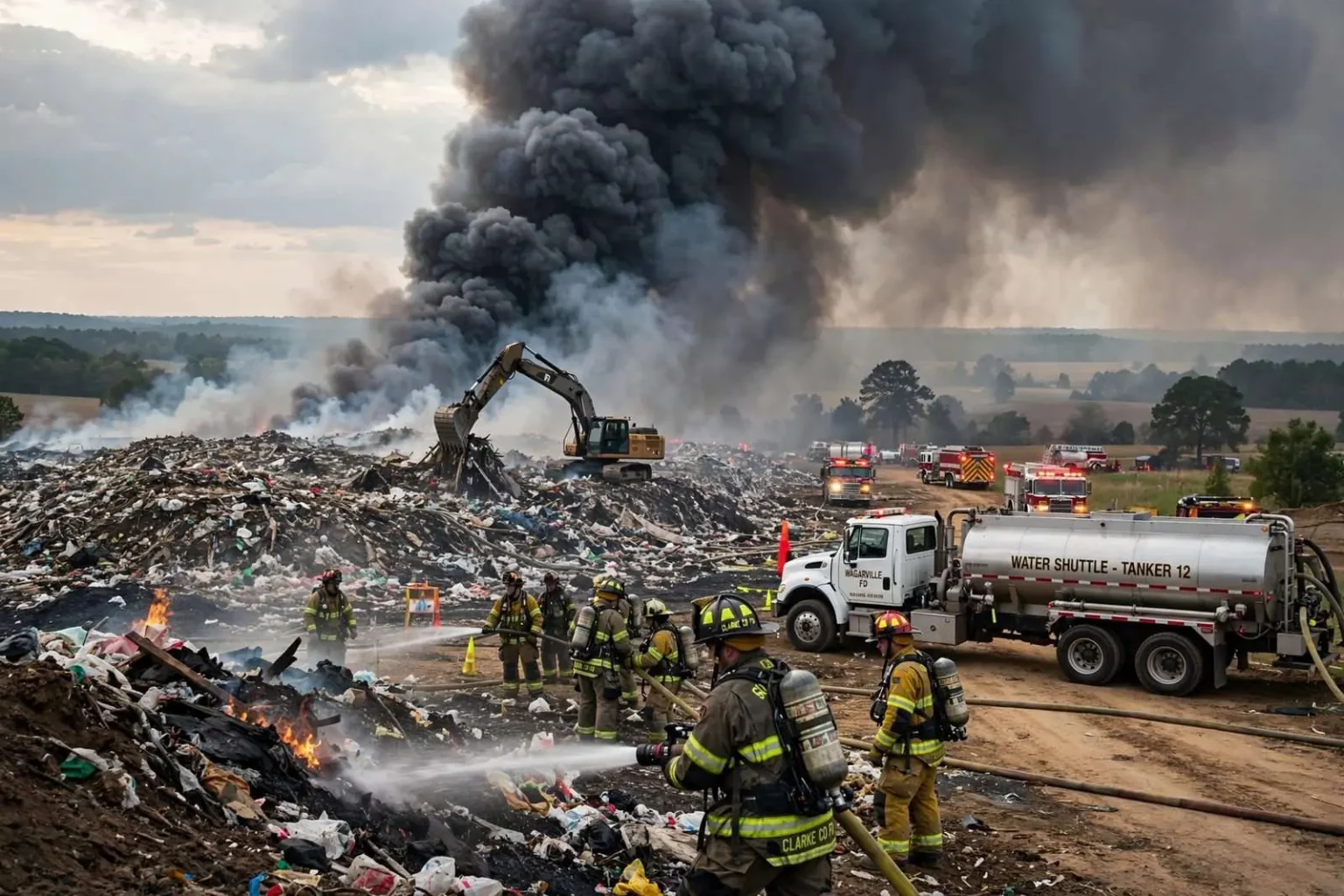
Firefighters from multiple departments spent hours working a large fire at a Clarke County landfill, sending a towering column of black smoke over the Jackson area that was visible for miles. The Jackson Fire Department said crews were still fighting the blaze late in the afternoon and that the cause had not been determined. Flames were reported shooting up from the burning refuse, with heavy smoke drifting across the area.
Landfill fires are among the most demanding calls a rural fire department can answer. Unlike a structure fire, which can be attacked directly with a steady water supply, a fire buried in compacted waste burns from the inside out, pushing smoke and heat through layers of refuse and resisting even aggressive hose lines. The scale of the Clarke County blaze — and the visibility of its smoke column across the area around Jackson — made clear early on that this would be an extended operation rather than a quick knockdown.
Water Hauled to the Scene
Because landfill sites sit well away from municipal water lines, crews set up a staging area and shuttled water to the fire as it was needed, a labor-intensive tactic common in rural firefighting. The method, known as a water shuttle, depends on tanker trucks making repeated runs between the fire scene and fill points such as hydrants, ponds or loading stations, sometimes for hours at a time. Every gallon that reaches the fire has to be hauled in, which makes water supply the central logistics problem of the entire operation rather than an afterthought.
The Wagarville fire chief said several departments responded to help. Mutual aid is the standard answer to that kind of demand in Clarke County, where volunteer departments cover large rural districts with limited manpower and rely on neighboring companies for tanker support, extra crews and relief. Coordinating those arrivals — where to stage tankers, how to rotate the shuttle, when to send tired crews home — is a job in itself, and it runs alongside the actual firefighting.
Hours on the Fire Ground
Despite the heat and the length of the operation, no heat-related injuries or illnesses among firefighters were reported. That outcome reflects deliberate rotation of crews and the rehabilitation practices that rural departments have increasingly adopted: keeping firefighters hydrated, pulling them off the line before exhaustion sets in, and monitoring them in shaded rehab areas between assignments. Fireground rehab matters even more at a landfill fire, where black smoke, reflected heat from burning refuse and heavy protective gear combine to push body temperatures up quickly.
Long operations also strain the volunteer system that protects most of Clarke County. Many of the responders are volunteers who left jobs and other obligations to answer the call, and an all-day fire means repeated shift changes and a steady pull on each department’s membership. The fact that the operation ran for hours without injuries says a great deal about the discipline of the crews involved.
Why Landfill Fires Burn So Long
Landfill fires can smolder deep in compacted waste and often take extended periods to fully extinguish, requiring heavy equipment to break apart burning material so water can reach it. Firefighters and landfill operators typically have to pull apart the burning face of the dump with excavators and dozers, spreading the waste so hose lines can penetrate layers that would otherwise shield smoldering material from water. Then the pile must be turned and re-checked, because hot spots buried inside can reignite days after the visible flames are gone.
That is why officials treat these fires as marathon events rather than sprints. Even after the smoke column collapses and the scene quiets down, departments often leave units on scene for continued monitoring, and operators keep watch over the footprint of the burn. The deep-seated nature of the fire also means the total water demand is enormous — often many times what a structure fire would consume — which reinforces the importance of the tanker shuttle that sustained this operation.
The Smoke and the Surrounding Area
The heavy smoke drifting across the Jackson area was more than a visual spectacle. Landfill smoke carries particulates and combustion products from plastics, treated wood, household chemicals and whatever else the waste stream contains, and health officials generally advise residents — especially those with respiratory conditions, children and the elderly — to limit exposure when smoke settles over populated areas. People downwind of a large landfill fire are usually asked to keep windows closed and to avoid outdoor exertion until the smoke clears.
Environmental oversight adds another layer to the aftermath. Landfills in Alabama operate under state environmental permitting, and operators of sites that experience fires are expected to coordinate with regulators on any environmental concerns that follow, from runoff during suppression efforts to lingering air-quality issues. Those steps happen away from the fire line, but they are part of why the end of visible flames does not mean the end of the incident for the site’s operators or for the county.
The visibility of the smoke column for miles also drew attention from across the county, with residents reporting the plume from surrounding communities. In rural Alabama, where a tall column of black smoke can mean a woods fire, a structure fire or an industrial incident, a blaze this size generated calls and questions well beyond the immediate area of the landfill. Emergency officials worked to keep the public informed while crews concentrated on the fire itself.
Cause Undetermined
Officials had not determined what started the fire. The possible ignition sources at a landfill range from accidentally discarded hot materials to equipment sparks and spontaneous combustion deep within decomposing waste, and determining the origin in a field of compacted refuse is far harder than in a building. Investigators typically wait until the fire is fully out and the site is safe to walk before they can begin any meaningful examination of the burn area.
Until that work is done, the fire remains an open question, and officials have not tied it to any specific activity at the site. What is certain is the operational picture: multiple Clarke County departments, hours of shuttle runs, heavy equipment and persistent heat — and a community that watched the smoke rise above Jackson while its volunteer firefighters worked the pile below.
Rural Firefighting in Clarke County
The response to the landfill fire illustrates how firefighting works across Clarke County, a heavily rural county of roughly 23,000 residents in southwest Alabama where Jackson serves as the county seat. Most of the county is protected by volunteer fire departments rather than career fire houses, and those departments depend on mutual-aid agreements, shared tankers and the willingness of neighbors to respond whenever the tones sound. A fire of this scale would overwhelm any single rural department, which is why the mutual-aid call went out early.
Rural departments also operate with an eye on cost and availability. Tanker shuttles, portable tanks and farm ponds substitute for hydrants across most of the county’s geography, and drills that sound routine — dumping a tanker, refilling it, keeping the loop moving — are the skills that keep a water supply alive at a remote scene. The landfill fire tested all of those systems at once, over an extended period, with the eyes of the county on the smoke.
What Comes Next
With the initial fire knocked down, attention shifts to the slower work of ensuring the landfill does not rekindle. Crews and site operators will continue to monitor the burn area, break apart any remaining hot spots and apply water as needed in the days that follow, since buried embers in waste can hold heat far longer than surface flames suggest. Officials have not announced a cause, and any determination will come only after the site is safe enough to examine thoroughly.
For residents around Jackson, the practical advice remains straightforward: be mindful of smoke in the air, report any new flare-ups or spot fires near the landfill rather than assuming someone else has called it in, and give fire apparatus room to move along the rural roads serving the site. The blaze was a reminder of both the risks that come with large waste-disposal sites and the capacity of the county’s volunteer fire network to answer a long, difficult call together.
Departments involved in the response logged hours that few outsiders ever see — loading and unloading tankers, rotating through rehab, managing hose lines across uneven ground — and they did it in heat, in smoke, without reported injury. As Clarke County waits on word of the cause, the operation stands as a case study in rural fire service endurance and mutual aid, and a reminder that when a landfill burns, the fight is measured in hours and days, not minutes.