
Crews Contain 44-Acre Wildfire at Gulf Islands National Seashore’s Naval Live Oaks
Crews from five agencies contained the 44-acre Jackson Fire at Gulf Islands National Seashore's Naval Live Oaks area, with no injuries or structure damage.
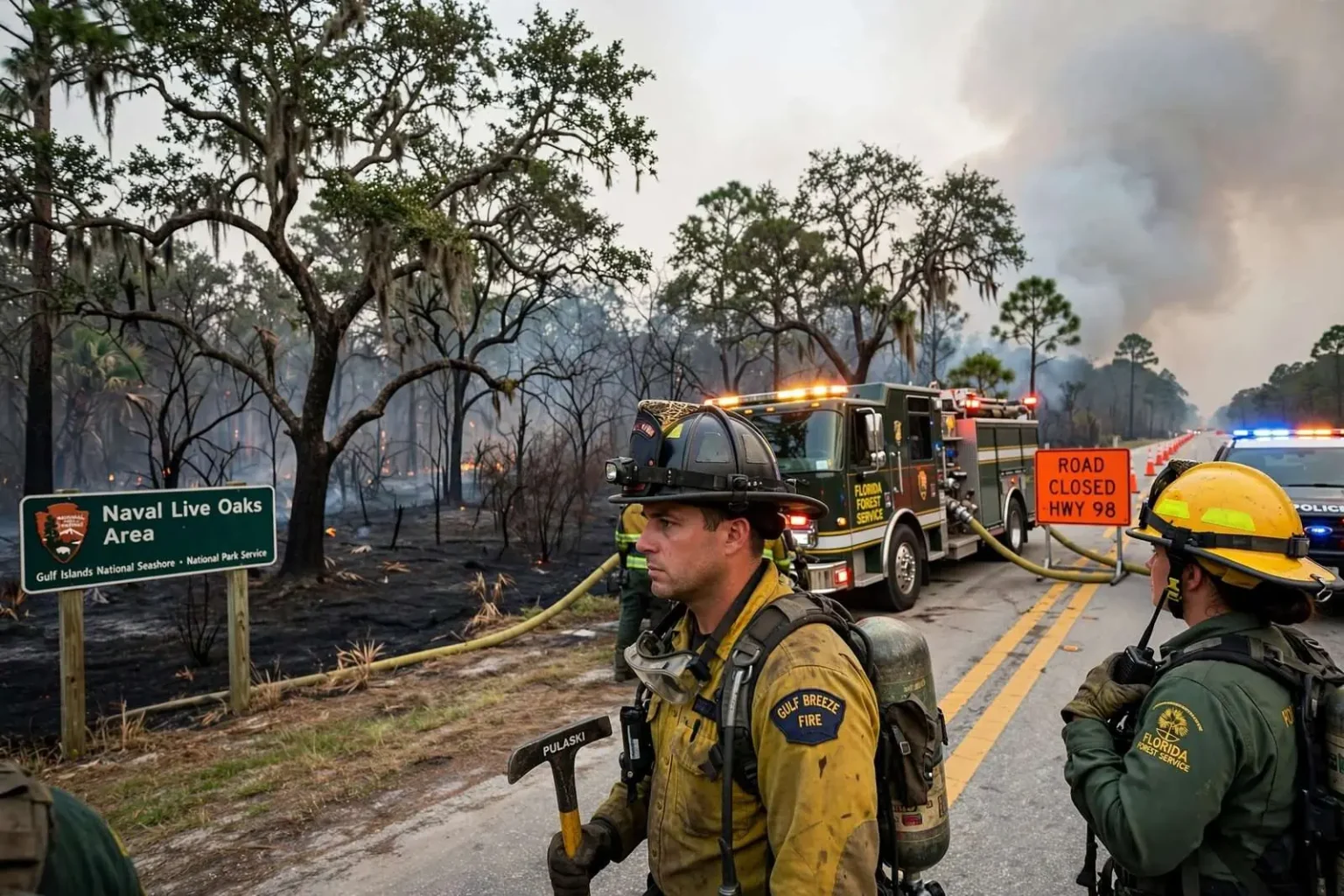
Fire crews in Gulf Breeze worked through the weekend to contain a 44-acre wildfire burning in the Naval Live Oaks area of Gulf Islands National Seashore, with the fire contained as of Monday afternoon though officials said active flames remained inside the burn zone. The blaze, dubbed the “Jackson Fire,” sent a column of smoke over one of the Panhandle’s most visited historic preserves and drew a response from agencies on both sides of the bay.
Multiple agencies responded Sunday afternoon to the fire at the historic preserve east of downtown Gulf Breeze. Flames and heavy smoke rose near Highway 98, prompting road closures and alarming residents who watched the smoke drift toward the roadway — the main east-west artery connecting Gulf Breeze to Navarre and the communities beyond it.
Gulf Breeze resident Stacy Chrisco said she saw billowing smoke while driving down Highway 98, with flames getting closer to the road until fire trucks arrived. Her account matched the experience of dozens of drivers who found themselves passing a burning woodland on one of the region’s busiest commuter routes on a Sunday afternoon.
Another resident, Mary StClair, credited the quick response of local first responders and said neighbors were concerned about damage to structures, people and wildlife. Those fears were ultimately eased: officials reported no injuries and no damaged structures, though the cause of the wildfire remained unknown as the containment lines held.
A Fast-Moving Fire in a Sensitive Preserve
The Naval Live Oaks area is no ordinary woodland. The preserve protects one of the last significant stands of live oak trees on the Gulf Coast — the same dense, gnarled hardwoods once prized by the nation’s early shipbuilders. The live oaks of this tract helped establish the federal government’s first effort to conserve timber for naval use, and the land’s protection predates the national seashore itself by more than a century.
Fire in such a landscape carries stakes beyond the immediate danger. Live oaks are remarkably resilient to fire compared to many hardwoods, but the preserve’s understory — dense palmetto, brush and pine scrub accumulated over years — can burn hot and fast when humidity drops and winds pick up. Weekend conditions gave Sunday’s flames plenty of fuel, and crews worked both the interior lines and the edges nearest Highway 98 to keep the fire from jumping the road.
The response drew together the Gulf Breeze and Midway fire departments, the Florida Forest Service, the Gulf Breeze Police Department and the National Park Service. That mix — municipal firefighters, state wildland crews, local police and federal land managers — reflects the reality of fighting fire on the boundary between a national seashore and a growing residential corridor.
Each agency handled a different piece of the problem. Gulf Breeze and Midway firefighters protected structures and monitored the road corridor. The Florida Forest Service brought wildland equipment and experience suited to brush fires burning across acres rather than buildings. Police managed closures along Highway 98, keeping traffic away from smoke that could reduce visibility to a few feet in seconds. National Park Service staff coordinated access to the preserve itself, where much of the burned acreage lay.
By Monday afternoon the fire was contained, but containment is not the same as extinguishment. Officials said active flames remained inside the burn zone, and staff urged drivers to use caution in the area, warning that shifting weather could pool smoke along the roadway and force additional closures or delays. Pockets of deep brush can smolder for days after a fire is officially contained, and overnight humidity changes can reawaken hot spots that seemed dormant.
Why This Land Looks the Way It Does
The Naval Live Oaks tract occupies a unique place in American environmental history. In the 1820s, the federal government set the land aside specifically to preserve live oaks for shipbuilding — the curved, immensely strong limbs of the trees were ideal for the ribs and knees of wooden warships. The reservation was among the first managed timber resources in the United States, and its later incorporation into Gulf Islands National Seashore preserved both the trees and the story of why they were saved.
That history complicates every fire decision on the property. The National Park Service manages many of its wild landscapes with prescribed burning, using controlled fires to clear undergrowth and maintain the ecosystems that long depended on periodic burns. An unplanned fire like the Jackson Fire forces managers to balance immediate suppression with the ecological reality that fire is also a natural part of the coastal woodland’s cycle — a tension residents glimpsed as crews fought to stop a fire they may one day mimic on purpose.
For Gulf Breeze, the weekend was a reminder of how close the wild land sits to the developed one. Neighborhoods press against the preserve’s boundaries, and a fire on its western edge puts smoke and heat within sight of Highway 98 and the schools, businesses and homes beyond it. The absence of injuries or structural damage owed much to the speed of the multi-agency response — something local officials noted as they praised the crews who spent their weekend on the fire lines.
The 44 acres burned represent a modest fraction of the Naval Live Oaks area, which covers more than 1,300 acres of maritime woodland between Pensacola Bay and Santa Rosa Sound. But acreage understates the weekend’s difficulty. Fires burning in heavy undergrowth near a highway and occupied neighborhoods demand manpower in a way that remote wildfires do not, since every shift in the wind moves smoke and embers toward the road and the homes beyond it.
Residents who watched the smoke Sunday described a plume visible from well across the bay, with the smell of burning brush reaching neighborhoods in Gulf Breeze and beyond. Some drivers approaching the closures had to detour through town, adding time to trips that normally cross the preserve in minutes. Others stopped to photograph a sight uncommon on the Panhandle’s coastal corridor: open flame in a national park minutes from a city’s front doors.
The concerns StClair relayed about wildlife are shared by the biologists who manage the preserve. Gulf Islands National Seashore shelters deer, small mammals, gopher tortoises and a wide range of birds within the live oak woodland, and a fire of this size displaces or kills animals that cannot outrun the flames. In practice, wildlife populations in burned coastal woodlands typically recover within seasons, aided by the rapid regrowth that follows fire in the Gulf’s long growing season — but the weeks after a burn leave the landscape visibly scarred and the animals that survived it on the move.
Road Closures and Smoke Management
Highway 98 is the lifeline of the communities west of Pensacola Beach, and closing any stretch of it for fire operations ripples across the entire region. Police and fire officials coordinated the closures Sunday as flames approached the right-of-way, reopening the road once the immediate threat had passed but keeping a watch on conditions as smoke continued to drift from the burn zone inside the lines.
The warning about pooled smoke reflects a hazard specific to burns near roadways. Smoke settles in low spots and along drainage corridors in the early morning and evening, when the air is calmest, and visibility on Highway 98 can change from clear to dangerous within a quarter mile. Officials asked drivers passing through the area to slow down, use headlights and watch for equipment working along the shoulders in the days after the fire.
The investigation into the fire’s cause remained open as crews finished containment work. Wildfires in northwest Florida start most often from escaped debris burns, lightning, equipment sparks and human carelessness, and investigators with the Florida Forest Service typically examine burn patterns, weather records and any evidence of human activity in the origin area before reaching a conclusion. Officials had not announced a determination by the time containment was declared.
In the meantime, the National Park Service has asked visitors to respect any continued closures within the Naval Live Oaks area. The preserve’s trails and picnic areas are among the seashore’s most used amenities — a rare stretch of quiet woodland minutes from the beach communities — and recovery of the burned acreage will take place in full view of the hikers, joggers and school groups who pass through it year-round.
Fire managers will keep monitoring the interior of the burn zone for hot spots, a process that can extend for days or weeks depending on rainfall. A soaking rain would effectively end the risk; a dry, windy week could keep smoldering pockets alive and force renewed precautions along the highway. Either way, the containment lines dug and held over the weekend did their job: the fire stayed inside the preserve, and the homes and businesses along its edges stayed whole.
For the agencies involved, the Jackson Fire was a working demonstration of the cooperation that Gulf Coast emergency response depends on. A fire starting on federal land, threatening a state highway and a city’s neighborhoods, was met within hours by two municipal fire departments, a state forestry agency, a local police force and the National Park Service — and by Monday afternoon the combined effort had contained 44 acres of burning woodland with no injuries and no structures lost.
Residents of Gulf Breeze will see the evidence of the weekend for some time — blackened understory and scorched trunks visible from Highway 98 as the woodland begins its recovery. What they will not see, thanks to the crews who worked through the weekend, is anything missing: the live oaks that gave the preserve its name and its national significance still stand, the road stayed open through the workweek, and the community next door emerged from its closest brush with wildfire in recent memory unscathed.
Officials said the public should continue to check for updates before visiting the area, as conditions inside the burn zone and along the highway could prompt further closures or delays if weather shifts. The cause of the fire remained under investigation.