Crews Search Chickasaw Creek After Diver Does Not Resurface
Saraland and Daphne rescue teams searched Chickasaw Creek after a diver failed to resurface near Chickasaw, Alabama.
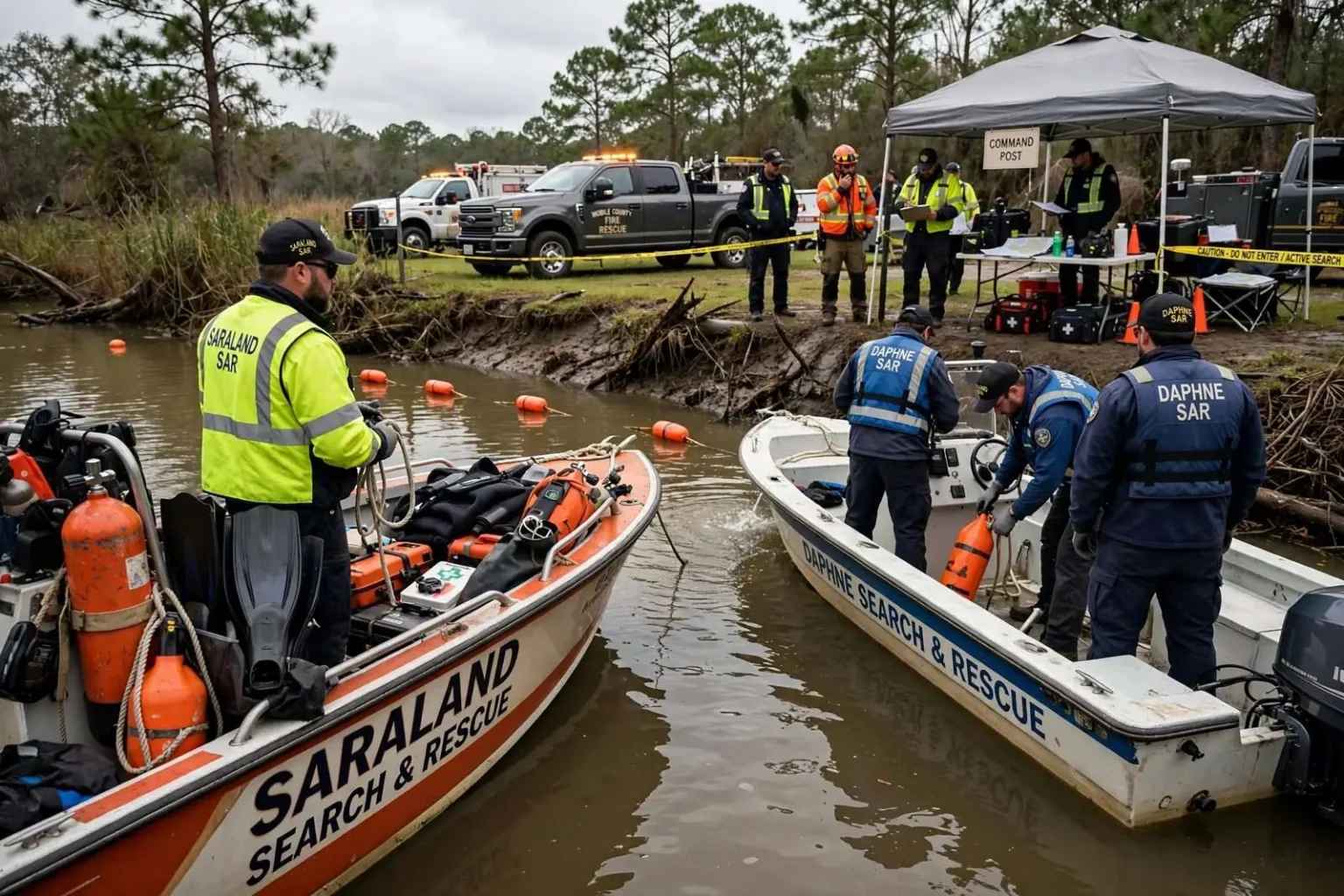
Search crews worked the waters of Chickasaw Creek after a diver went under the surface and did not come back up, setting off an extended effort to locate the missing individual. The incident drew dive teams from multiple communities along Mobile Bay and kept personnel on the water while authorities worked to determine what happened below the surface.
Divers from the Saraland and Daphne search and rescue teams searched the area where the individual went down, according to a local update on the response. Crews concentrated their efforts on the stretch of the creek where the diver was last seen, working methodically through the water in conditions that responders on scene described as challenging.
The effort focused on locating the missing diver in the creek near Chickasaw, a city in northern Mobile County whose namesake waterway has long been a gathering spot for fishing, boating, and other recreation. Rescue personnel staged along the banks while divers entered the water in rotations, a standard practice that allows teams to search for extended periods without exhausting individual divers.
Details on the circumstances that led to the disappearance were not immediately available. Authorities had not said whether the diver was alone at the time, what the individual had been doing in the creek, or how long the person had been under water before the alarm was raised. Officials asked the public to avoid the area while the search continued, both to keep onlookers clear of working boats and to prevent boat wakes from further churning water that divers had to move through.
A Waterway at the Heart of the Community
Chickasaw Creek winds through the northern reaches of Mobile County, threading between the communities of Chickasaw, Prichard, and Saraland before joining the broader Mobile River system that eventually feeds Mobile Bay. For generations it has served as a neighborhood fishing hole and a launching point for small boats, which means the waterway sees steady recreational traffic even when it is not in the news.
That popularity cuts both ways when something goes wrong. The creek’s water is heavily influenced by tides pushing up from the bay, and visibility below the surface is often poor because of sediment carried downstream. Responders who work these waters regularly say those two factors — current and murk — are what turn a straightforward search into a slow, careful grind that can stretch across multiple days.
Search and rescue work on the Gulf Coast depends heavily on volunteer organizations that stand ready around the clock. The Saraland search and rescue team has built a reputation across Mobile County for its dive capability, and its members routinely train in the same creeks and rivers they are later called to search. That local knowledge matters: knowing where the channels run deep, where snags collect, and how the tide moves through a given bend can dramatically shorten the time it takes to cover a search area.
The Daphne search and rescue team brings a similar mission from the Baldwin County side of Mobile Bay. Cross-bay cooperation like this is a long-standing feature of emergency response in the region, where specialized resources are spread across two counties and agencies have learned to call on one another quickly rather than waiting for a single department to muster everything it needs.
Dive operations of this kind are rarely the work of a single boat. A typical response involves a command post on shore, safety divers standing by in the water, personnel tracking each diver’s time and depth, and support staff coordinating communications. Every dive in zero-visibility water is done by feel and by touch, with divers sweeping the bottom in patterns, a process that is slow by design because safety is the first priority on every descent.
How Searches on the Creek Typically Unfold
The first hours of an incident like this one are usually devoted to fixing the search area. Responders interview anyone who was with the diver or who saw the person go under, then use that information to establish a last-seen point. Markers or buoys are placed in the water, and the initial dives concentrate on the bottom directly below and downstream of that spot, since currents in tidal creeks can move objects and debris from where they first went down.
If the first pass does not locate the person, teams generally widen the operation. Side-scan sonar can be towed behind a boat to map the creek bottom and flag anomalies for divers to inspect, and searches often extend into the evening and resume at first light. Weather and water conditions play a major role in pacing — lightning, heavy rain, or a strong tidal run can pause diving until conditions improve, and commanders weigh the risk to their own personnel at every step.
Local fire departments and county EMS typically support operations like this on the shore side, providing rehab for divers who cycle out of the water, medical monitoring, and staging support. Dispatchers coordinate the movement of multiple agencies on shared radio channels, and in cases that cross jurisdictional lines the county sheriff’s office often helps manage the overall response.
Why Authorities Close the Area During a Search
The request for the public to stay away is more than a formality. Every additional boat on a narrow creek kicks up sediment that further reduces what little visibility divers have, and wakes can shift markers or disturb the bottom in ways that erase hours of careful search work. Boaters near active dive operations also create real hazards for personnel who may be surfacing without much warning, which is why law enforcement routinely establishes a perimeter around the search zone.
For residents who live along the creek, the disruption is temporary but noticeable — access points may be blocked, and the sight of dive trucks, rescue boats, and emergency lights becomes a fixture along the banks until the operation concludes. Officials generally release more information once the search reaches a resolution and family members have been notified.
A Broader Reminder About Water Safety
Incidents on Chickasaw Creek and similar waterways across the Gulf Coast follow a pattern that water-safety advocates know well. Diving alone, diving into unfamiliar water, and underestimating currents and depth changes are recurring factors in drownings across the region every year. Safety instructors stress simple habits: never dive or swim alone, always have someone on shore watching, wear a properly fitted life jacket when boating, and assume that water you cannot see through is deeper or more obstructed than it looks.
Tidal creeks add their own hazards. Depth can change dramatically with the tide, submerged limbs and other debris accumulate after storms, and the current near channel bends is stronger than it appears from the bank. First responders in Mobile and Baldwin counties repeatedly urge swimmers and boaters to treat these waters with the same caution they would show a river, even when the creek looks calm on the surface.
The search along Chickasaw Creek continued as crews from Saraland and Daphne worked the water near where the diver went down. Authorities said additional details would be made available as the investigation into the circumstances moved forward, and they repeated their request that the public avoid the area while the operation was underway.
The Challenges of Diving Gulf Coast Waterways
Search divers across south Alabama describe the region’s creeks and rivers as some of the most difficult environments in which to work. Below the surface of a tidal creek like Chickasaw Creek, daylight fades within a few feet, and divers frequently operate by touch alone, following a guideline line back to their safety partner. Silt clouds the water with every movement, which means a diver who moves too quickly can erase the little visibility there was in the first place.
The gear itself adds to the workload. A diver in a full wetsuit or dry suit, carrying a tank, weights, and search equipment, can be managing well over 50 pounds of gear in the water. Strong current multiplies the effort required for every yard of bottom covered, which is why dive supervisors limit each working dive to short intervals and rotate team members through the water throughout the day.
Underwater obstructions are another constant. Creek bottoms across Mobile County hold submerged logs, discarded appliances, fencing, and storm debris that can snag a diver’s line or gear. Searchers probe slowly around anything that registers as a possible obstruction, a careful process that is necessary but time-consuming. All of these factors combine to make an operation that a casual observer might expect to take hours stretch into days instead.
How the Community Typically Responds
News of a search on the creek spreads quickly in a small city like Chickasaw, where residents often gather at nearby bridges and boat launches to watch and offer help. Emergency officials generally direct that energy to the appropriate channels — family assistance, information tips, and staying clear of the scene — rather than amateur searching, which can put untrained volunteers at risk and complicate the professional response.
Local officials also tend to use incidents like this to renew familiar appeals: check on neighbors who use the waterway, keep life jackets accessible for children near the water, and report anyone seen in distress immediately by calling 911 rather than attempting a rescue alone. Time and again, the difference between a rescue and a recovery comes down to how quickly someone on shore calls for help.
As of the latest update, the search on Chickasaw Creek remained active, with Saraland and Daphne dive teams continuing to work the area near Chickasaw where the individual was last seen. Authorities had not released the identity of the missing diver, and no timeline was given for the operation. The public was again asked to avoid the creek in the search zone until crews conclude their work.