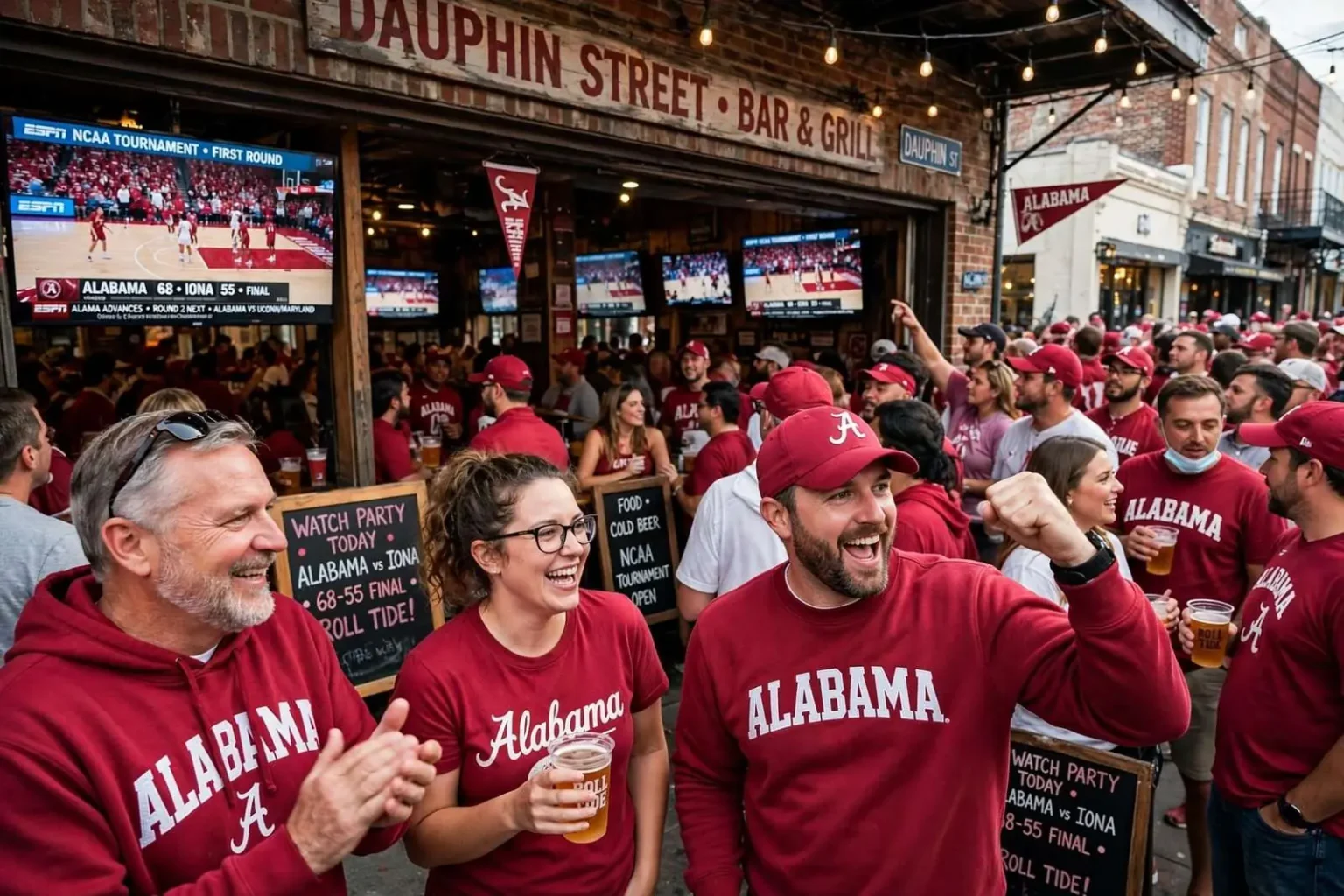
MOBILE, Ala. — Downtown Mobile’s bars and restaurants filled with Crimson Tide fans Saturday afternoon as the Alabama men’s basketball team opened NCAA Tournament play with a 68-55 win over Iona, punching a ticket to the second round.
The victory sent Alabama into a round-two matchup against either UConn or Maryland, and gave local fans plenty to celebrate in the heart of downtown. On Dauphin Street and across the entertainment district, televisions that carried the game all afternoon stayed crowded through the final whistle, with the kind of red-clad turnout that usually reserves for football Saturdays in the fall.
A Taste of Normalcy
For many who packed the venues, the afternoon carried an added meaning: it felt like a step back toward normal life. With COVID-19 cases declining across south Alabama and vaccination rates climbing, fans said they were comfortable cheering shoulder-to-shoulder again.
“I feel very, very safe. It feels great coming out,” said fan Roderick Moss, who watched the game with his wife.
Coming off Alabama’s January national championship in football, he admitted his expectations had grown: “I’m hoping we can come out and pull through in the NCAA Championship too.”
Fellow fan Tim Corbett liked the momentum. “It’s almost a little surprising, you know, but why not become the best at everything that you can — spread the love and the championships around, and get more of them. Roll Tide,” he said.
The double-barreled optimism summed up the mood of a fan base living through one of the rarest stretches in college sports. Alabama’s football program had claimed the national title in January, and the basketball team’s tournament run gave fans a second postseason to invest in before spring arrived — a scheduling quirk of dominance that downtown Mobile was happy to toast on a Saturday afternoon.
The win over Iona carried its own storyline for followers of the program. The Gaels, coached by hall of fame legend Rick Pitino, arrived as a difficult opening-round out, and Alabama’s ability to put the game away by seventeen points sent a message that the Southeastern Conference champions intended to be more than a first-week participant. The second-round opponent — the winner of the UConn-Maryland game — promised a taller order, but for one Saturday afternoon, the brackets and the spreads could wait.
Basketball’s March moment has been quietly building its own following in a state where football rules every other month of the year. The Crimson Tide’s rise under its current staff, built on pace, spacing and three-point shooting, has turned SEC play into must-see television and given Alabama fans a reason to keep their winter weekends spoken for. A downtown crowd watching an afternoon tip-off in mid-March — in a bar district built on football traffic — is one measure of how far the program’s audience has grown.
Cases Near Pandemic Lows
The festive weekend coincided with encouraging public health numbers. Mobile County had averaged roughly 30 new COVID-19 cases per day over the preceding two weeks and was among 57 Alabama counties rated “low risk.”
“What you see with these numbers are consistently low numbers that are approaching the lowest we’ve had throughout the pandemic, which is incredibly encouraging — so we are going in the right direction,” Dr. Scott Chavers of the Mobile County Health Department said at the department’s regular Friday briefing.
Chavers’s briefings had become a fixture of the pandemic’s routine in Mobile County, translating daily case counts, hospitalization trends and vaccination figures into guidance residents could act on. The numbers behind this week’s optimism represented a long descent from the surges that had filled the county’s briefing slides in earlier waves — and, for the first time in a long while, a level of community transmission low enough that crowded bars and tournament watch parties felt like choices rather than risks.
The “low risk” designation that Mobile County shared with 57 other Alabama counties mattered for more than morale. County risk ratings shaped recommendations for businesses, schools and public gatherings across the state, and a sustained stay in the lowest tier meant fewer limits on the kinds of crowds that tournament weekends produce. For downtown restaurants and bars still recovering from a year of capacity restrictions, a packed NCAA Saturday was both a relief and a test — the first big postseason crowd of the new normal.
Vaccination rates, which continued climbing through the spring, formed the other half of the county’s improving picture. Public health officials had spent months urging residents to take the shots, and the growing share of vaccinated adults was steadily changing the calculus of everyday activity. Fans like the ones on Dauphin Street were, in effect, the visible evidence of that campaign: crowds returning not because the virus had vanished, but because the risk had receded to levels the community could live with.
The economic layer is impossible to separate from the celebratory one. March tournament weekends deliver to downtown establishments a kind of sustained, afternoon-through-night traffic that ordinary Saturdays rarely match, and after a year in which hospitality businesses absorbed capacity caps, closures and staffing shortages, the combination of a winning team and improving health numbers arrived at exactly the right time.
Downtown as Alabama’s Second Home Crowd
Mobile’s relationship with Alabama athletics has always run deeper than proximity suggests. The city sits inside the Crimson Tide’s permanent television footprint, fills its neighborhoods with alumni, and supplies its share of players and fans to every program the university fields. When the Tide plays, downtown Mobile watches — and the Saturday turnout for a basketball game confirmed that the habit now extends well beyond the fall.
The afternoon also demonstrated how the watch-party tradition has become part of the college sports economy. Venues that once filled only for football Saturdays now build March schedules around the tournament, advertising the games the way they once advertised only SEC football. For fans without tickets to the arena site, the downtown bar scene is the next best seat — big screens, full volume and a crowd wearing the same colors.
The second round brought another week of the same ritual. With Alabama set to face the UConn-Maryland winner, the watch parties would reconvene with higher stakes and, fans hoped, the same result. The optimism on Dauphin Street ran toward the possibilities of the second weekend in the bracket — the kind of talk that follows a team that has already beaten Pitino’s Gaels by seventeen.
For the fans quoted in the stands of downtown’s bars, the afternoon offered the simplest summary of the moment: a championship team in one sport, a rising one in another, and a pandemic finally loosening its grip on the rituals of gathering. “Spread the love and the championships around,” as Corbett put it — and for one March Saturday in Mobile, that sentiment was easy to toast.
The Crimson Tide’s tournament run continued in the days that followed, and wherever it ended, Saturday afternoon in downtown Mobile had already made its own bracket statement: the crowd was back, the cases were near their pandemic lows, and the Tide’s postseason had a hometown viewing section as loud as any it would find.
The win’s margin told fans something about the team’s readiness, too. Opening-round games against lesser-known opponents have tripped many a high seed — the tournament’s first weekend is where underdogs harvest upsets — but Alabama handled Iona’s tempo and physicality without ever letting the game drift into danger. By the second half, the downtown crowds had shifted from anxious watching to celebration, the surest sign a fan base gives that it trusts what it is seeing.
Health officials watching the same weekend saw reasons for their own optimism. The county’s two-week average of roughly 30 cases a day, coming alongside the low-risk designation shared by most of Alabama’s counties, suggested that the winter’s surge was truly in the rearview mirror rather than pausing between waves. Dr. Chavers’s Friday briefing struck a tone that had been rare in the pandemic’s briefings — encouragement grounded in numbers that kept moving the right way.
Still, the department’s guidance continued to urge common sense, particularly for residents who had not yet been vaccinated. The return of crowds to downtown entertainment districts made that remaining work visible: the pandemic was not declared over, but for vaccinated fans and the businesses that depend on them, the distance between guidance and life had narrowed to something manageable.
The NCAA Tournament’s first weekend is a traveling festival wherever it lands, and in Mobile it landed in the one part of town built to host it. Dauphin Street’s bars and restaurants turned the win into an afternoon-long block gathering, the kind of scene that reminds visitors why the downtown district anchors the city’s nightlife. Between the scoreboard, the weather and the health numbers, the day offered downtown a fairly complete victory.
Fans will find out soon enough whether the bracket cooperates with the optimism. The second-round matchup against the UConn-Maryland winner pairs the Tide with a program of similar pedigree, and the winner advances to a region where the road only steepens. But for the crowd that filled downtown on Saturday, the outcome was already an improvement on recent years: basketball worth watching in March, a football trophy from January still gleaming, and a city healthy enough to gather and enjoy both.
That is the full context of the afternoon — a sports story, a public health story and an economic story braided together on one busy street. Mobile has spent a year learning what distance looks like; Saturday was what the return looks like. And with the Tide still playing, downtown will get another chance to practice it next weekend.