
Dance Off! Benefit Takes Over Alabama Music Box With Fire Competitions and a Midnight Marathon
Dance Off! Last Man Standing hits the Alabama Music Box Sept. 9 with fire dance contests, prize giveaways and a midnight marathon benefiting Rumor Union.
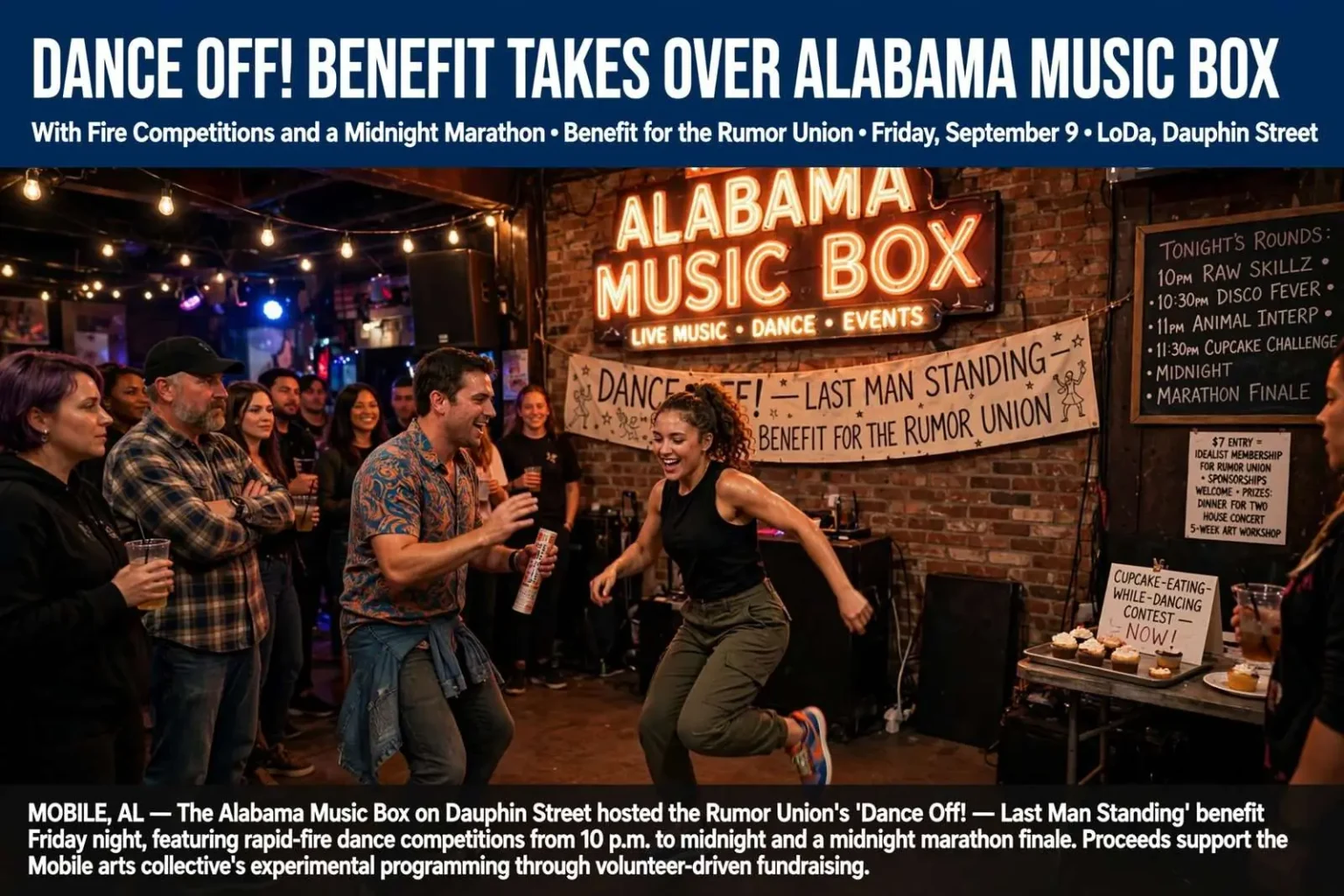
The Alabama Music Box hosts “Dance Off! — Last Man Standing” on Friday, September 9, a benefit for the Mobile arts collective the Rumor Union that mixes short-fire dance competitions with prize giveaways and a marathon finale.
Performances by professional contemporary dancers open the night at 8 p.m., followed by rapid-fire competitions from 10 p.m. to midnight covering categories like Raw Skillz, Disco Fever, animal interpretation and even a cupcake-eating-while-dancing contest.
A downtown venue built for nights like this
The Alabama Music Box has spent years as one of the anchor rooms of Mobile’s downtown nightlife, occupying a spot on Dauphin Street where touring bands, local showcases and late-night dance parties all share the same stage. The venue’s open floor and up-close stage make it a natural fit for a dance competition, where the audience crowds the rail and the judges can see every footwork mistake from a few feet away.
Dauphin Street itself is the spine of the LoDa entertainment district, the stretch of lower Dauphin Street where Mobile’s galleries, bars and music rooms cluster within a few blocks of each other. On a Friday night, foot traffic on the street runs heavy from Bienville Square to the intersections near the water, and events like this one draw from the same mix of downtown regulars and visitors wandering between venues.
The Rumor Union
The beneficiary of the night is the Rumor Union, a Mobile arts collective that has made a habit of staging events outside the gallery-and-coffeehouse mainstream. The group’s approach blends visual art, music and performance into social gatherings where the line between audience and participant stays deliberately thin, and its membership model reflects that spirit — admission to Friday’s event doubles as an “Idealist” membership in the collective.
Collectives like the Rumor Union fill a niche that few established institutions in Mobile cover. Gallery shows tend to present finished work to quiet audiences, and concert venues present finished performances, but a dance-off with an animal interpretation category lives somewhere between the two, turning the creative act itself into spectator sport. Funding that work through door receipts rather than grants or ticketed galas keeps the barrier to entry low for both artists and attendees.
How the competition works
The format is built around speed. Professional contemporary dancers open the evening at 8 p.m. with polished performances that set the bar, then the amateur and competitive rounds take over from 10 p.m. to midnight in rapid-fire bursts. The categories rotate quickly enough that a dancer can enter several: Raw Skillz rewards pure technique, Disco Fever leans on costume and character, and animal interpretation asks dancers to embody whatever creature the organizers throw at them.
The cupcake-eating-while-dancing contest is exactly what it sounds like, a category where digestion and choreography compete for the same attention. Categories like these are a staple of underground dance culture, where the point is less about who executes the cleanest routine than about who can keep a crowd entertained under absurd constraints.
At midnight sharp, the marathon dance-off begins. Local sound artists and musicians will be working as what organizers call an orchestra that defies the senses, supplying live music for the endurance round while the field of competitors wears down. The last dancer standing is declared the winner, a structure borrowed from the marathon dance contests of the early twentieth century and revived in club culture, where stamina and showmanship matter as much as style.
Getting in and getting sponsored
Admission is $7 at the door on Dauphin Street, which includes a Rumor Union “Idealist” membership — a bundle that turns a night out into a standing relationship with the collective and its future events.
Dancers have a second route in. Organizers are letting competitors line up local business sponsorships, which covers free entry and adds raffle tickets for each sponsor a dancer brings on board. The setup works as informal fundraising for the collective while pulling neighborhood shops into the event, and it gives dancers an incentive to recruit beyond their own circles of friends.
A homegrown prize list
The prize list is distinctly homegrown. The winner takes home a three-course dinner for two cooked in your own home by chef Garrick Ogburn — a private dinner rather than a restaurant gift certificate, which keeps the prize personal and keeps the money circulating among local cooks.
Other prizes follow the same logic. The Underhill Family Orchestra house party puts the winning dancer’s living room on the map for a night of live music from one of Mobile’s family bands, and the Paper Cut house party offers a similar prize built around another local act. House concerts have a long tradition in Gulf Coast music scenes, trading on intimacy that no venue ticket can match, and offering one as a raffle prize doubles as promotion for the bands themselves.
The final prize comes from the collective’s own programming: a free five-week workshop in the Rumor Union’s “Everything You Never Learned in Art School” series. The series title sums up the group’s pitch — practical creative education that formal art programs either skip or price out of reach, taught in the informal setting where the collective does its best work.
Why benefits like this matter to Mobile’s arts scene
Mobile’s downtown arts economy runs on a mix of institutions and volunteer energy. The museums and established galleries anchor the calendar, but much of the city’s experimental work happens in rooms like the Alabama Music Box, where a $7 door charge and a volunteer roster are the entire operating budget. Events that fold fundraising into an ordinary night out tend to raise modest sums, but they also recruit new members and audiences in a way a formal appeal never does.
September 9 falls early enough in the fall season that the event lands while the LoDa district is shaking off its summer slowdown, when galleries are resetting their shows and venues are filling their calendars. For the Rumor Union, the night serves three purposes at once: it raises money for the collective’s programming, it introduces new people to the membership, and it gives Mobile’s dancers — professional and otherwise — a stage they rarely get.
Doors open with the professional performances at 8 p.m., the competitive rounds run from 10 to midnight, and the last dancer standing will be determined in the marathon that follows. Dancers planning to compete can arrange sponsorships in advance to secure free entry and extra raffle tickets, and everyone else can pay the $7 admission at the door on the night of the event.
The venue’s role in the street’s night life
The Alabama Music Box occupies a particular place in downtown Mobile’s lineup. Larger theaters book national touring acts, and the smaller bars along Dauphin Street host solo performers and weeknight open mics, but the Music Box has staked out the middle ground — a room big enough for full bands and dance floors, small enough that a midweek show still feels like a gathering. That positioning makes it a frequent partner for local organizers who need a stage and a sound system without the overhead of renting a theater.
For a dance event, the room’s layout matters as much as its sound. Competitions that depend on crowd reaction work best when the audience surrounds the floor, and the rapid-fire format — rounds lasting minutes rather than hours — keeps energy high through what would otherwise be the dead stretch of a Friday night between ten and midnight.
The marathon tradition
The midnight marathon finale draws on a piece of American dance history. Marathon dance contests swept the country during the Depression, when couples danced for days with prize money on the line and audiences buying tickets to watch the exhaustion set in. The format largely disappeared from mainstream entertainment, but elements of it survive in club culture and in endurance formats like the one the Rumor Union has built here — a live band, a shrinking field of dancers, and a single rule: keep moving.
With local sound artists and musicians supplying what organizers describe as an orchestra that defies the senses, the final round becomes as much a performance for the musicians as for the dancers. Live music changes the texture of a dance competition entirely; competitors cannot rely on a rehearsed routine timed to a recording, and the crowd gets something closer to a jam session than a show.
Buying in
The $7 admission and the sponsorship route give Mobile residents two very different ways to support the same collective. A single night’s door charge covers the venue and the seed money, while the sponsorship model turns each competitor into a small fundraiser, with raffle tickets stacking up for every local business they sign on. Prizes built around dinners, house parties and workshops keep the rewards inside the local creative economy rather than paying out in generic gift cards, which is consistent with the collective’s broader approach to its events.
The night ends when the last dancer is standing — and in a marathon format on a Dauphin Street Friday, that could be well past midnight.


