Daphne Police Search for Driver Who Struck Motorcyclist on US-98 and Fled
Daphne police are searching for the driver of a white Subaru who struck a motorcyclist on U.S. 98 and fled. The rider seeks help identifying the driver.
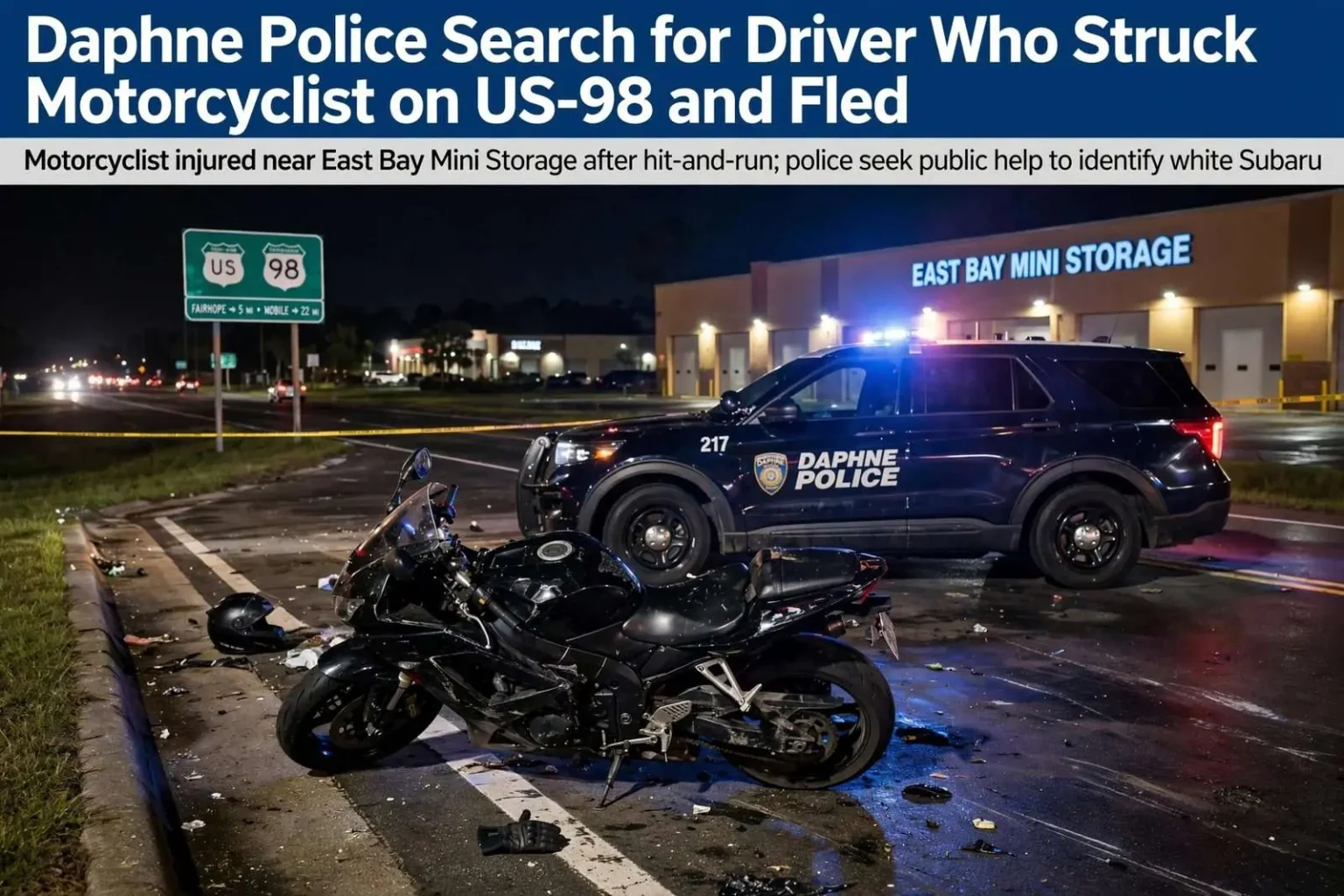
A Mobile motorcyclist is asking for the public’s help after he says a driver struck him on U.S. 98 in Daphne and sped away without stopping. The incident happened Thursday evening around 9:30 p.m. near East Bay Mini Storage. Marc Jones said he was riding along Highway 98 on his way to visit a friend in Fairhope when the driver of a white Subaru drifted into his lane and knocked him from his bike.
U.S. 98 is one of the Eastern Shore’s busiest north-south corridors, carrying commuter, commercial and recreational traffic between Daphne, Fairhope and points beyond. The stretch near the storage facility mixes through-traffic with local businesses, and at night the combination of headlights, driveways and moderate speeds makes it the kind of road where a moment of inattention can turn dangerous, particularly for riders, who have none of the protection a car provides.
Jones said several bystanders stopped to help him after the crash. He was treated at a hospital, and he said none of his injuries are life-threatening.
“My knee has some road rash on it. My right hip is pretty bruised, I got a bruised shoulder and elbow and some abrasions on my left arm,” Jones said.
Road rash — abrasions caused by skin scraping across pavement — is among the most common injuries motorcyclists suffer in crashes, along with the bruises and fractures that come from the impact itself. Riders are often advised to treat even seemingly minor abrasions carefully, because gravel and debris embedded in the wounds can lead to infection, and the full extent of injuries frequently becomes clear only in the days after a crash.
With medical bills and motorcycle repairs to pay, Jones is urging the driver to come forward.
“Leaving the scene of an accident with injuries is against the law, I believe it’s a felony,” Jones said. “If they just come back and do the right thing and give me their insurance information that would be helpful because I’m going to have a lot of medical bills.”
What the Law Says
Under Alabama law, a driver involved in an accident that results in injury must remain at the scene, provide reasonable assistance to anyone hurt, and exchange identifying and insurance information. Leaving the scene of an injury crash is a serious criminal offense, and when injuries are substantial the charge can rise to the felony level, carrying the possibility of prison time, fines and a suspended or revoked license.
Hit-and-run cases are notoriously difficult to close. Investigators rely on witness accounts, vehicle descriptions, surveillance footage from nearby businesses and, increasingly, tips from the public. A description as specific as the one involved here — a white Subaru on U.S. 98 at a known time and location — narrows the field considerably, and a single credible tip from someone who noticed matching damage on a vehicle, or who heard someone talk about the crash, is often what cracks the case.
For the victim, the stakes are practical as much as legal. Without an insurance exchange, the cost of repairing or replacing a damaged motorcycle falls on the rider, as do medical bills, and the uninsured-motorist coverage that might apply depends on the specifics of the policy. Coming forward, Jones suggested, would begin the process of making things right even at this late stage.
A Police Report and an Open Case
A police report was filed with the Daphne Police Department.
The Daphne Police Department handles patrols and investigations across the city, one of the Eastern Shore’s largest municipalities, and its officers work the U.S. 98 corridor daily. A formal report accomplishes several things at once: it documents the crash for insurance purposes, creates the official record investigators will work from, and gives the case a paper trail that can support criminal charges if the driver is identified. Victims and witnesses who remember additional details after the fact can ask that the information be added to the report.
For motorists who witness or come across the aftermath of a crash, stopping to help — as the bystanders in this case did — can make a decisive difference. Calling 911, staying until officers arrive and providing a statement about what they saw gives investigators the raw material they need, and for the injured party, having someone on the scene until help arrives can be the difference between a quick rescue and a long wait on a dark roadside.
Look Twice for Motorcycles
Jones also wants to remind drivers to look twice for motorcyclists sharing the road.
“There are a lot of us out there riding motorcycles and we have every right to be out there on the road. It’s not the motorcycles, it’s the careless drivers on the road injuring the motorcyclists,” Jones said.
His point reflects a reality recognized by every highway safety agency: the most common multi-vehicle motorcycle crashes happen when a driver fails to yield to an oncoming rider, often while turning left or changing lanes. A motorcycle’s narrow profile makes it easy to miss in traffic, and drivers scanning for cars can look directly at a bike and still fail to register it — a phenomenon safety instructors call inattentional blindness. The “look twice” message exists precisely for that reason, urging drivers to make a second, deliberate check for riders before pulling out or over.
Along the Gulf Coast, where warm weather keeps riders on the road nearly year-round, the stakes stay high in every season. Riders on corridors like U.S. 98, U.S. 90 and the region’s scenic routes share those roads with heavy commuter and tourist traffic, and safety campaigns across Alabama and the panhandle repeatedly stress the same fundamentals: give motorcycles a full lane, check mirrors and blind spots for riders rather than just cars, and never follow a bike as closely as a car, since a motorcycle can stop in a shorter distance.
For riders, meanwhile, the standard advice — wear bright or reflective gear, keep headlights on, stay out of blind spots, and assume drivers do not see you — reduces risk but cannot eliminate it. What riders and safety officials alike emphasize is that responsibility for preventing these crashes falls on everyone using the road, and that the consequences of a single careless moment, as this case shows, can follow both parties long after the vehicle that caused them disappears down the highway.
Anyone with information about the driver of the white Subaru is encouraged to contact the Daphne Police Department. For the rider recovering from his injuries, the path forward runs through the same request he has made publicly: that the driver return, do the right thing, and take responsibility for the crash.
The Financial Weight of a Hit-and-Run
Beyond the physical recovery, a crash like this one creates a cascade of costs that can linger for months. Emergency treatment, follow-up appointments, physical therapy for bruised joints, and prescription medications all arrive as bills before any settlement is ever negotiated. A motorcycle that has been knocked over and damaged in a crash may need a full inspection before it is safe to ride again, since even damage that looks cosmetic — bent handlebars, a cracked fairing, a stressed frame — can compromise handling at highway speeds. Towing and storage fees add to the total.
In a typical crash between two identified drivers, insurance companies sort out who pays for what, and the injured party files a claim against the at-fault driver’s policy. A hit-and-run removes that counterpart from the equation entirely. The rider is left to weigh a claim under his own policy’s uninsured or underinsured motorist coverage, if he carries it, against out-of-pocket costs, all while the person responsible faces no such burden. That asymmetry is a large part of why victims like Jones press so publicly for the driver to step forward: the practical remedy — an insurance exchange — costs the driver far less than the criminal and civil consequences that follow if the case is solved without them.
The timeline matters, too. Evidence degrades quickly in hit-and-run cases. Vehicle debris on the shoulder, paint transfer, security camera footage and human memory all fade within days, which is why investigators urge anyone with even partial information to come forward promptly rather than waiting. A driver whose conscience catches up with them weeks later may still help resolve the insurance side of the case, but the sooner they do, the better the outcome tends to be for everyone involved.
The Eastern Shore’s Growing Roads
The crash also lands on a corridor that has grown busier as Baldwin County’s population has climbed. Daphne and neighboring Fairhope have added residents, retail centers and commuter traffic year after year, and highways like U.S. 98 that once carried mostly rural traffic now move thousands of vehicles a day between homes, schools and jobs. More vehicles mean more exposure at every driveway and intersection, and motorcyclists — a small fraction of total traffic but a disproportionate share of serious injuries — feel that exposure acutely.
Local riders often describe the region as some of the best motorcycling country in the state, with long straightaways, scenic loops toward the bay and a riding season that barely pauses in winter. That popularity cuts both ways: the more riders on the road, the more drivers need to expect them, and the more a single careless lane change endangers someone.
For now, the case remains open with the Daphne Police Department, and the rider’s message to the public is unchanged. The bystanders who stopped to help showed what the community can do in the minutes after a crash; what happens next depends on whoever was behind the wheel of that white Subaru, and on whether anyone who knows something decides to pick up the phone.