Daphne Relays Presidential Proclamation as Flags Fly at Half-Staff for Rep. John Lewis
The City of Daphne relayed the presidential proclamation ordering U.S. flags to half-staff nationwide through July 18, 2020 in memory of Rep. John Lewis.
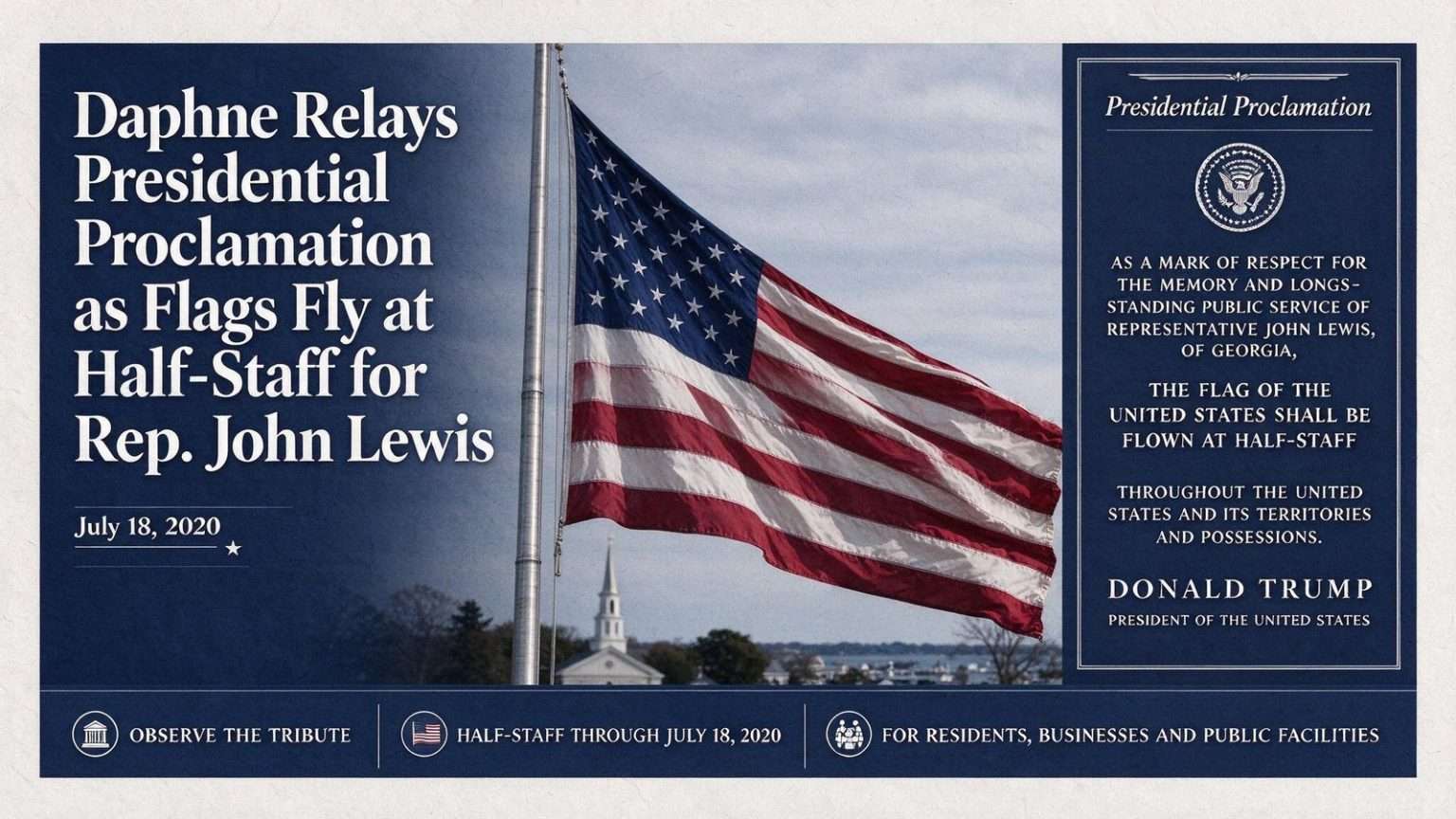
The City of Daphne shared a presidential proclamation on July 18, 2020 directing that the American flag be flown at half-staff nationwide in honor of Representative John Lewis, the Georgia congressman and civil rights icon who died earlier that month. The city passed the proclamation along so that residents, businesses and public facilities on the Eastern Shore could observe the tribute correctly and understand its meaning.
The order, issued by President Donald Trump under constitutional authority, called for the flag to fly at half-staff at the White House and all public buildings and grounds, military posts, naval stations and vessels across the country and its territories through July 18, 2020. The same period applied at U.S. embassies, consular offices and other facilities abroad, extending the tribute to every corner of the government’s presence worldwide.
“As a mark of respect for the memory and longstanding public service of Representative John Lewis, of Georgia,” the proclamation reads, “the flag of the United States shall be flown at half-staff … throughout the United States and its Territories and possessions.”
Half-staff tributes under presidential proclamation follow a tradition as old as the republic’s flag customs. When a figure of national consequence dies, the president directs the flag lowered — hoisted first to the peak, then drawn down to the halfway point — at federal buildings and installations everywhere, a visible signal of collective mourning that reaches even Americans who never followed the person’s career.
Few figures in American public life were as closely identified with the struggle the flag represents as John Lewis. The Georgia congressman, who had represented Atlanta’s congressional district for more than three decades, was the last surviving speaker from the March on Washington of 1963 and spent his life moving between protest and public office without ever abandoning the principles that brought him to both.
His death, at age 80 after a battle with pancreatic cancer, prompted an outpouring of remembrance across the political spectrum. Tributes poured in from civil rights organizations, members of Congress from both parties, and ordinary Americans who recalled his decades of service — first as a young activist, later as a legisator known as the conscience of the Congress.
For Alabama, the tribute carried special weight. Though Lewis represented Georgia in Congress, the state was where his story began, and its soil held the defining episodes of his life’s work.
Alabama’s Place in the John Lewis Story
Lewis was born in rural Troy, Alabama, the son of sharecroppers in Pike County, and grew up in the segregated South at a time when Black residents faced systematic exclusion from the ballot box, the classroom and public life. As a young man he wrote to Dr. Martin Luther King Jr., attended American Baptist College and Fisk University in Nashville, and joined the sit-in movement that desegregated lunch counters across the South.
He marched alongside Dr. Martin Luther King Jr. and was beaten on the Edmund Pettus Bridge in Selma during the 1965 voting rights marches. On what became known as Bloody Sunday, March 7, 1965, Lewis led hundreds of marchers across the bridge toward Montgomery and was struck by state troopers at the far end, suffering a fractured skull in an assault broadcast into living rooms across the nation.
The images from Selma galvanized public opinion and helped push the Voting Rights Act through Congress months later — the single most consequential civil rights law of the era, and the legislation with which Lewis’s name is forever linked. The bridge itself, spanning the Alabama River in Selma, became a national landmark of the movement, and decades later Lewis returned again and again to mark anniversaries, walking the span alongside presidents and aging foot soldiers of the movement.
That Alabama connection is why tributes to Lewis resonated so strongly in this state and across the Gulf Coast. His journey from a cotton field in Pike County to the floor of the House of Representatives traces the arc of the civil rights movement itself, and Selma’s Edmund Pettus Bridge remains one of the most visited civil rights sites in America.
What the Order Required
The proclamation’s language followed the standard formula for flag tributes, directing the honor across every category of federal facility: the White House, public buildings and grounds, military posts, naval stations and vessels, and all American installations overseas, including embassies and consular offices. The uniform through-date of July 18, 2020 gave agencies a clear window for the observance.
Municipalities typically relay such proclamations to their own facilities and to residents who fly flags at homes and businesses. City halls, police and fire stations and public parks all lower their flags in observance, and cities like Daphne share the text so the community understands why the flags on the Eastern Shore fly at half-staff.
Flag Customs and How Half-Staff Works
The mechanics of the half-staff tribute are spelled out in the U.S. Flag Code, the federal guidance governing display of the flag. Lowering the flag to half-staff — first raising it briskly to the peak, then lowering it slowly to the midpoint — is the nation’s most visible gesture of mourning, reserved by custom for the deaths of officials, military members and figures of national significance, and ordered nationally only by the president.
State governors hold parallel authority for their own states, ordering flags lowered at state facilities when prominent citizens die or tragedies strike close to home. Alabama’s governor has used that authority many times for Alabamians lost in service and for national figures with state ties, and municipalities such as Daphne follow both presidential and gubernatorial proclamations at their own facilities.
When the tribute period ends, the flag is raised again to the peak before being lowered for the day or returned to full staff, completing the observance. The physical act takes only moments, but its symbolism — a nation lowering its banner in grief and honor — is understood without a single word of explanation.
Gulf Coast Communities Joined the Tribute
Cities and states across the Gulf Coast joined the national tribute as Lewis’s death prompted an outpouring of remembrance. From Mobile to Pensacola and beyond, municipal facilities lowered their flags, and local governments shared the proclamation text with residents just as Daphne did, extending the observance from federal installations to Main Street.
The observance came during a summer already charged with national reflection on racial justice, and Lewis’s passing added a historical dimension to the moment. The congressman had lived to see the confederate emblem removed from Alabama’s state flag in Mississippi’s neighbor debates, the Selma bridge become a national historic landmark, and a new generation of activists cite his example — though he died before the Edmund Pettus Bridge was formally renamed in his honor, a change Alabama legislators approved later.
For Eastern Shore residents who saw the lowered flags over Daphne’s public buildings that week, the proclamation connected a small city’s daily landscape to a life that began in the red clay of Pike County and helped change the nation. That is precisely the purpose of a presidential flag tribute: to mark, in cloth and ceremony, the passing of an American whose life the country judged worthy of the honor.
A Life of Good Trouble
Lewis distilled his philosophy into the phrase he repeated to young people for decades: get into “good trouble, necessary trouble.” The advice came from a man who was arrested more than forty times as an activist, beaten at both Nashville lunch counters and the Selma bridge, and who nonetheless carried his commitment into institutional politics, serving in Congress from 1987 until his death in 2020.
In the House, he represented Georgia’s Fifth Congressional District, covering much of Atlanta, and built a record focused on voting rights, gun violence prevention, health care and the preservation of civil rights history. He helped establish the National Museum of African American History and Culture on the National Mall and was awarded the Presidential Medal of Freedom, the nation’s highest civilian honor, by President Barack Obama in 2011.
His annual return to Selma for the bridge crossing anniversary became one of the civil rights movement’s most enduring living traditions. Each March, foot soldiers, elected officials and new generations of demonstrators walked the Edmund Pettus Bridge together, and Lewis used those gatherings to press for restored voting rights protections, arguing that the struggle he joined in 1965 remained unfinished.
Alabama institutions joined the national mourning as well. The state’s civil rights sites — Selma’s bridge, Birmingham’s 16th Street Baptist Church, Montgomery’s movement landmarks — stood as the physical backdrop to his story, and the tributes paid there carried the intimacy of places that knew him not as a national symbol but as a neighbor and a movement veteran.
When the flags that Daphne and cities like it lowered were raised again on July 18, the formal observance ended. But the proclamation’s reach — from the White House to a city hall on Mobile Bay — illustrated how broadly one Alabamian’s life had traveled, and how a simple act of flag custom can bind a local community to the history that shaped it.