Dauphin Island West End Hit Harder by Ida Than Last Year’s Storms, Mayor Says
Mayor Jeff Collier says Hurricane Ida's surge did worse damage to Dauphin Island's west end than Sally and Zeta, cutting off power for weeks.
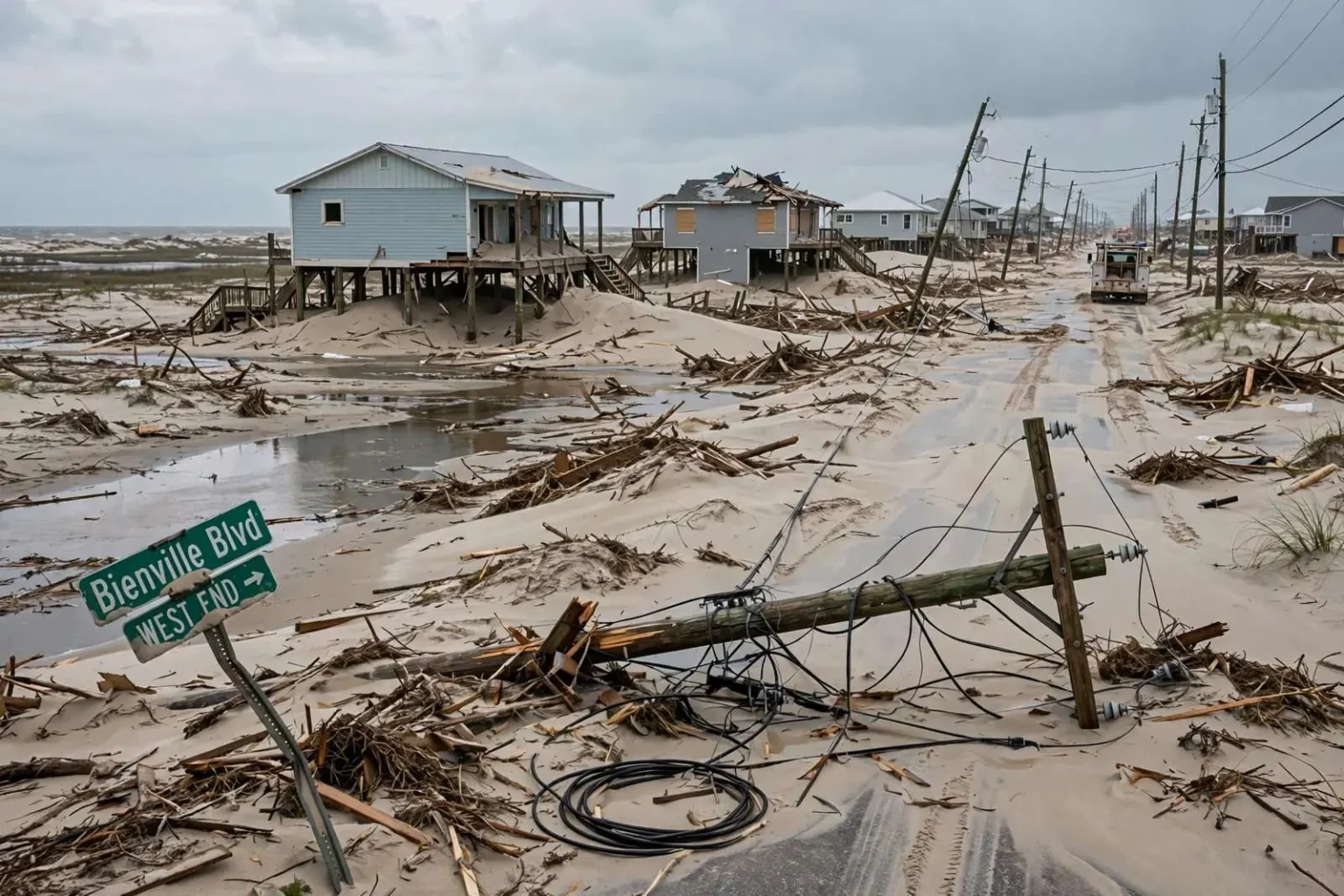
DAUPHIN ISLAND, Ala. — Dauphin Island emerged as one of the hardest-hit spots in south Mobile County when Hurricane Ida swept through, and Mayor Jeff Collier says the island was still in the early stages of cleanup as floodwaters and sand covered the west end, where most residents remained without power.
The barrier island, which guards the entrance to Mobile Bay and sits squarely in the path of storms entering the central Gulf, took the brunt of Ida’s effects even though the hurricane’s landfall fell far west of Alabama’s coastline. Distance from the storm’s center offered little protection to a low-lying island whose west end rises only a few feet above sea level, and the days after Ida passed found the community once again measuring what the Gulf had taken.
“This equals to if not exceeds what we saw during Sally and Zeta last year,” Collier said, comparing the damage to the two major storms that struck the island in 2020. The comparison carried weight in a community that had barely finished repairing from the previous season. Hurricane Sally had come ashore to the east in September 2020, and Hurricane Zeta had followed in late October, and together the two storms had tested every part of the island’s defenses. For Ida’s damage to match or exceed that toll, barely a year later, told residents how severe the new round of impacts was.
Ida’s powerful storm surge shoved sand and water onto Bienville Boulevard, toppled power poles and made the west end of the island impassable. Bienville Boulevard serves as the island’s main thoroughfare, running the length of the community from the eastern end’s shops and ferry landing through the residential stretches that thin out toward the western end. When surge water and sand bury the boulevard, the island’s spine is broken, and the parts of the community beyond the damage become difficult or impossible to reach.
An Island Built on Shifting Sand
Dauphin Island’s geography explains both its appeal and its vulnerability. The island is a classic Gulf Coast barrier island, a narrow strip of sand that migrates and reshapes itself with every significant storm. The east end, where much of the town’s permanent infrastructure sits at higher elevations, weathers storms better than the west end, a long low stretch of mostly residential property that has been flooded repeatedly over the decades and has seen entire rows of beach houses knocked from their pilings by past hurricanes.
That difference showed again after Ida. Most of the impact was concentrated on the west end, where surge rolled across the low ground and left behind a landscape of sand drifts, standing water and downed utility lines. While the rest of the island reopened after the storm, the west end stayed cut off pending cleanup, isolating the residents — many of them seasonal property owners — whose homes stand along the western miles of the island.
For the island’s year-round residents, the storm’s timing compounded the disruption. Ida’s approach came at the height of the late-summer season, when the community was preparing for the Labor Day weekend that traditionally draws visitors to the coast. Instead of final preparations for a holiday crowd, the island found itself clearing roads, restoring power and accounting for the damage along its western shoreline.
The power outages struck most of the residents on the west end, where toppled poles took the distribution lines down with them. Restoring electricity to a barrier island after a surge event is a multi-step process: crews must first clear the debris and sand that block access, then repair or replace the poles and lines, then energize the circuits section by section. On an island reachable by a single bridge or by boat, every truckload of material and every crew must cross that narrow connection to the mainland.
Recovery Measured in Weeks
Collier said recovery would be measured in weeks. “I think it’s going to take multiple weeks at least before we can get things back to where you can get back down there without too much trouble, so it’s going to take us quite a bit of time,” he said. The timeline reflected the scale of the cleanup: tons of sand deposited across roadways, debris scattered through neighborhoods, utility infrastructure to rebuild and private property damage to assess, all on an island with limited access and limited equipment of its own.
Sand removal is among the most labor-intensive tasks a barrier island faces after a surge event. Waves of sand deposited across roads can be feet deep in places, and the material must be scraped, hauled and in some cases sorted from the debris mixed within it. Until the boulevard is cleared and made safe, utility crews cannot follow behind to restore power, and residents cannot return to assess their own properties.
A concert planned for Labor Day weekend there was relocated to the rodeo grounds, a small logistical footnote that captured the storm’s larger disruption. The rodeo grounds, on the island’s more protected east end, could host the event that the west end venue could not, and the relocation let the holiday weekend go on — a signal to residents and visitors alike that the island’s life continues even as its western reaches wait for cleanup.
The sequence of storms that has struck Dauphin Island in recent years has become part of the community’s reality. Sally and Zeta in 2020, and now Ida, have each left their mark within a span of about twelve months, and each round of damage, repair and recovery has tested the island’s finances, its infrastructure and its residents’ resolve. Barrier island communities across the Gulf live with the same calculus: the beauty and the risk arrive together, and every storm season renews the question of what can be rebuilt and how.
For now, the work on Dauphin Island continues — crews on the boulevard, utility lines going back up, residents waiting for the word that the west end is open again. Collier’s estimate of multiple weeks sets the expectation, and the island has been through this before. What Ida left behind will be cleared, as Sally’s and Zeta’s marks were before it, by a community that knows exactly what the Gulf can do and rebuilds anyway.
The Bridge That Connects Everything
Every recovery task on Dauphin Island passes through a single chokepoint: the Gordon Persons Bridge, the span that carries traffic across the Gulf of Mexico waters of Pelican Bay and connects the island to the mainland via Alabama State Route 193. When storms damage the island, every line truck, front-end loader, dump truck and utility crew must cross that one connection, and the pace of cleanup is measured by how quickly materials and equipment can flow across it.
The island’s isolation shapes its disaster response in ways mainland communities never face. There is no alternate route, no parallel highway to distribute traffic. Emergency management planning for Dauphin Island always begins with the bridge — keeping it open, prioritizing the vehicles that cross it, and sequencing the recovery so that the most critical work happens first. After Ida, that sequencing meant road clearing ahead of utility repair, and utility repair ahead of reopening the west end to residents.
Mobile County’s emergency management apparatus coordinates with the town during events like this, linking the island’s small municipal government with county, state and federal resources. Damage assessments conducted after the storm feed into the documentation that determines whether the community qualifies for public assistance programs, and the town’s officials have been through the process enough times in recent years to know what the paperwork requires.
Life on a Barrier Island After the Storm
For the residents who stayed through Ida or returned quickly after it, the days that followed followed a familiar routine. Chainsaws and rakes came out first. Neighbors checked on neighbors, generators hummed behind houses without power, and the island’s lines of communication — the local social media groups and word of mouth that serve as the community’s nervous system — carried reports of who had damage, who needed help and which roads were passable.
The east end’s quicker recovery allowed the parts of island life that anchor the community to resume. The ferry landing, the shops and restaurants near the eastern end of Bienville Boulevard, the church congregations and the school bus routes that connect island children to mainland schools all depend on the east end functioning, and its earlier reopening kept daily life on the island from halting entirely while the west end waited.
The seasonal rhythm adds another layer. The west end’s beach houses are owned in large part by families from across the Gulf Coast region and beyond, many of whom were not on the island when Ida struck. Property owners returning after the storm faced the same scene that has greeted them after Sally and Zeta and the storms before those: sand where driveways should be, debris in yards, and the question every barrier island owner eventually asks — what will this storm season cost, and is the next one far behind?
Ida itself went on to become one of the defining storms of the 2021 season, but its reach extended well before its catastrophic landfall far to the west. The outer bands and surge that swept the north-central Gulf coast reminded communities from southeast Louisiana to the Alabama line that a hurricane’s damage is not confined to the point where its eye comes ashore. Dauphin Island’s experience proved the point: the island took damage equal to or worse than the previous year’s direct hits from a storm that never came close to making landfall in Alabama.
The lesson is one the island has absorbed across decades of Gulf storms. Distance from the eye means little to a low-lying barrier island when the surge direction and the winds align against it. The town’s building codes, its elevated construction and its storm-hardened infrastructure reflect that reality, and each recovery adds to the playbook for the next one.
By the time the west end reopens and the last sand is cleared from Bienville Boulevard, the island will have completed its third major cleanup in roughly a year. The concert at the rodeo grounds will be a pleasant memory of a holiday weekend that went on despite the storm, and the west end’s residents will have their island back — until the next time the Gulf decides to test it again.