Dauphin Street Beer Festival Turns 21 With a Crawl Through Downtown Mobile
Dauphin Street Beer Festival Turns 21 With a Crawl Through Downtown Mobile — local South Alabama news from southalnews.com.
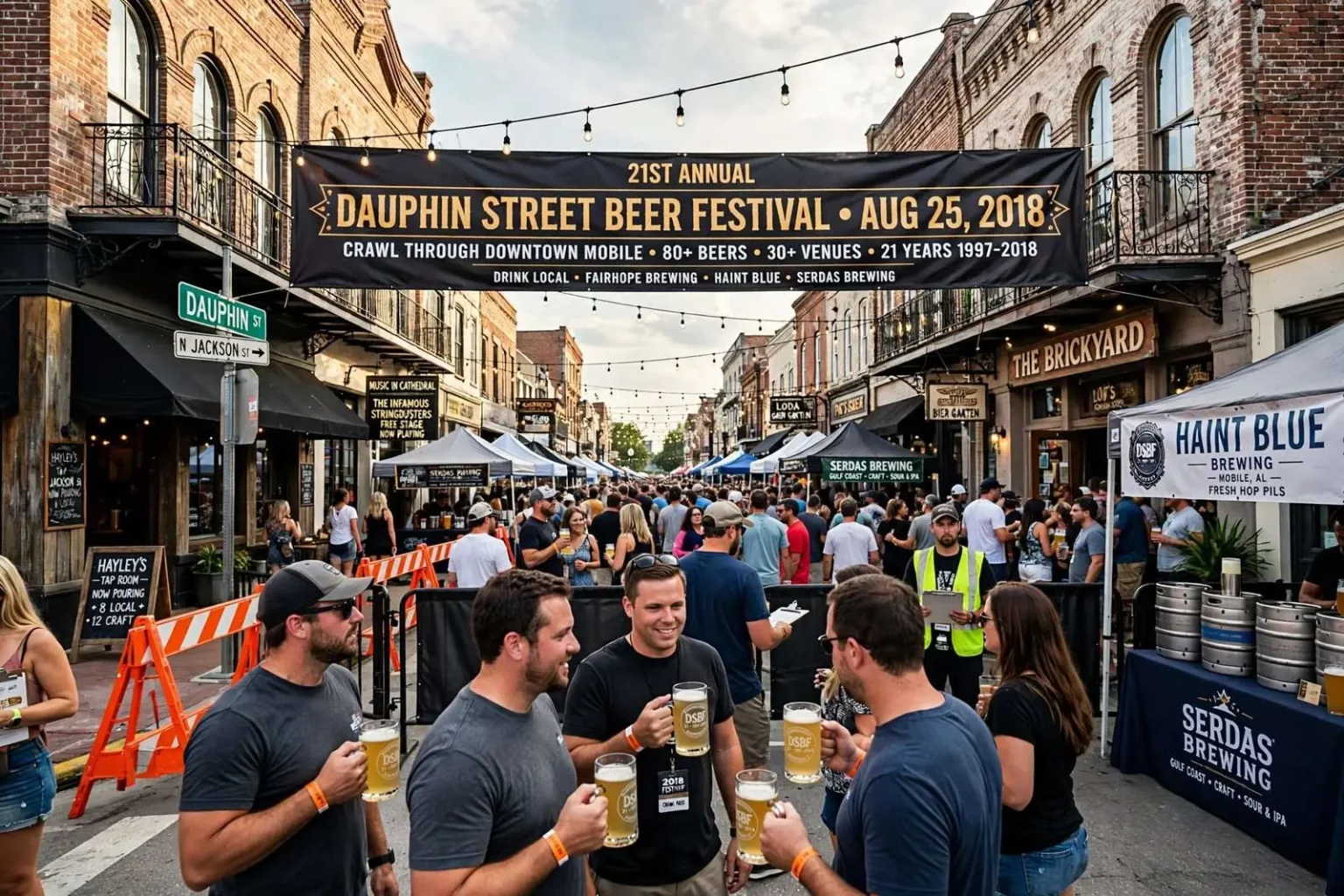
The Dauphin Street Beer Festival turned 21 in style on Aug. 25, 2018, sending more than 80 beers from around the world pouring across 30-plus taverns and restaurants in downtown Mobile. A $30 ticket bought a commemorative mug, membership card and wristband for the annual crawl.
Twenty-one editions in, the festival has become one of the anchors of downtown Mobile’s event calendar, and the coming-of-age number suited it. What began as a novelty crawl had matured into a production that closes a street, moves thousands of participants between venues, and fills registers across the entertainment district on a late-summer Saturday when the calendar would otherwise be quiet.
A Maturing Tradition
When the festival began in 1997, craft beer was nearly impossible to find downtown. Two decades later, Fairhope Brewing Company holds down the Eastern Shore while newer Mobile breweries like Haint Blue and Serdas Brewing have reshaped the drinking culture. Signs all along Dauphin encouraged guests to drink local.
The arc tracks the transformation of American beer itself. In 1997, the craft brewing wave that had swept the West Coast and the Southeast’s larger cities had barely reached the Gulf Coast; a downtown Mobile bar’s tap list was a wall of industrial lagers with an occasional import. By 2018, the region supported its own production breweries, taprooms had become social anchors, and festival-goers arrived with opinions about hops and sours that would have been exotic a generation earlier. The festival grew up alongside that revolution, and its 80-plus beer roster — international and local alike — reflected a market that now expected variety.
The push to drink local acknowledged the new hierarchy. Fairhope Brewing, across the bay in Baldwin County, gave Eastern Shore drinkers a hometown taproom, while Haint Blue and Serdas put production breweries inside Mobile proper. For festival organizers, featuring local beers is both civic pride and practical economics — the breweries that pour at the festival are the ones whose year-round success keeps the city’s beer culture alive between editions.
The road was blocked from near N. Jackson St., letting throngs move safely between Hayley’s, Heroes, Pat’s, Boo Radley’s and The Brickyard. Savvy guests fanned out to shorter lines at spots like Loda Bier Garten and T.P. Crockmiers.
The Crawl Mechanics
Closing Dauphin Street to traffic is the festival’s central engineering decision. With the road blocked from near North Jackson Street, participants could drift between venues on foot, mug in hand, without crossing live traffic — the difference between a street party and an organized crawl of separate establishments. Police and event staff manage the closure, and the venues along the corridor become stations on a single continuous route.
Veterans of the event develop strategies. The named venues — Hayley’s, Heroes, Pat’s, Boo Radley’s, The Brickyard — draw the heaviest crowds, and lines for the rarest pours can stretch out the door. Guests who fan out to Loda Bier Garten or T.P. Crockmiers find shorter waits and often the more adventurous selections, a dynamic organizers encourage: the festival’s promise is that every participating door holds something worth the stop. With more than 80 beers spread across 30-plus stops, no single venue can be more than a fraction of the experience, and the crawl format turns venue-hopping into the entertainment itself.
The $30 ticket economics made the arithmetic easy for attendees. The mug, membership card, and wristband covered sampling across the district at a per-beer cost no bar night could match, and the keepsake mug turned the wristband-and-mug combination into an annual souvenir — the kind of detail that builds a tradition’s ritual quality. For venue owners, the ticket revenue and the guaranteed crowd compensate for the cost of staffing a festival-scale Saturday, and the exposure to thousands of new faces is the deeper payoff.
Music and Late Nights
Cathedral Square hosted a free tent with local favorites The Infamous Stringdusters, while Alchemy Tavern’s patio featured 80s cover band Venom and its upstairs kicked off karaoke. The Blind Mule ran a separate patio entrance, and Hayley’s stayed packed well into the morning.
The music programming extended the festival beyond beer. Cathedral Square — the park at the heart of the Dauphin Street district — gave the event a free, open-air stage where anyone could soak in the atmosphere without a ticket, a public gesture that keeps the festival connected to the whole city rather than only paying attendees. The band bookings matched the crowd: bluegrass and jam-oriented acts like the Stringdusters fit the beer-festival demographic the way 80s covers fit Alchemy’s patio party.
As the evening aged, the crawl splintered into its natural after-parties. Karaoke upstairs at Alchemy, the Blind Mule’s separate patio entrance managing its own crowd flow, and Hayley’s running until morning gave participants anywhere to land — and gave the district’s venues their own late-night windfalls. The festival’s real duration has always stretched well past its official hours, and the after-midnight economy is part of what makes the event worth the production cost for the businesses involved.
Twenty-One Years of Downtown Transformation
The festival’s lifetime spans the rebirth of downtown Mobile itself. In 1997, Dauphin Street’s entertainment district was still proving itself; the blocks that now fill with foot traffic on event nights were emerging from decades of retail flight and suburban drift. Bars and restaurants that staked their futures on the corridor did so on faith, and events like the beer festival became the proof of concept — nights when the district demonstrated it could draw the whole metro area downtown.
That history explains the organizers’ stated philosophy: the low ticket price is essentially an advertisement for downtown business, and the hope is that first-timers become regulars. A $30 pass introduces thousands of people to venues they might never otherwise enter, and every festival veteran can name the bar they discovered during a crawl and kept returning to. The mug and wristband are souvenirs; the customer relationships formed over the course of a summer Saturday are the actual product.
The 21st edition also showed how far the district’s offerings had diversified. A 1997 crawl would have had little local beer to pour and no production breweries to feature; the 2018 version poured Haint Blue and Serdas alongside imports, boosted by Fairhope’s Eastern Shore operation, with a live-music footprint that ranged from Cathedral Square’s free stage to patio bands and karaoke. The festival no longer sells just beer — it sells a version of downtown Mobile that has become real.
The Anniversary Crowd
The late-August date has always served the festival well. Coming after the summer lull and before Mardi Gras season begins ramping up, the event lands when students have returned, vacation season is ending, and downtown businesses welcome a surge. The evening timing keeps participants ahead of the worst heat, and the street closure turns the corridor into an open-air gathering that feels like a block party scaled to a district.
Twenty-one years is long enough for traditions to acquire their own folklore — the strategies for beating lines, the venues that always deliver, the morning-after stories that Hayley’s midnight crowds generate. It is also long enough to matter economically: hundreds of thousands of dollars flow through the district’s registers on festival night, and the event’s consistency — two decades without a missed beat — is what lets downtown businesses plan around it.
As the 2018 crawl wrapped, with the last pours drawn and Hayley’s still full in the early morning, the festival’s 21st year closed the way its organizers have always intended: as the best possible advertisement for the street that hosts it. More than 80 beers, more than 30 venues, one closed road, and a crowd that now spans generations of Mobile drinkers — the Dauphin Street Beer Festival has come of age, and downtown has come up with it.
Beer Tourism and the Gulf Coast Craft Wave
The festival’s growth parallels the craft brewing industry’s arrival on the Gulf Coast. Production breweries are economic anchors as much as drinking establishments — they draw visitors, anchor districts, and supply the bars and restaurants around them. Fairhope Brewing’s presence on the Eastern Shore gave Baldwin County a destination taproom, while Haint Blue and Serdas brought brewing into the city proper, shortening the loop between Mobile’s production and its pint glasses. Beer festivals everywhere have benefited from that build-out, but few host cities have seen their local scene develop so dramatically during a festival’s own lifetime.
For visitors, the 2018 edition doubled as a survey of that landscape. A drinker moving through the crawl could taste German-style lagers and Belgian ales from abroad, then find Gulf Coast-brewed options a stop later, with the “drink local” signage nudging the choice. Local participation in festivals of this kind feeds back into the breweries’ growth: every convert made at a crawl is a future taproom regular and grocery-aisle customer.
What Regulars Know
Two decades of the same event breeds expertise, and the 21st edition rewarded it. Regulars know to arrive with a plan but hold it loosely — the biggest names on the beer list draw queues that snake down the block, while the gems often sit at venues with room to spare. They know Cathedral Square’s free tent is the place to regroup, that Alchemy’s patio will run hottest in the early evening, and that the night belongs to whoever paces the first two hours sensibly.
They also know the social mechanics that make the festival unusual among beer events. Because the street itself closes, the crawl blurs the line between venue and festival — conversations start in line at one stop and finish blocks away, and groups form and dissolve across the district all night. That fluidity is what the organizers are really selling: not 80 beers so much as one long evening in which the whole of downtown Mobile becomes a single room.
The membership card that comes with each ticket nods to that continuity — a small token that treats attendees as members of something annual rather than customers of a one-off. At 21, the festival has earned the framing: long enough to have history, still young enough to grow.
By any measure the anniversary delivered what the district needed: a packed Saturday, a showcase for the local beer now brewed on both sides of the bay, a stage for the bands that give the crawl its soundtrack, and a fresh crop of first-timers — the future regulars every ticket is designed to create.