Davidson High Student Accused of Punching, Choking School Employee
Mobile police say a 17-year-old Davidson High student punched and choked a school employee; the teen was taken to Strickland Youth Center.
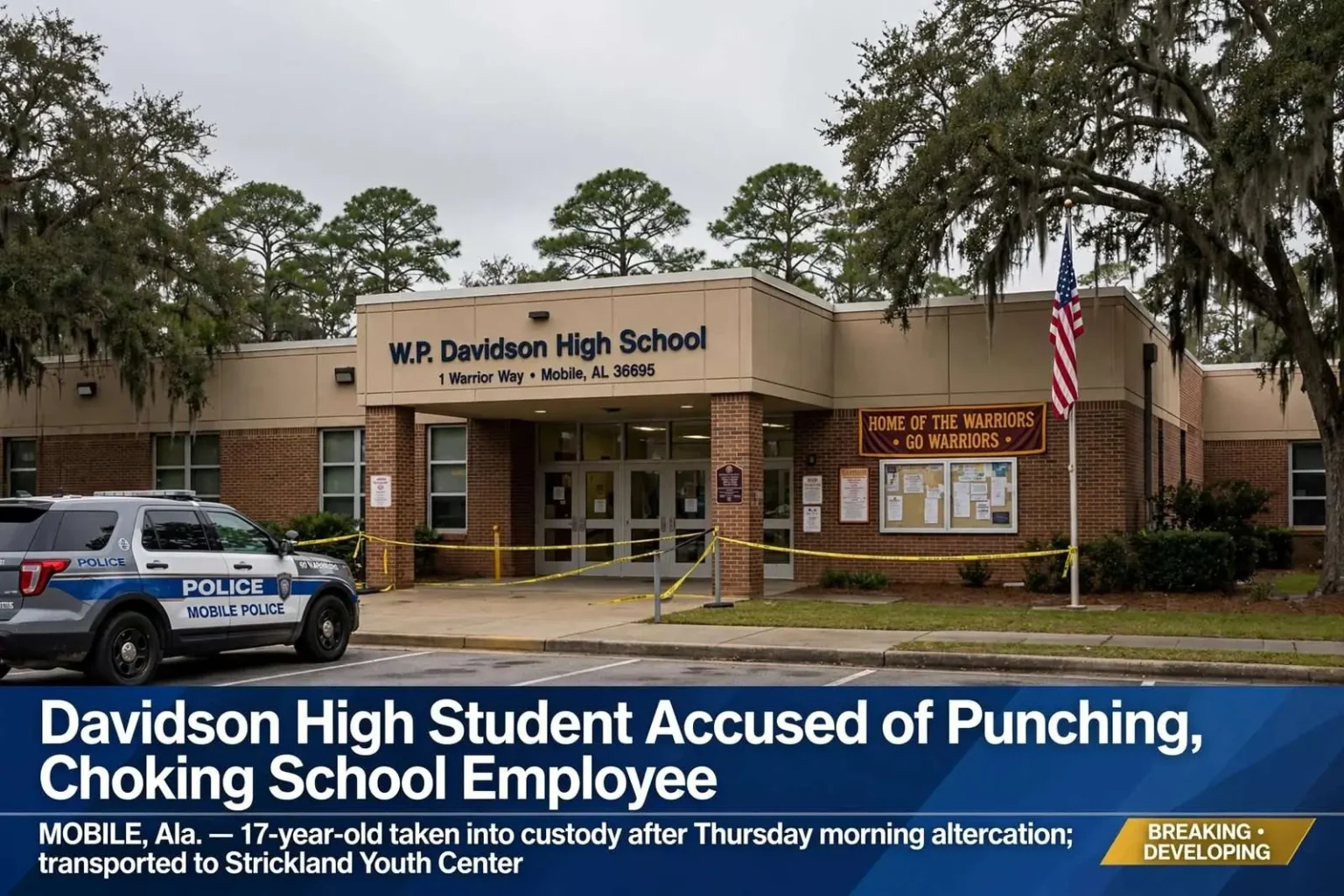
MOBILE, Ala. — Mobile police are investigating after a Davidson High School student allegedly attacked a school employee on campus, punching and choking the worker during an altercation Thursday morning.
According to the Mobile Police Department, the 17-year-old student was taken into custody after the incident, which was reported at around 10:30 a.m. The student was transported to Strickland Youth Center, which handles juvenile detentions for Mobile County.
Police have not released what may have led up to the confrontation, and the name of the employee and the extent of any injuries were not disclosed. Because the accused is a juvenile, the case will proceed through the juvenile justice system.
Incidents involving students accused of assaulting school staff set in motion two separate institutional responses: a police investigation into the alleged attack, and a school district process that governs the student’s status in the school system. The two proceed on different tracks and on different timetables, and neither depends on the outcome of the other.
For the school community, the morning also brought the practical aftermath of a campus incident — questions from parents, reassurance from administrators and the task of continuing a normal school day for the students who witnessed none of it.
Davidson High and the district it belongs to
W.P. Davidson High School is one of the comprehensive high schools in the Mobile County Public School System, the largest school district in Alabama, serving students in west Mobile. The school draws from a broad suburban attendance zone and fields well-known athletics and academic programs, and it operates under the district’s standard code of conduct governing student behavior on campus.
District policy across Mobile County treats physical assaults on employees as among the most serious offenses in the student code of conduct, with consequences that can include long-term suspension or expulsion regardless of what happens in any criminal proceeding. The district also coordinates with law enforcement when an incident on campus rises to the level of a reported crime, as happened here.
School system administrators generally handle communication with families after a campus incident, and principals are tasked with keeping the school day as routine as possible for the vast majority of students who were not involved. Details about a juvenile suspect and an employee victim are typically limited both by privacy law governing minors and by the district’s practice of not publicly discussing personnel matters.
Strickland Youth Center’s role in Mobile County
Strickland Youth Center, located in Mobile, serves as the juvenile detention facility for Mobile County. When police take a juvenile into custody on serious charges, the youth is transported to Strickland rather than an adult jail, where staff from the juvenile court system handle intake and where detention decisions are made under state law governing when a juvenile may be held.
The facility works in tandem with Mobile County’s juvenile court, whose judges hear the cases of young people referred by law enforcement agencies across the county. Detention before a court hearing is reserved under Alabama law for cases where a juvenile is considered a risk to public safety or a flight risk, and any continued detention must be reviewed by a judge within a short window after intake.
A case like Thursday’s will move through that system — intake, an initial detention hearing, and eventually adjudication proceedings before a juvenile court judge. Proceedings are closed to the public and records are confidential, which is why the public account of what happened ends where it does, with a student in custody and an investigation ongoing.
What Alabama law says about assaults on school employees
Attacks on teachers, aides, administrators and other school personnel are treated with particular seriousness under Alabama law. The state legislature has repeatedly strengthened penalties for offenses committed against school employees acting in the course of their duties, and an assault that involves physical injury can carry felony exposure even for conduct that might be charged more lightly in another setting.
For a juvenile suspect, the criminal consequences run through the juvenile court rather than the adult system. Juvenile adjudication is focused on rehabilitation as well as accountability, and the range of outcomes available to a judge extends from probation and counseling to commitment to the state Department of Youth Services, depending on the severity of the offense and the young person’s history.
Nothing in that process happens quickly or publicly. Investigators must complete their work, the district attorney’s office decides how to proceed, and the juvenile court holds hearings that are closed to spectators and largely shielded from disclosure. Residents hoping for details about what led to the altercation are unlikely to get them at any stage unless the case were transferred out of the juvenile system, an outcome reserved for the most serious offenses.
When a school day is interrupted
Police activity on a school campus inevitably ripples outward. Students in nearby classrooms hear or see parts of the response, word travels on phones within minutes, and by afternoon parents are asking in group chats and at pickup lines what happened and whether their children are safe.
School districts generally respond with a familiar playbook: confirm the facts, communicate with families as far as privacy allows, make counseling available to students affected by what they saw, and emphasize that staff followed the procedures designed for exactly this kind of incident. Mobile County schools maintain safety plans for each campus, coordinated with local law enforcement, that govern how staff respond when a confrontation turns physical.
The employee at the center of Thursday’s incident, whose name and condition were not disclosed, is covered by the district’s personnel privacy practices, and any leave or accommodations the employee receives would not be public. Teacher and staff organizations have long pushed for stronger protections and clearer reporting pathways when school employees are assaulted, arguing that such incidents are more common than the public record reflects because they are handled quietly and rarely charged.
What comes next in the case
In the near term, the police investigation will determine the charge or charges forwarded to juvenile authorities, and the district attorney’s office will review the evidence before the juvenile court docket takes up the case. The school district, separately, will conduct its own review under the student code of conduct, which can result in disciplinary measures independent of anything the court decides.
Neither process will unfold in public. Juvenile confidentiality and personnel privacy will keep names, motives and outcomes largely out of view, and the Mobile Police Department’s public account — a 17-year-old in custody at Strickland, an investigation ongoing — is likely to remain the full public record unless authorities announce a development.
What residents can take from the morning is procedural reassurance: an employee was allegedly attacked, police responded the same morning, a suspect was taken into custody and transported to the county’s juvenile facility, and the systems built for such incidents — police, juvenile court and school administration — each picked up their part of the case. The questions that remain unanswered, including what started the altercation and how badly the employee was hurt, belong to those processes now.
How the morning unfolded
The report reached Mobile police at around 10:30 a.m. Thursday, on a school day when campus offices were fully staffed and hallways were busy with class changes. Responding officers took the 17-year-old into custody on campus, and the school continued operating while the police response was underway — the standard approach for an incident confined to the people directly involved rather than a broader threat to the building.
Taking a juvenile suspect to Strickland Youth Center rather than processing the arrest in another setting reflects the routine division between the adult and juvenile systems in Mobile County. From the moment of intake, the young person is in the custody of the juvenile court system, not the county jail, and every decision that follows — detention, charges, hearings — is governed by the juvenile code.
Police acknowledged that the confrontation’s origin remains unknown. Investigators will interview the student, the employee and any student witnesses, and they will collect any video from campus security cameras, which in modern school buildings cover hallways, offices and entrances. What they find will shape both the charge decision and the school district’s disciplinary review.
Juvenile cases and the public’s questions
Residents following the case will find that it moves largely out of public sight, and that is by design. Alabama’s juvenile code keeps court proceedings and records confidential to protect young people from the lifelong consequences of public criminal records, and it limits what police can disclose even when an arrest is a matter of public knowledge.
The practical effect is that the community is left with an outline rather than a narrative: an altercation in the middle of a Thursday morning, an employee allegedly punched and choked, a 17-year-old in detention, an investigation continuing. Whether more is ever disclosed will depend on how the case proceeds through a system that is built to resolve such matters quietly.
That confidentiality can frustrate parents who want reassurance with specifics. School officials walk a similar line, since discussing an employee’s medical status or a student’s discipline would violate privacy rules that protect both sides. What administrators can say — and generally do say in such cases — is that the incident involved specific individuals, that police were called, and that there was no ongoing threat to the campus.
The broader question of school safety
Incidents of students assaulting staff renew a long-running conversation in Alabama school districts about support for teachers, training for de-escalation and the resources available to schools for handling students in crisis. Educator groups in the state have periodically pushed for stronger reporting requirements when staff are injured, so that the frequency of such incidents is visible in state data rather than scattered across local reports.
Districts, for their part, balance discipline with services: a student involved in a serious incident may also be evaluated for the underlying causes of the behavior, from family instability to mental health needs, particularly in the juvenile system’s rehabilitation-oriented framework. Neither approach excuses an assault; they simply operate on parallel tracks, one punitive and protective, the other corrective.
For now, the case sits where Thursday’s events left it. A Davidson High employee was allegedly attacked inside a Mobile school, a 17-year-old is held at Strickland Youth Center, and Mobile police say their investigation remains open. The juvenile court will take up what happens next, in a process the public will watch only through its outline.