Dead manatee pulled from Mobile River near downtown
A manatee recovered from the Mobile River near downtown is undergoing a necropsy as biologists work to determine its cause of death.
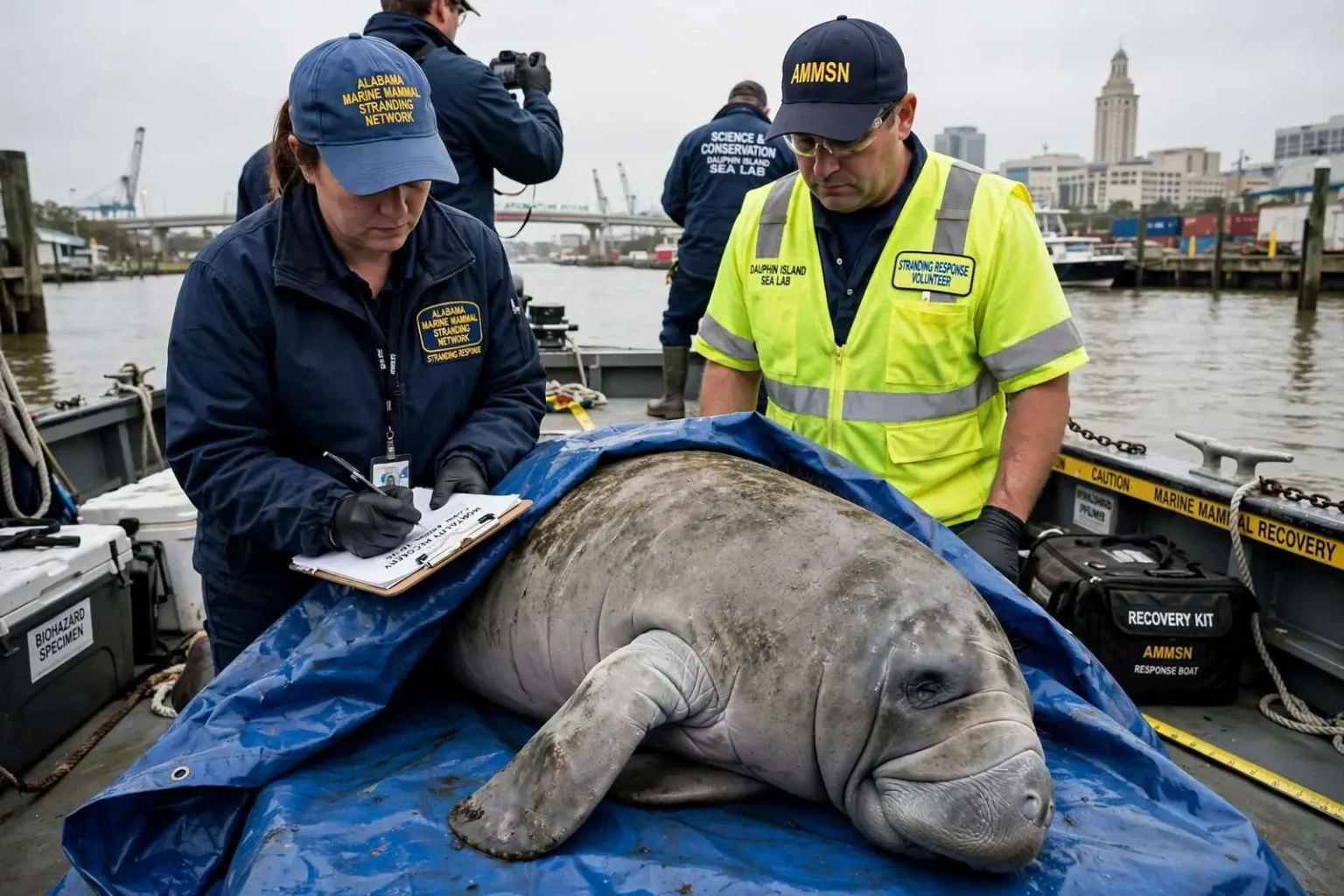
Marine biologists are awaiting necropsy results to determine what killed a manatee recovered from the water near downtown Mobile. Staff and volunteers with the Alabama Marine Mammal Stranding Network pulled the animal from the Mobile River on Wednesday.
Video of the recovery shows crews handling the manatee’s body; some viewers may find the footage graphic. The animal’s remains were taken for examination, and researchers hope the necropsy — the animal equivalent of an autopsy — will establish the cause of death and add to what is known about the manatees that visit Alabama waters each year.
Manatees in Alabama waters
West Indian manatees are warm-water mammals most often associated with Florida, but every warm season a number of them move west along the Gulf Coast into Alabama. They arrive through Mobile Bay and range into the Mobile-Tensaw Delta, the brackish bays, rivers and bayous north of the city where freshwater from the vast delta system mixes with Gulf water. Seagrass beds and other submerged vegetation provide food, and in the heat of summer the delta’s waters offer comfortable temperatures for an animal that cannot tolerate cold.
Sightings have become regular enough that locals know to keep an eye out in places like the Mobile-Tensaw Delta, Mobile Bay and the rivers that feed them. Manatees are graceful but slow, surfacing quietly to breathe and often traveling just below the surface where boaters cannot easily spot them. Their presence here is a sign of healthy habitat — and also a source of risk, since the same shallow, heavily used waterways that attract manatees carry significant boat traffic.
How a stranding response works
The Alabama Marine Mammal Stranding Network is the state’s organized response for whales, dolphins, manatees and other marine mammals that turn up sick, injured or dead. Coordinated through the Dauphin Island Sea Lab, the network trains and dispatches responders who can document a carcass, recover it safely and arrange for examination. When a live animal strands, the same network coordinates rescue, transport and rehabilitation efforts with partners in Alabama and Florida.
A recovery like Wednesday’s follows a careful protocol. Responders record the location, photograph the animal, take measurements and note external injuries before the remains are moved. That documentation matters even before the necropsy begins: the size, condition and markings of the animal all contribute to understanding its life history and its death. Because the recovery took place on the Mobile River in a visible, downtown area, crews also had to manage the practical realities of working on a working waterfront.
What the necropsy can show
The necropsy gives scientists their best chance to answer the question everyone asks first: what killed this animal? Common findings in manatee deaths include boat strikes, which leave characteristic propeller cuts or blunt trauma; cold stress, which develops when the animals linger in water that stays too cool; entanglement in fishing gear; and disease or natural illness. In some cases the examination reveals perinatal loss, when a young animal dies at or shortly after birth.
Each data point feeds a larger record. Manatees are protected under the federal Marine Mammal Protection Act and are listed as threatened under the Endangered Species Act, following their reclassification from endangered in 2017. Scientists track mortality closely because it informs protection measures — boat speed zones, habitat protections and rescue capacity — both in Florida’s core population and along the expanding edges of the range, which includes the northern Gulf Coast.
What the public should do — and not do
Officials are using the case to remind the public of the most important rule: if you spot a sick, injured or dead marine mammal in Alabama waters, do not push it back into the water. That instinct, though well meaning, can do harm. A live animal that appears stranded may be resting, sick or injured, and returning it to the water can separate it from needed care, delay responders and destroy the evidence needed to understand its condition. A dead animal that is pushed back out may simply surface again somewhere else, unrecovered and unexamined.
Instead, the public is asked to call the Alabama Marine Mammal Stranding Network at 1-877-WHALE-HELP. Callers should be ready to describe the location as precisely as possible, the condition of the animal, whether it is alive, and any visible injuries. Keeping other people and pets away from the animal while help is summoned protects both the animal and the public, since marine mammals can carry diseases and injured animals can behave unpredictably.
For living manatees that appear healthy — swimming normally, surfacing regularly — the guidance is different: enjoy the sighting from a distance and report it. Sightings reports help researchers map where manatees are spending time in Alabama, information that guides protection efforts. Boaters are urged to follow posted speed rules, wear polarized sunglasses to see below the surface, and give any manatee a wide berth, especially mothers with calves.
Why downtown Mobile matters as a habitat
The Mobile River runs through the heart of the city, and while the downtown waterfront is an industrial and commercial corridor, it sits within a watershed of extraordinary ecological value. The Mobile-Tensaw Delta, just north of the city, is one of the largest wetland systems in the country and supports an exceptional range of species, from alligators and black bears to the manatees that swim up from the Gulf. The river itself connects that delta to Mobile Bay and, ultimately, the open Gulf.
That connectivity is how a manatee ends up near downtown in the first place. An animal following food or warm water can travel many miles up the river system in a few days, passing through busy waters along the way. Recovery crews working downtown are reminded by such incidents that the city’s waterfront is not separate from the ecosystem around it — it is part of a corridor that wildlife uses, sometimes in the middle of Alabama’s largest port.
The people behind the recovery
Recovering a 1,000-pound animal from a tidal river is not a job for one person. Stranding network responses depend on trained staff and volunteers, boats and equipment, and cooperation from other agencies with jurisdiction over the site. The work can be physically demanding and emotionally difficult, particularly when the animal involved is a species the public loves and the outcome cannot be changed. The network’s crews take on that work because every recovered animal adds knowledge that helps protect the rest of the population.
Volunteers and members of the public who want to support that work can do so by reporting sightings and strandings promptly, which is the network’s single most valuable source of information. Time matters in every case: for a live animal, quick reports can mean the difference between rescue and death, and even for a dead animal, an early call means fresher evidence and a more informative necropsy.
The necropsy results for Wednesday’s manatee will be added to the record of manatee activity in Alabama waters, joining the data that scientists use to understand how these animals use the northern Gulf Coast. Until those results are known, the network’s message to the public stays the same: report what you see, do not interfere, and call 1-877-WHALE-HELP whenever a marine mammal is found sick, injured or dead in Alabama waters.
Boaters as first line of defense
Because most manatee injuries in busy waterways come from boats, the boating community plays an outsized role in manatee protection along the Gulf Coast. Slowing down in shallow water gives manatees time to move and gives pilots time to see the tell-tale swirls and wakes a swimming manatee leaves behind. Sticking to marked channels keeps boats in deeper water where manatees are less likely to feed. And a propeller guard is worth considering for anyone who spends the season in the Delta or the Bay, where encounters are increasingly common.
The law backs up those practices. Harassing, touching, feeding or attempting to move a manatee is prohibited, and violations can carry federal penalties under the protections that cover the species. Officials stress that even well-intentioned interaction — steering a manatee away from a dock, pulling one closer for photos, offering food or fresh water — can change the animal’s natural behavior and put it at risk. Observation from a distance is both the legal and the safe approach.
What scientists still hope to learn
Alabama’s manatee visitors remain, in scientific terms, a relatively recent phenomenon, and every carcass and sighting adds to a young body of knowledge. Researchers want to know how many manatees enter Alabama waters each summer, where they travel within the Delta and the Bay, how long they stay, and what routes they use to move between Florida and Alabama. Answers to those questions determine whether the state’s waters warrant formal habitat protections and where boater education should focus.
The necropsy results from this week’s recovery will feed that record along with the rest. Whatever the examination shows, the fact that the animal made it to the Mobile River near downtown tells researchers something about the range these animals are willing to travel — and reminds everyone who works and lives along the waterfront that Alabama’s rivers and bays are shared with wildlife that has no regard for property lines or port schedules. The public can help make that sharing work by calling 1-877-WHALE-HELP whenever a marine mammal needs attention in Alabama waters.