
Delta Surge Pushes Ascension Providence COVID Numbers Past Prior Waves
Ascension Providence in Mobile is treating more COVID-19 patients than in any prior surge as the delta variant fills ICUs across South Alabama.
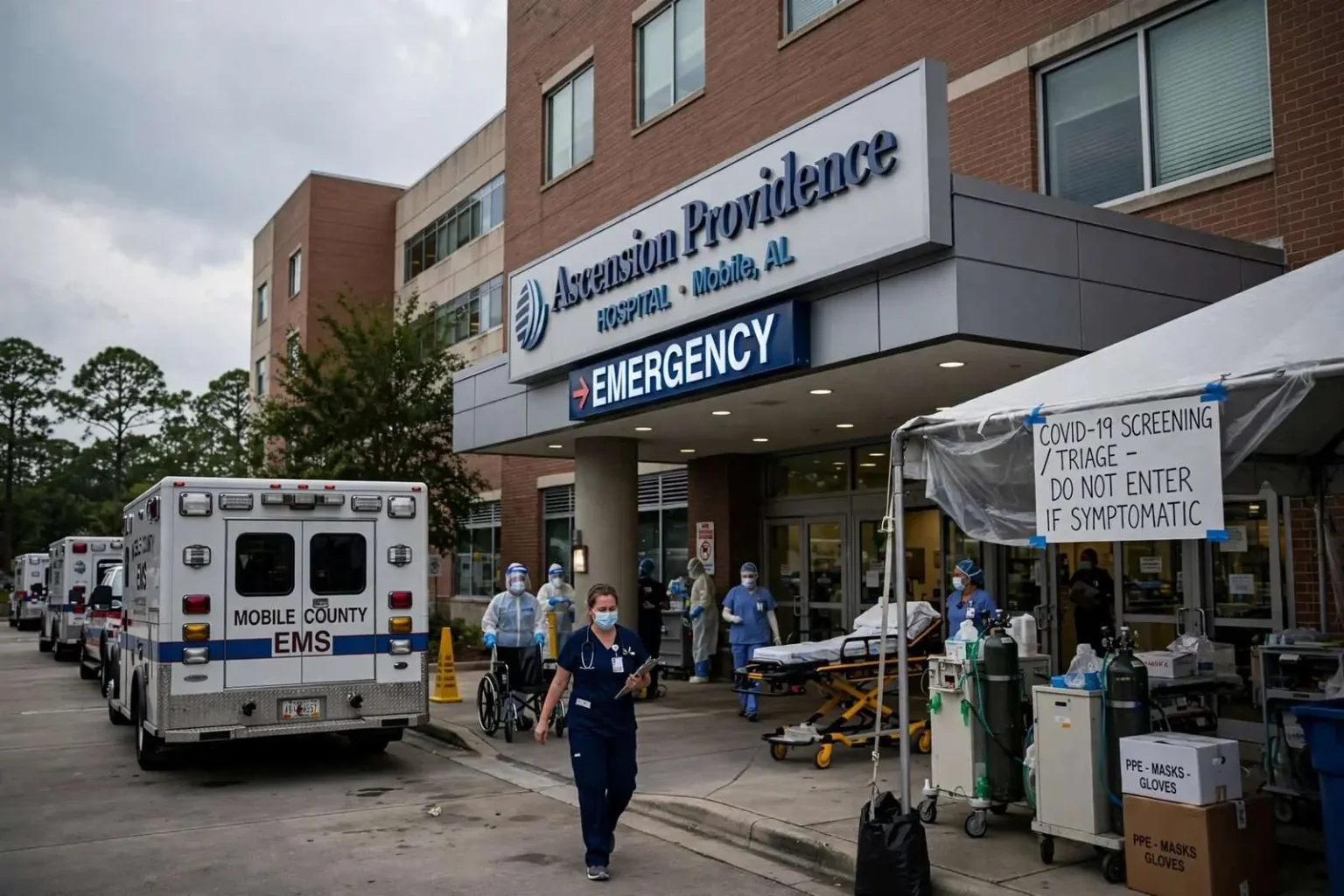
Ascension Providence hospital in Mobile is treating more COVID-19 patients than at any point in the pandemic’s previous two surges, as the highly contagious delta variant drives hospitalizations sharply upward across South Alabama.
Hospital administrators said 105 COVID-19 patients were being treated at the facility, with ICU beds running short and patients being held in the emergency department. The census was roughly 50% higher than just one week earlier and nearly ten times the level recorded on July 1 — even as the hospital continued to care for its regular patient load.
The numbers place Mobile’s hospitals in territory the city had not seen since the worst stretches of 2020. During the summer wave, intensive care units across the Gulf Coast filled with patients who were, on average, younger than in previous surges, and hospital systems that had spent a year and a half building surge capacity found it consumed within weeks. Patients waiting in emergency departments for an inpatient bed became the defining image of the delta surge, because the alternative — turning patients away — was never acceptable.
Ascension Providence, one of Mobile’s major hospitals, has served the city’s western communities for generations, and its staff lived through the earliest waves of the pandemic with the rest of the region’s health care workers. The delta surge, administrators said, was different in scale and in speed: the jump from a handful of patients in early July to a census exceeding a hundred by late summer compressed what had taken months in 2020 into a matter of weeks.
Care Quality Under Strain
“Those choices of those in the community not to get vaccinated have overwhelmed our health systems across Mobile and across the region,” said Todd Kennedy, president of Ascension Providence. The hospital leader’s assessment was blunt, and it reflected what administrators across Alabama were reporting during the same weeks: the patients filling beds were overwhelmingly unvaccinated, and the strain on hospitals was concentrated in communities with the lowest vaccination rates.
He warned that patients arriving with heart attacks, strokes, and other emergencies were not receiving the same level of care they had received weeks earlier, and that emergency room waits on some days stretched to eight hours. The phenomenon — sometimes called collateral damage by emergency physicians — arises when every bed, every nurse and every monitor is committed to the surge: care that would be immediate in normal times arrives late, and conditions that would be managed routinely compete for attention.
That degradation of care is the metric hospital leaders emphasize most when they ask the public to take the surge seriously. It is not only COVID-19 patients who suffer when a hospital is full; it is the resident with chest pain, the child with a broken bone, the mother in labor. Emergency medicine operates on a principle that every patient gets the care they need when they need it — and a hospital running at or beyond capacity cannot always keep that promise.
Kennedy stressed that triage still prioritized severity and urged anyone experiencing an emergency to seek care rather than stay home. The warning mattered because a familiar pattern had emerged during the surge: patients frightened by crowded emergency rooms were delaying care for heart attack and stroke symptoms, arriving at hospitals sicker than they would have been days earlier. Physicians across the region repeated the same message — a hospital under strain is still the safest place for a medical emergency, and delay only increases the danger.
Younger Patients, Low Vaccination Rates
About 89% of the hospital’s current COVID-19 patients were unvaccinated, and administrators noted this surge was sending notably younger patients into beds than earlier waves. The shift in demographics was one of the most alarming features of the delta wave for Alabama hospitals: adults in their 30s, 40s and 50s — people who had not been eligible for vaccination in the pandemic’s earliest months and who had, in many cases, chosen not to get the shot once they were — filled intensive care units that in 2020 had held mostly elderly patients.
The pattern tracked with the variant’s biology and the state’s vaccination picture. Delta spreads faster than earlier forms of the virus, and its wave crested first in communities where vaccination rates lagged. Alabama had spent the summer among the states with the lowest vaccination uptake, and Mobile County’s rates, while better than some rural counties, left a large share of the population without protection at precisely the moment the more contagious variant arrived.
The hospital encouraged everyone eligible to get vaccinated; only about 52% of its employees had done so at the time. The figure drew attention because hospital workers, like the general public, reflected the hesitancy present in their communities — and because their unvaccinated status carried professional consequences in a health care setting.
Ascension Health had announced the month before that it would require employees to receive the COVID-19 vaccine. The mandate, announced by the St. Louis-based parent of the Providence hospital, made Ascension one of the large national health systems to require vaccination for its workforce, and it followed similar moves by hospitals and health systems across the country as the delta variant spread. Administrators framed such requirements as a patient-safety measure: health care workers who see vulnerable patients every day were, in the words of system leaders, obligated to protect them from a preventable infection.
A region under pressure
What was happening at Ascension Providence was happening across South Alabama. Hospitals in Mobile, Baldwin County and the surrounding region activated crisis standards of care planning, postponed elective procedures to free up beds and staff, and appealed to the public for vaccinations as their intensive care units exceeded normal capacity. Statewide, Alabama’s remaining ICU beds dwindled to a fraction of normal availability during the surge, and some patients were transferred hundreds of miles to find an open bed.
Staffing, more than physical beds, was the binding constraint. A hospital can add beds in hallways and converted units, but it cannot conjure the nurses and respiratory therapists to staff them. Workers who had endured eighteen months of pandemic shifts were burning out, testing positive themselves, or leaving the profession, and agencies that contract traveling nurses charged rates that strained hospital budgets during the surge.
Public health officials used the moment to renew the basic playbook: vaccination for everyone eligible, masks in indoor public spaces, and prompt testing for symptoms. The vaccines available in the United States, they noted, were proving highly effective at preventing the severe disease, hospitalization and death that filled the wards — the small fraction of vaccinated patients who did become seriously ill were overwhelmingly older or medically fragile.
For Mobile residents, the situation at Ascension Providence was a measure of the surge’s severity close to home. A hospital whose COVID census had multiplied tenfold since the start of July, whose emergency room waits stretched to eight hours, and whose leader blamed the unvaccinated for overwhelming the region’s health systems was describing not an abstraction but the state of medical care in the city that summer — and the choices residents made about vaccination would determine, in the weeks that followed, whether the strain deepened or eased.
The surge also reshaped day-to-day operations inside the hospital in ways patients could see. Visitation was restricted again as case counts climbed, families waited by phone for updates they once would have received in person, and procedures scheduled weeks in advance were pushed back as operating rooms and recovery beds were redirected. Hospital communication teams issued regular public updates, urging the community to understand that every unvaccinated hospitalization displaced care for someone else.
Emergency medical services felt the same pressure upstream. Ambulance crews that once delivered a patient to the emergency department in minutes found themselves waiting for hours to transfer care when no beds were available — a phenomenon known as wall time, which keeps paramedic units out of service and delays response to the next 911 call. Rural ambulance services across south Alabama, already stretched thin, sometimes hauled patients long distances seeking an emergency department that could accept them.
The delta surge’s effect on the region’s health care workforce extended beyond exhaustion. Hospitals offered incentive pay to employees who picked up extra shifts, borrowed staff from staffing agencies at premium rates, and in some cases asked recently retired nurses to return to duty. The financial strain of a surge is measured not only in deferred procedures but in the overtime, contract labor and supply costs that accompany each wave — costs that health systems absorbed while continuing to serve every patient who walked through the door.
Health officials said the clearest path out of the crisis remained unchanged since the vaccines first arrived: more residents vaccinated, and fewer severe cases for the region’s hospitals to carry.


