Denton Magnet School of Technology Named Alabama’s Outstanding Middle School
Mobile's Denton Magnet School of Technology earned the Technology Student Association of Alabama's top middle school honor after a big contest run.
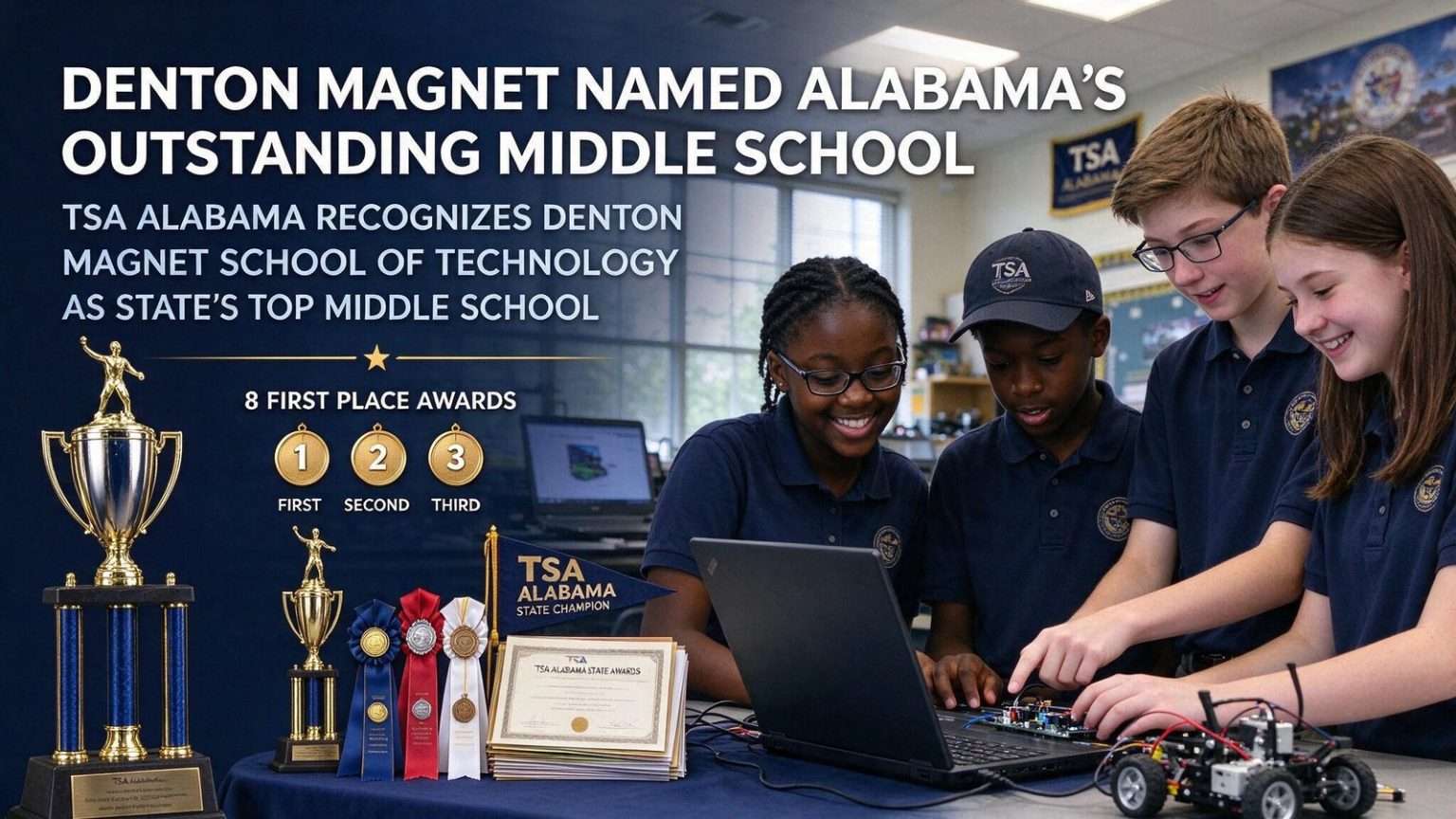
Denton Magnet School of Technology in Mobile has been named Alabama’s Most Outstanding Middle School of the Year by the Technology Student Association of Alabama. The honor follows a dominant performance by Denton students in a recent statewide virtual competition, where the school’s entries took top marks across a wide range of events.
Members of the school’s ACES club collected eight first-place awards across categories ranging from coding and mechanical engineering to leadership and video game design, along with three second-place and three third-place finishes. For a single middle school, the haul represents the breadth of the program — victories not just in technical events but in leadership categories that test how students communicate, organize, and work with a team.
The Technology Student Association is a national organization that gives students in technology and engineering education a competitive outlet, with state chapters running annual conferences and contests. Alabama’s chapter hosts competitions that range from written assessments to build-and-present challenges, and in recent years many events have been run virtually, letting schools across the state compete without traveling. The statewide awards are judged against every member school in Alabama, which is what makes the “Outstanding Middle School” designation significant.
Denton’s ACES club — the student group behind the eight first-place finishes — has become the engine of the school’s competitive record. Clubs like it function as the extracurricular arm of a magnet curriculum: students who spend their class days in robotics labs and design courses bring those skills to contest events, and the contests feed back into the classroom as momentum.
A Curriculum Built on Technology
Located on Pleasant Valley Road, Denton Magnet pairs advanced-level coursework across all subjects with hands-on technology exploration. Students take design and modeling in sixth grade and can progress into classes like robotics, flight and space, medical detectives, television production, graphic arts, and computer science for innovators. The sequence is deliberately built so that every student starts with the fundamentals of design thinking and can then specialize as the grades advance.
That pathway is what distinguishes a technology magnet from a traditional middle school. Where a standard schedule might offer one computer class, Denton’s program spans engineering, media production, and applied science, with equipment and coursework that mirror what students will encounter in high school academies and college engineering programs. The “medical detectives” course, for example, introduces forensic and biomedical reasoning years before most students see it again.
“We have really talented kids,” said Melanie Kriner, a technology teacher at the school. She noted that TSA participation is about more than trophies — it builds leadership skills, service projects, and teamwork. “It’s also about getting the kids thinking about what they want to do. We have kids who are engineering whizzes.”
Kriner’s framing captures the point of the competition circuit: the awards matter, but the deeper outcome is a middle schooler who has stood up at a statewide event, presented a project, answered questions from judges, and discovered what kind of work excites them. The leadership and video game design categories Denton won are exactly the events that reward those skills alongside technical ability.
What the Honor Means for Mobile County
The statewide title is a milestone for Mobile County Public Schools’ magnet programs, which draw students from across the county into specialized schools built around themes — technology, the arts, international studies, and more. Denton’s recognition shows the pipeline working at the middle school level, where students first commit to a technical pathway that high school academies and career-tech centers continue.
For the families who choose Denton, the award is external validation of a competitive admissions process. Magnet schools in Mobile County admit students from across the district, and parents weigh programs on the strength of their offerings. A school that produces eight first-place finishes in a single statewide competition gives prospective families a concrete measure of what the program produces — and gives the students who earned it a credential that follows them into high school applications.
The virtual format of the recent competition also reflects how student contests have evolved. Running events online opens participation to schools far from the judging sites and allows categories like coding and video game design — where the work product is digital — to be submitted and scored remotely. Mechanical engineering and other build categories are adapted for remote submission with documentation and photographs, keeping the competitive season running regardless of logistics.
Denton’s sweep across categories tells its own story about balance. A school that wins coding but not leadership, or engineering but not communication, is producing specialists; a school that wins both is producing students who can build something and explain it. Judges in TSA events consistently weight presentation and teamwork alongside technical execution, which is why teachers like Kriner emphasize the soft skills that come with competition — and why the school’s leadership awards sit alongside its technical ones.
Inside the ACES Club’s Winning Year
The ACES club’s results — eight firsts, three seconds, three thirds — came from students preparing on top of a full academic load. Competitive club seasons at the middle school level typically mean months of after-school build sessions, practice presentations, and iteration on projects between qualifying rounds and finals. Teachers supervise and coach, but the work that wins awards is the students’ own.
The categories Denton won cover the spectrum of modern technology education. Coding events ask students to write working programs to a specification. Mechanical engineering events challenge teams to design, build, and test a device against performance criteria. Video game design requires both programming and creative storytelling. Leadership events — often overlooked in the results column — test public speaking, parliamentary procedure, and the ability to organize a team, and they are the ones that transfer most directly to any career a student eventually chooses.
Mobile County has invested in its magnet and technology programs for decades as a way to offer families choices within the public system. Denton Magnet School of Technology occupies a specific niche in that landscape: a middle school where the technology curriculum is not an elective sprinkle but the organizing spine of the school. The Most Outstanding Middle School of the Year award from the Technology Student Association of Alabama is the kind of recognition that confirms the niche is working.
For the students of the ACES club, the season now shifts from competition to recognition — the assembly announcements, the certificates, and the point Kriner makes about what comes next: kids thinking about what they want to do, with a few of them already established, by statewide judges’ decision, as engineering whizzes worth watching.
The honor also lands at a moment when middle school technology education has become a focal point for schools nationwide. Pre-adolescent students who take design and modeling, robotics, and coding are picking up skills that industry groups have repeatedly identified as critical — not just programming itself, but the habit of iterating on a design, testing it, and defending the results to an audience. Middle school is where those habits either take root or don’t, which is why organizations like TSA build their programs around this age group.
Denton’s course sequence shows the philosophy in practice. Design and modeling in sixth grade teaches every student the common vocabulary of sketching, prototyping, and measurement. From there, the electives branch: a student drawn to machines moves into robotics and flight and space, one drawn to storytelling moves into television production and graphic arts, and one drawn to problem-solving moves into medical detectives and computer science for innovators. By the time students leave for high school, they have sampled several technical fields with real equipment and real projects.
The statewide competition results give Mobile County families a data point in a decision that can be hard to evaluate from the outside. A school’s brochure can list its courses; a statewide sweep of first-place awards shows what students actually do with them. Prospective families considering the magnet application process will find in Denton’s results an unusually concrete answer to the question every parent asks — what does the school produce?
The recognition also belongs to the teachers who run the program. Technology education at the middle school level requires an instructor who can coach a robotics build in the morning and a video game pitch in the afternoon, and the school’s leadership in both categories reflects that range. Awards like Most Outstanding Middle School of the Year are as much an endorsement of the adults in the building as the students.
For now, the plaque goes back to Pleasant Valley Road, and the ACES club’s trophy case gets fuller. The next competition season will bring a new field of statewide challengers — and a Denton program that has just been measured, by the Technology Student Association of Alabama itself, as the state’s best middle school.