
Deputies Kill 66-Year-Old Man Who Opened Fire on Them During Lott Road Response
Mobile County deputies shot and killed 66-year-old Terrance Edward White after he fired at them during a response to a Lott Road home.
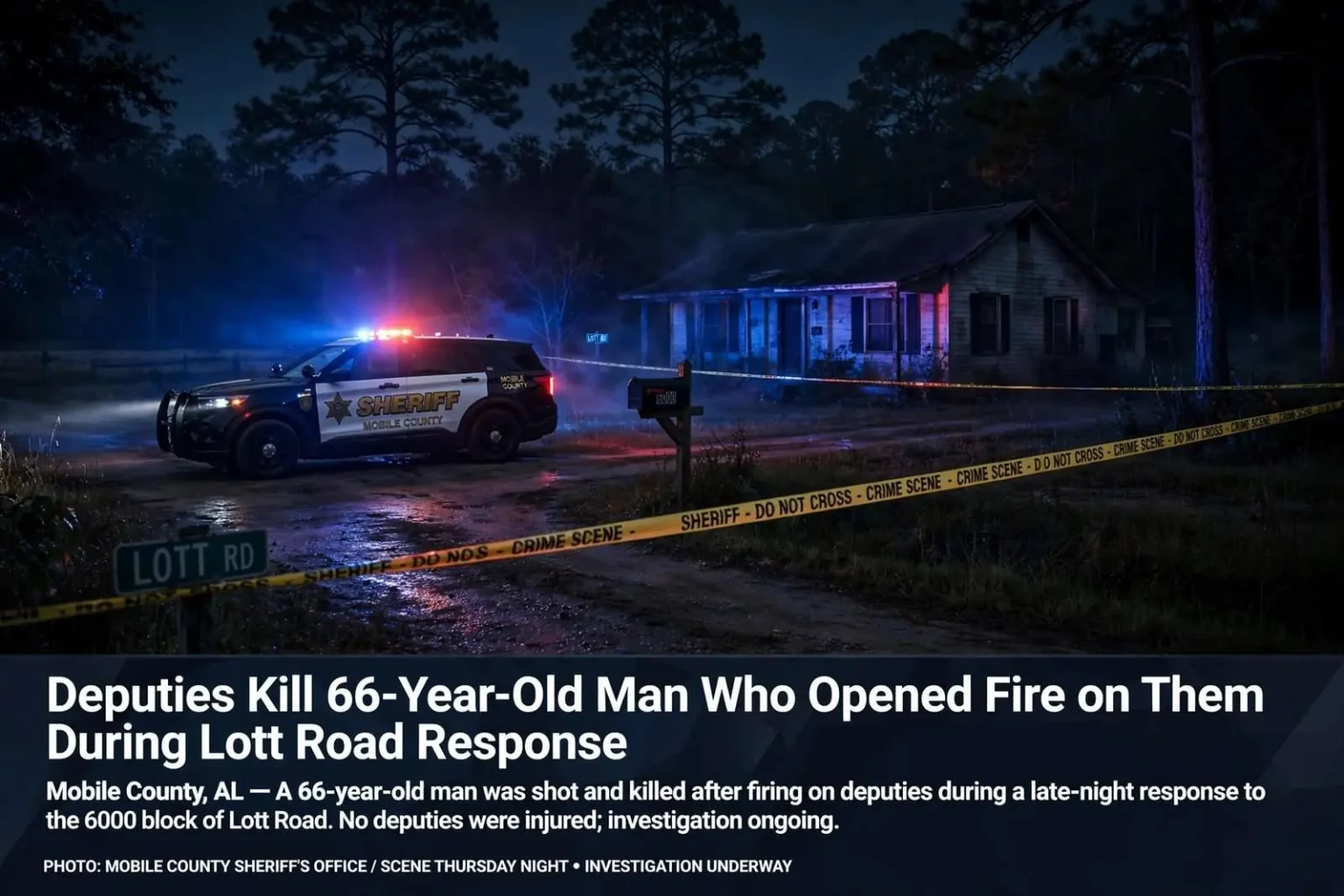
A late-night 911 call from a concerned neighbor brought Mobile County sheriff’s deputies to a home in the 6000 block of Lott Road, where the encounter ended with deputies shooting and killing the 66-year-old resident inside. The Mobile County Sheriff’s Office identified the man as Terrance Edward White.
Deputies said they were trying to speak with White when he shined a flashlight into their eyes while firing a weapon at them. Two to three deputies returned fire, striking and killing him. No deputies or anyone else was hurt.
Capt. Paul Burch of the sheriff’s office confirmed the suspect was dead later that night and said no other injuries were reported. The call that started the response came from a neighbor concerned about activity at the home, the kind of late-night report that draws deputies to rural northwest Mobile County regularly — though this one ended in gunfire.
While reviewing the case, investigators also noted that deputies had previously responded to the same home in 2015 for a domestic call. Authorities said White’s wife told them at the time that he had threatened to kill her, kill himself, and shoot any deputy who came to the scene. The incident remains under investigation by the sheriff’s office.
How the night unfolded
The sequence began with a 911 call from a neighbor in the 6000 block of Lott Road, a rural stretch of northwest Mobile County near the Mississippi line. The caller was concerned enough about what was happening at the home after dark to ask for deputies, and the sheriff’s office sent them out to check. When deputies arrived and tried to make contact with White, authorities said, they found themselves under fire — a flashlight beam in their eyes and a weapon being discharged at them in the dark.
The flashlight is a detail investigators will weigh. Shining a bright light into officers’ eyes at night degrades their vision precisely when they need it most, and in officer-involved shooting reviews it is treated as part of the threat calculus, not an afterthought. Deputies facing muzzle flashes and gunfire in darkness, blinded by a light, returned fire with two to three deputies shooting. White was struck and killed.
After the shooting, deputies secured the scene and accounted for everyone in the home. Burch, speaking for the sheriff’s office later that night, confirmed the 66-year-old was dead and said no deputies or anyone else was injured.
The scene was held for investigators overnight, as it is in every deputy-involved shooting. Deputies on scene become witnesses, and the investigation that follows — interviews, ballistics, scene mapping — is conducted separately from the deputies who fired, so that the review of what happened is as independent as the sheriff’s own process allows.
The home’s history with deputies
One thread of the review reaches back years. Deputies had responded to the same Lott Road home in 2015 for a domestic call, and during that earlier response White’s wife told deputies that he had threatened to kill her, kill himself, and shoot any deputy who came to the scene. That earlier report — a threat against family and against law enforcement alike — is now part of the record investigators are reviewing alongside the night’s events.
Threats against responding deputies are taken seriously in part because they sometimes prove prophetic. Deputies across the country are killed each year responding to domestic disputes, which law enforcement agencies consistently identify as among the most dangerous calls they run: emotions are high, weapons are frequently present, and the address itself may hold a grudge. For that reason, dispatch notes, prior-call history and comments made during earlier responses shape how deputies approach a door.
The 2015 call also places the case inside the larger problem of domestic violence in rural Mobile County. Homes along Lott Road and the surrounding communities of Wilmer, Citronelle and Semmes sit far from streetlights and close neighbors, and when violence erupts inside one of them, the first outside person to know is often the one who calls 911. In this case, the neighbor’s call — and the earlier wife’s account from years before — form the two bookends of the home’s contact with the sheriff’s office.
His wife’s account from 2015 — that he had threatened to kill her, kill himself, and shoot any deputy who came — matches a pattern officers are trained to recognize as a warning sign. Threats against law enforcement made during domestic calls are documented and passed along, and families who make such reports are often connected with advocates and protective resources afterward. What investigators will examine now is what happened in the years between that call and the night the neighbor dialed 911.
Deputy-involved shootings in Mobile County
Shootings involving deputies are rare relative to the number of calls the Mobile County Sheriff’s Office answers each year, but each one triggers a defined process. The sheriff’s office investigates the incident itself — who fired, how many rounds, what the deputies perceived — and the findings typically go to a grand jury or a district attorney’s review to determine whether the use of force was lawful. Deputies involved are commonly placed on administrative leave during the review, a standard practice that removes them from the street while the facts are established.
The review will reconstruct the encounter from physical evidence and statements. Investigators will document the positions of the deputies and the shooter, collect shell casings from the weapons involved, examine the flashlight and the firearm White used, and interview the neighbor who called 911, family members and the deputies on scene. The question at the center of every such review is the same: what did the deputies reasonably believe about the danger they faced at the moment they fired.
Alabama law, like the law in every state, allows officers to use deadly force when they reasonably believe it necessary to protect themselves or others from death or serious physical injury. A subject firing a weapon at deputies — with a light aimed to blind them — sits squarely inside the circumstances that doctrine contemplates. The formal review, however, exists precisely so that the judgment is not left to the deputies alone: the evidence is laid out, the sequence is established, and an outside check is applied to the sheriff’s own conclusions.
The community context
Lott Road runs through the rural northwest corner of Mobile County, an area of family plots, small farms and scattered homes where the sheriff’s office is often the only law enforcement presence for miles. Deputies who work the district know the roads and the households along them, and calls after dark in that terrain are handled differently than they are in a lit subdivision — approach, cover and contact are all decisions made with less information than urban deputies have.
The neighbor’s 911 call illustrates the role rural neighbors play in that landscape. With homes set back from the road and no streetlights, unusual activity at a neighboring property is often noticed first — and reported first — by the people next door. Deputies responding to such calls are walking into a situation described only by whoever dialed, which is why the sheriff’s office asks callers to stay on the line and update them when the situation changes.
The sheriff’s office has not released the deputies’ names or the findings of the review, and the investigation remains open. What is known from the night itself is narrow but consequential: a concerned neighbor called for help, deputies went to check on a home in the 6000 block of Lott Road, and the man inside — a 66-year-old who had years earlier threatened to shoot any deputy who came — fired a weapon at them while shining a light into their eyes. Two or three deputies fired back, and Terrance Edward White was killed in the home where the whole story began.
For the families on both sides of the exchange, the aftermath is the same long process: investigators’ questions, the review of a domestic history that reaches back to 2015, and a determination about whether the deputies’ response that night was lawful. Until that process concludes, the account of the night rests where the sheriff’s office left it late that evening — a neighbor’s call for help, gunfire in the dark, and a 66-year-old man dead on Lott Road with no one else hurt.
Domestic-related calls also carry a procedural weight that shapes the response itself. When deputies know, or learn en route, that a previous call at the same address involved threats — especially threats against police — the response is typically upgraded: more units, staging at a distance, contact attempted by phone where possible and a supervisor notified. Those protocols exist because of outcomes like this one; they cannot eliminate the danger, but they are designed to slow an encounter down before it becomes a shootout on a dark road.