Discovery Day Opens Dauphin Island Sea Lab to the Public on April 6
Discovery Day at the Dauphin Island Sea Lab offers a public open house of Alabama coastal research, marine science and the Gulf ecosystem.
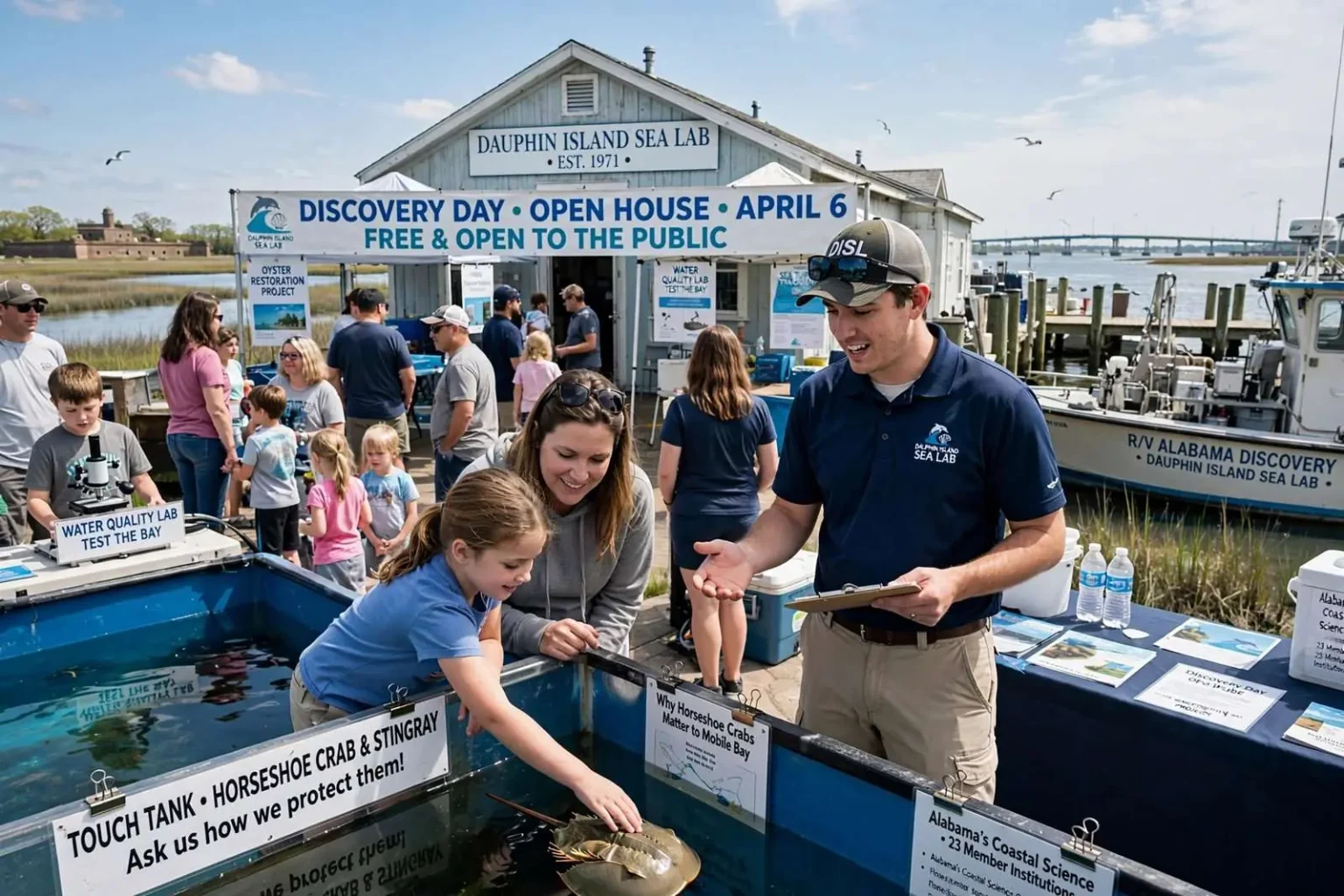
The Dauphin Island Sea Lab throws open its doors each spring for Discovery Day, an annual open house that lets the public step inside one of Alabama’s premier coastal research facilities. This year’s Discovery Day was set for Saturday, April 6.
Visitors got a guided look at the lab’s research and learned how the coastal ecosystem of south Alabama works and why protecting it matters. For many families from Mobile and Baldwin counties, the event is the one day each year when the working parts of a scientific institution — the research vessels, the laboratories, the collections and the classrooms — are open for anyone to walk through, ask questions and see what marine scientists actually do.
The setting alone makes the event a destination. Dauphin Island sits at the mouth of Mobile Bay, guarding the ship channel that connects the port of Mobile to the Gulf of Mexico. The barrier island is a working landscape of fishing families, historic sites and storm-worn beaches, and the Sea Lab occupies a campus on its east end near Fort Gaines, where the waters of the bay, the Sound and the Gulf meet. Few research facilities in the country sit within sight of a major shipping channel on one side and a national wildlife refuge on the other, and Discovery Day makes the most of that location.
A Coastal Science Institution
The Dauphin Island Sea Lab was founded in 1971 by the Alabama Legislature to provide marine science programs for the state’s colleges and universities. Today, 23 member institutions partner with the lab to offer undergraduate and graduate study.
That partnership model is what makes the Sea Lab unusual. Rather than belonging to a single university, the lab serves as a shared marine campus for public and private colleges across Alabama, letting students from schools hundreds of miles inland spend a semester studying estuarine and marine science on the coast. Courses take advantage of the surrounding habitats — salt marshes, seagrass beds, oyster reefs, barrier island beaches and open Gulf waters — which function as living classrooms a short boat ride from the docks.
Since its founding, the lab’s mission has grown to include K-12 education, professional development for teachers and a public aquarium, making it both a research hub and a place for the public to connect with the Gulf Coast’s unique environment. That expansion reflects a conviction shared by the lab’s scientists: that coastal research only matters to the public if the public can see and understand it.
The Estuarium, the lab’s public aquarium, anchors that public mission year-round. Its exhibits trace the flow of water from the Mobile-Tensaw Delta down the Mobile Bay system and out into the Gulf, displaying the fish, turtles, invertebrates and plant communities that depend on each stage of the journey. On Discovery Day, the Estuarium joins the rest of the campus in welcoming visitors, and exhibits that are normally off-limits — touch tanks stocked by the lab’s aquarists, research displays prepared by graduate students — come out for the crowds.
What Visitors Found at Discovery Day
A typical Discovery Day blends education and festival. Children line up to touch horseshoe crabs and stingrays, board research vessels at the dock, and try their hands at the same sampling gear the lab’s scientists use to monitor the bay. Researchers staff stations throughout the campus, explaining projects that range from oyster restoration in Mobile Bay to the tracking of sea turtles along the Alabama coast and the long-term monitoring of water quality in the estuary.
The timing of the event, in early April, catches the coast at one of its best moments of the year. Spring on Dauphin Island brings migrating birds through the island’s famous stopover habitat, warm weather before the summer crowds, and an active research season getting underway on the water. For the lab, it is a chance to show off work that happens largely out of public view — the hulls of research boats, the wet labs where specimens are studied, the monitoring buoys that feed weather and water data to scientists across the region.
Discovery Day also serves the lab’s educational mission directly. Staff and volunteers use the event to recruit: teachers learn about professional development workshops and field trips available to their classes during the school year, college students hear about semester programs, and families discover summer camps that introduce school-age children to marine science on the island. Many of the graduate students and staff answering questions at the exhibit tables once visited as children themselves — a pipeline the lab points to whenever it describes why public events matter.
Why the Lab Matters to South Alabama
The Sea Lab’s research reaches well beyond the island. Mobile Bay and its surrounding waters form one of the most productive estuarine systems on the Gulf Coast, supporting a seafood industry, a shrimp fleet, recreational fishing and a port economy that all depend on the health of the bay. The lab’s scientists monitor that system continuously, study the effects of storms, spills and development, and advise state agencies on restoring habitats from oyster reefs to marsh grass.
The lab also stands on the front line of coastal hazards. Dauphin Island has taken repeated hits from Gulf hurricanes, and the campus itself has flood damage in its history. That experience shapes the lab’s work on coastal resilience, from studying how barrier islands absorb storm surge to educating communities about living shorelines as an alternative to hardened bulkheads. When a storm approaches the Alabama coast, the lab’s researchers are among the first asked what the bay and barrier islands will do — and among the first out measuring the aftermath.
For the public, though, the message of Discovery Day is simpler. The institution the Legislature created in 1971 has become a place where a child from Mobile can hold a hermit crab, a teacher can plan a field trip, a college student can find a career, and a researcher can study the waters that define south Alabama. One Saturday each April, all of that is on open display — and admission of curiosity is the only ticket required.
Planning a Visit to the Sea Lab
For families considering a trip beyond Discovery Day, the Sea Lab operates year-round as one of the Gulf Coast’s most affordable science attractions. The Estuarium’s exhibits are arranged along the “journey of water” that defines the region: starting with the Mobile-Tensaw Delta, the vast wetland system where the Alabama and Tombigbee rivers meet, moving through Mobile Bay’s brackish middle ground, and ending at the Gulf beaches and open waters beyond the island’s sand.
Along the way, visitors encounter the species that make the estuary famous — spadefish and red drum cruising large tanks, diamondback terrapins, octopuses, seahorses and the ubiquitous blue crabs that support both the bay’s ecosystem and its seafood tables. Docents are typically on hand to explain the life cycles on display, and outdoor areas let visitors watch pelicans and gulls working the waters of the Sound just beyond the boardwalk.
Getting to the island is part of the experience. The Dauphin Island Bridge carries Alabama Highway 193 across the Sound, connecting the island to the mainland via the community of Coden on the western shore of the bay. The drive crosses open water with views of the bay’s oyster reefs and fishing boats, and on a clear day the skyline of the port of Mobile is visible across the water. Parking on the island is easy by city standards, though Discovery Day’s popularity means arriving early is wise.
Education That Reaches Across the State
While Discovery Day showcases the campus, the bulk of the Sea Lab’s educational work happens the rest of the year. School groups from across Alabama travel to the island for structured field programs that put students into the marsh with nets and into the lab with microscopes — often the first time an inland student has stood knee-deep in a salt marsh or handled a live horseshoe crab. Teachers can build single-day trips or multi-day residential experiences, and the lab’s educators align the content with state science standards so a coastal trip reinforces classroom work.
The 23 member institutions that partner with the lab form its academic core. Students from those schools enroll in semester programs on the island, taking courses in marine biology, oceanography, coastal ecology and related fields while conducting research alongside faculty. The arrangement gives Alabama’s universities — many of them far from the coast — a marine science presence they could never build alone, and it gives undergraduates considering scientific careers an early taste of field research on the Gulf.
Discovery Day, in the end, is the public face of that much larger enterprise. The single Saturday in April draws thousands of visitors to the east end of Dauphin Island, but the goal is to send them home with something that lasts: an understanding that Mobile Bay and the waters around it are a living system worth studying, and a working research institution worth supporting. This year’s event on April 6 continued a tradition that has run for decades — and, by all appearances at the crowded exhibit tents and busy docks, will run for decades more.