Dog River Mud Bottom Revival Returns With Music on the Riverbank
The Mud Bottom Revival fundraiser on Dog River features Will Kimbrough Band, Red Clay Strays and Ryan Balthrop while supporting watershed cleanup.
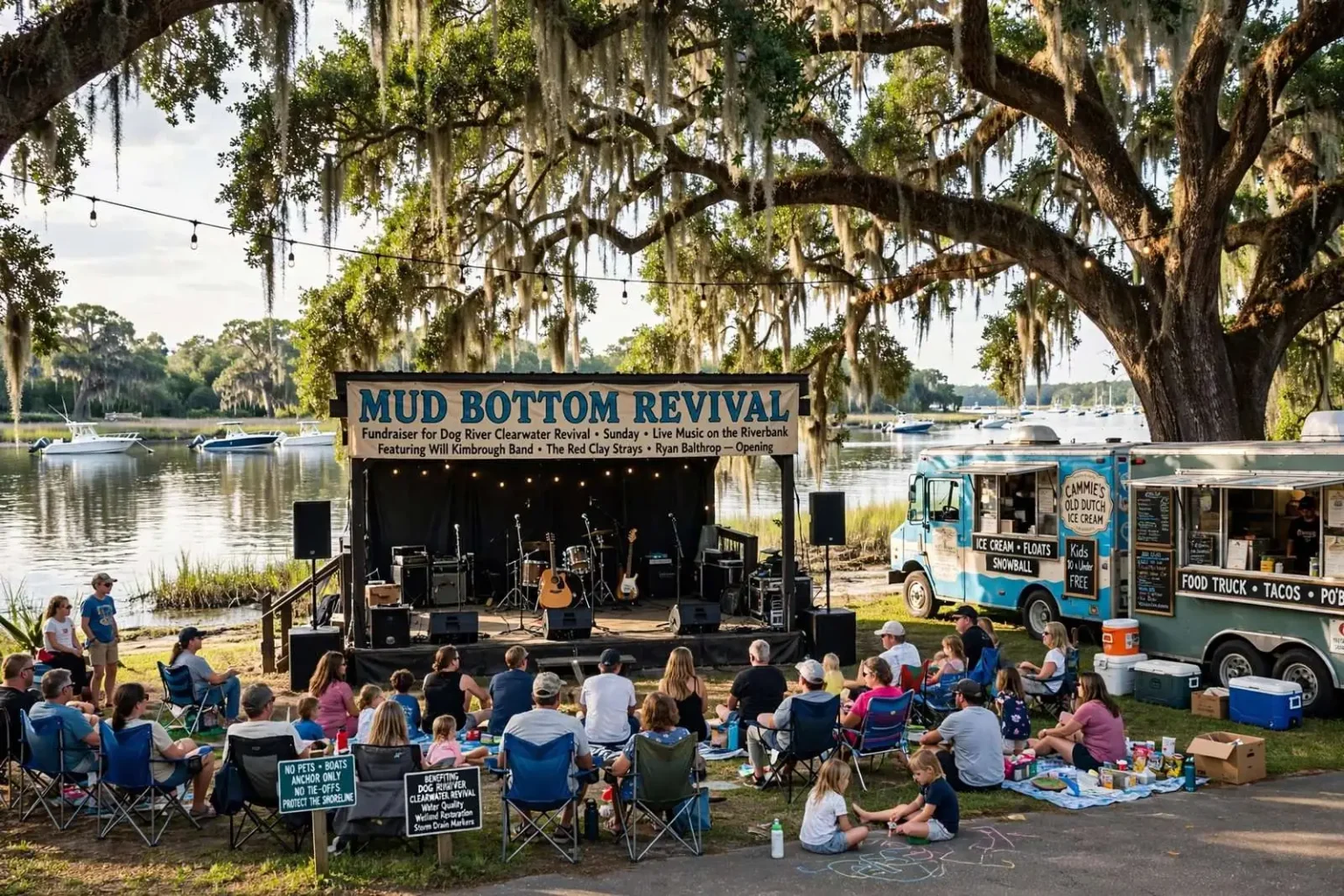
The annual Mud Bottom Revival fundraiser returns to the banks of Dog River, pairing an afternoon of live music with a push to improve water quality in the Dog River watershed and its tributaries. This year’s lineup features the Will Kimbrough Band, the Red Clay Strays and Ryan Balthrop opening the show, giving the fundraiser one of its strongest bills yet and its supporters a full afternoon of Gulf Coast music in an uncommonly beautiful setting.
The family-friendly concert takes place Sunday at a new location at the end of Riviere Du Chien Road. Attendees can bring coolers, blankets and chairs to a shaded oak-covered spot on the river, where the mature canopy offers relief from the Gulf Coast sun and the water provides the afternoon’s backdrop. Pets are not allowed, and motorboats may anchor at the river’s edge but not tie off — rules designed to protect both the event site and the shoreline the fundraiser exists to defend.
Food trucks and Cammie’s Old Dutch Ice Cream will be on site, covering everything from a full lunch to the frozen treats that have made the Mobile institution a fixture of local childhoods. Children 10 and under get in free, keeping the event accessible to the families whose neighborhoods surround the river and whose children will inherit whatever condition the watershed is left in.
Where the Money Goes
Proceeds support the Dog River Clearwater Revival, a nonprofit dedicated to cleaning up the river. The organization’s track record is unusually concrete for a volunteer watershed group, spanning infrastructure, restoration, and advocacy across the stream system that drains a substantial share of Mobile’s urban landscape into Mobile Bay.
Its record includes more than 5,000 storm drain markers across the watershed — small medallions on the drains that remind residents that whatever goes into a storm drain flows untreated into the river and, eventually, the Bay. The markers are a low-cost intervention with a long reach: thousands of households walk past them daily, and each one carries the message that the street and the river are hydraulically connected.
The group also conducts ongoing water-quality monitoring, building the data record that shows how the river is responding to pollution sources and restoration work. Monitoring gives the organization’s other efforts a feedback loop — it reveals which tributaries need intervention, whether completed projects are working, and where the next dollar of cleanup should go. In watershed management, that evidence base is what separates durable improvement cycles from one-time cleanup events that fade within a season.
Wetland restoration at Dog River Park and on Halls Mill Creek extends that work into the landscape itself. Wetlands are a watershed’s natural filtration system, absorbing stormwater, trapping sediment, and sheltering the small aquatic life that anchors the food chain. Restoring them — replanting, stabilizing banks, removing invasive growth — multiplies the river’s own capacity to clean itself, a quieter form of environmental work than a cleanup day but far more permanent.
The organization’s recreation infrastructure includes an 11-mile Scenic Blueway with six kayak launches, opening the river system to paddlers and giving the public a reason to care for what they can now easily access. Blueways convert a hidden urban waterway into a destination, and every paddler who travels the route becomes another witness to the river’s condition — and another potential member, donor, or volunteer for the group that built the access.
On the debris side, the nonprofit has removed 26 derelict vessels from the river and its tributaries — abandoned boats that leak fuel, shed debris, and foul the waterway for everyone downstream. The organization also operates the city’s only litter trap on Eslava Creek, which has kept 517 cubic yards of debris out of Dog River, plus a second trap installed on Bolton Branch. The traps function around the clock, catching the bottles, bags, and floatables that stormwater carries off Mobile’s streets before they can reach the river, Mobile Bay, or the Gulf beyond.
The group also leads the Alabama arm of the International Coastal Cleanup locally, connecting Mobile’s volunteers to the world’s largest single-day volunteer effort for ocean and waterway health, and has updated the Dog River Watershed Management Plan alongside the Mobile Bay National Estuary Program. The management plan is the watershed’s blueprint — a technical document that inventories pollution sources, ranks restoration priorities, and gives grant agencies the planning basis they require before funding large-scale work.
The Watershed Behind the Festival
Dog River and its tributaries drain a broad swath of south and west Mobile, collecting stormwater from residential streets, commercial corridors, and older neighborhoods whose drainage infrastructure predates modern pollution controls. The system’s health therefore functions as a report card on how the city manages runoff — and like most urban watersheds, the report card has long shown the strain of development, with elevated bacteria levels, litter loads, and sediment problems that intensify after every heavy rain.
That vulnerability is what makes events like the Mud Bottom Revival more than a concert. Every dollar raised funds the unglamorous machinery of watershed recovery — monitoring equipment, trap maintenance, restoration plantings, planning work — that keeps the river moving toward swimmable, fishable condition. Gulf Coast residents understand intuitively what clean water means for property values, fishing, recreation, and the regional identity built on the Bay.
The Music That Fills the Afternoon
The lineup itself is a statement of local pride. Will Kimbrough, the Mobile-born guitarist and songwriter whose career spans acclaimed solo work and collaborations with major artists, returns to play for the hometown crowd. The Red Clay Strays, the South Alabama band whose blend of country, rock and gospel swagger has drawn a fast-growing following, bring the evening’s energy, and Mobile’s own Ryan Balthrop opens the day with the character-driven southern eclectic rock that has made him a Gulf Coast favorite.
Programming homegrown talent for a hometown watershed fundraiser ties the cause to the community’s own creative identity. Attendees are not merely donating to an environmental nonprofit while listening to music; they are supporting the river that runs behind their city with musicians their city produced — a pairing that explains why the event has become an annual fixture on the local calendar.
The practical details invite easy participation: a Sunday afternoon, a shaded riverside site at the end of Riviere Du Chien Road, coolers and chairs welcome, food and ice cream on site, children free under 10, and boats able to anchor within earshot of the stage. The only prohibited items — pets and tie-offs along the bank — exist to keep the shoreline intact. Everything else about the afternoon is designed to let Mobile enjoy its river while paying for the work that keeps it worth enjoying.
A Volunteer Model That Works
Dog River Clearwater Revival’s achievements illustrate what a resident-led watershed organization can accomplish without a large staff or a government mandate. The storm drain markers, litter traps, blueway launches, and vessel removals were each financed and executed through a mix of grants, donations, and volunteer labor — the same fundraising streams that the Mud Bottom Revival feeds. The organization’s progress has come in increments, but the increments have compounded into a visibly changed river system.
The litter traps alone demonstrate the model’s value. Positioned on Eslava Creek and Bolton Branch, two of the tributaries that funnel urban runoff into the river, the traps intercept debris continuously and are emptied and maintained by the organization — a service no other entity in the city provides. The 517 cubic yards of debris already intercepted represent material that would otherwise have accumulated along the river’s banks, snagged in its wetlands, or drifted into Mobile Bay.
The derelict vessel removals tell a similar story of persistence. Abandoned boats are among the most difficult forms of waterway debris to clear, requiring salvage operations, disposal arrangements, and often legal work to establish ownership before removal. Each of the 26 vessels pulled from the system required the organization to navigate that full process — an unglamorous administrative burden wrapped around a visibly satisfying result.
Why the Community Keeps Showing Up
The Mud Bottom Revival’s endurance on the Mobile calendar reflects a relationship between the river and the residents who live along it. Dog River’s banks are lined with homes whose backyards meet the water, and the boating, fishing, and paddling culture around the river runs generations deep. When water quality suffers, those residents see it daily; when a cleanup succeeds, they see that too. Few environmental causes offer their supporters such immediate, visible feedback.
The event’s move to the end of Riviere Du Chien Road adds a new stretch of riverbank to the tradition, and the shaded, oak-covered setting underscores the site’s suitability for an afternoon crowd. Organizers’ rules — no pets, no tie-offs for boats — preserve the ground and the water for future gatherings, an environmental ethic embedded in the event’s own logistics.
As the Will Kimbrough Band, the Red Clay Strays, and Ryan Balthrop take the stage Sunday, the afternoon’s simple transaction will repeat itself once more: Mobile enjoys its musicians, its food, and its river, and the river gets another season of markers, monitoring, traps, and restoration funded by the crowd’s enjoyment. For a waterway that drains a city’s streets into the Bay, there is no better arrangement — the community that benefits from the cleanup is the community that pays for it, one afternoon of music at a time.