Dollar General Donates $5,000 to Mobile’s Wholistic Wellness for Early Childhood Nutrition Program
Dollar General donated $5,000 to Mobile nonprofit Wholistic Wellness to fund its Healthy Snack Program for Pre-K and Kindergarten students in Mobile, Prichard and Chickasaw.
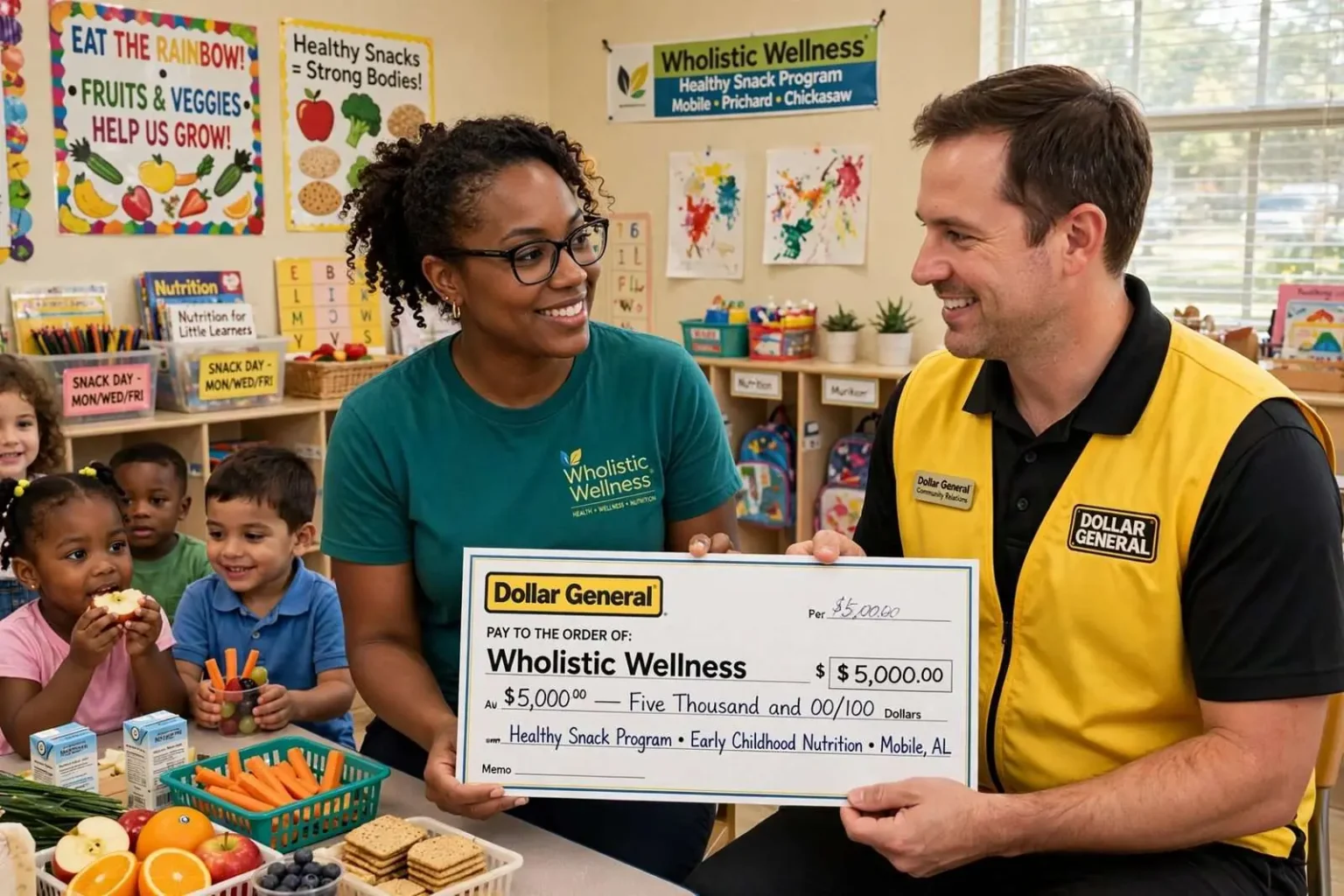
Dollar General has donated $5,000 to Wholistic Wellness, a Mobile-based nonprofit that promotes health, wellness and nutrition education in underserved communities, to support its work with local Pre-K and Kindergarten classrooms. The gift will fund the organization’s Healthy Snack Program, which brings nutrition education to young students across Mobile, Prichard and Chickasaw — communities where many families face food insecurity and limited access to nutrition resources. The program currently reaches more than 70 students.
“We are incredibly grateful to Dollar General for supporting our Healthy Snack Program as we prepare for another school year,” said Angelia Dickinson, founder and president of Wholistic Wellness. “This donation will help us continue reaching young students during an important stage of development and provide opportunities for them to build healthy habits that can benefit them for years to come.”
Dollar General said the donation reflects the retailer’s broader commitment to supporting health and wellness initiatives in communities it serves across the country. For the local organization, the gift arrives at a practical moment: the start of a school year, when classroom routines are being established and the habits formed in the opening months tend to carry through the year. Programs aimed at children this young work precisely because they are embedded in that routine rather than delivered as occasional events.
Why Start With Pre-K and Kindergarten
The age group the Healthy Snack Program serves is not accidental. Early childhood — roughly ages three through six — is when eating patterns, taste preferences and attitudes toward food take root, and research on nutrition has consistently shown that habits established in those years are far easier to form than to change later. A child who learns to reach for fruit, who understands that different foods do different jobs in the body, and who sees healthy eating modeled as normal rather than as a lecture carries those assumptions into first grade and beyond. Reaching students before those patterns harden is the most efficient moment any nutrition intervention can target.
The classroom setting is the other half of the program’s logic. Pre-K and Kindergarten teachers see their students every day, five days a week, in an environment built for learning — and young children absorb lessons about food the same way they absorb letters and numbers, through repetition and routine. A program that delivers both education and an actual healthy snack turns abstract instruction into daily practice: the children taste what they are learning about, and the lesson sticks because it involved their senses and not just their ears.
There is also a practical equity dimension. More than 70 students across Mobile, Prichard and Chickasaw are currently in the program, and those communities were chosen for a reason. Prichard and Chickasaw, neighboring cities north of downtown Mobile, have among the highest poverty rates in the metropolitan area, and parts of urban Mobile share the same profile. In neighborhoods designated as food deserts — where full-service grocery stores are scarce and convenience stores dominate — the affordable options available to families skew heavily toward processed, calorie-dense foods. A classroom program cannot fix the food system, but it can make sure that the children growing up inside it encounter fresh, nutritious food as a regular part of their week rather than a rarity.
Food Insecurity on the Gulf Coast
The donation lands in a region where childhood food insecurity is a persistent, documented problem. Along the Gulf Coast, poverty rates in Mobile County’s urban core run well above national averages, and food insecurity — the lack of reliable access to enough affordable, nutritious food — affects thousands of households with children. The consequences show up in classrooms: children who arrive at school hungry or undernourished struggle to concentrate, manage their behavior and absorb instruction, and teachers routinely report the difference a snack or a school breakfast makes in a student’s morning.
The problem is not simply a shortage of calories but a shortage of nutrition. Families with limited access to fresh food often rely on shelf-stable, heavily processed options that are inexpensive and filling but low in the nutrients developing bodies need. The effects compound over time, contributing to higher rates of childhood obesity, diabetes risk and other health conditions that follow children into adulthood. Nutrition education paired with actual access to healthy food — the combination Wholistic Wellness’s program provides — addresses both sides of that equation within the scale of a classroom.
Wholistic Wellness’s Approach
Wholistic Wellness has built its mission around the idea that health in underserved communities requires more than medical care — it requires education, access and habit change at the neighborhood level. The organization’s name signals the approach: rather than treating wellness as a series of separate problems, it works on the interconnected pieces of how people eat, move and care for themselves, with programming aimed at the populations where intervention makes the largest difference. The Healthy Snack Program, focused on the youngest students in Pre-K and Kindergarten classrooms, is the expression of that philosophy at the start of life.
The program’s structure pairs the snack itself with education, so children are not just being fed but being taught — what the foods are, what they do for the body, and why choosing them matters. Teachers participate in the delivery, which multiplies the program’s reach: an adult the child already trusts reinforcing the same messages every day. For families, the program’s effects can extend home as well, since young children regularly bring home what they learn at school, asking for the foods they tried in class and repeating lessons to parents and grandparents.
Angelia Dickinson, who founded the organization and serves as its president, has emphasized preparation for the school year as the moment the donation supports — the period when programs are stocked, scheduled and set in motion. For a nonprofit of this size, a $5,000 gift is not symbolic; it is the difference in how many classrooms can be served, how often the program can deliver during the year, and how fresh the offerings can be. Small nonprofits run lean, and direct community donations like this one flow almost entirely into program delivery rather than overhead.
The Corporate Role in Community Health
Dollar General’s gift also illustrates a particular model of corporate giving. The retailer’s footprint in communities like Mobile, Prichard and Chickasaw is deep: Dollar General stores are among the few national retail chains with locations in small towns and urban neighborhoods that larger retailers overlook, and the company’s stores are often the most convenient source of groceries and household goods for exactly the families the Healthy Snack Program serves. Its stated commitment to supporting health and wellness initiatives in the communities it serves gives its giving a local logic — the money goes to places where the company operates and where its customers live.
Corporate donations to community nutrition programs have become an important supplement to public funding, which rarely reaches early-childhood health education at this scale. Public programs concentrate on school meals and federal nutrition assistance, both essential, but classroom-level education about food — the part that changes what children choose when they do have options — depends heavily on nonprofits and private support. A gift of $5,000 to a program serving 70-plus students amounts to a meaningful per-child investment in exactly the intervention research suggests is most cost-effective: prevention at the age when habits form.
The donation also reflects the broader relationship between the retail sector and the food environment it shapes. Retailers operate on the front lines of the American food system, and initiatives like this one acknowledge the responsibility that position carries. For Dollar General, supporting nutrition education in underserved communities aligns its philanthropy with its geography; for Wholistic Wellness, a national retailer’s endorsement adds credibility that helps when the organization approaches the next donor or partner.
What the Gift Makes Possible This Year
Concretely, the donation funds another school year of healthy snacks and nutrition lessons for more than 70 students across Mobile, Pre-K and Kindergarten classrooms in three communities. That means regular deliveries during the school year, instruction built into classroom routines, and the compounding effect of habits practiced daily across an academic calendar. The students served this year will be a year older and a year further along in their habits when the program’s next cohort begins — which is, in miniature, how a community’s health trajectory changes: one classroom, one school year, one habit at a time.
For families in Mobile, Prichard and Chickasaw, the program’s value shows up in small, ordinary ways: a child who asks for fruit instead of chips, a kindergartner who can name what vegetables do for the body, a household conversation about healthy eating that starts because a five-year-old brought it home from school. Those moments are the deliverables of a program like this, and the donation from Dollar General buys another year of them. Anyone interested in supporting the work can look for opportunities to contribute to Wholistic Wellness directly, since programs of this kind grow classroom by classroom as local support allows.