
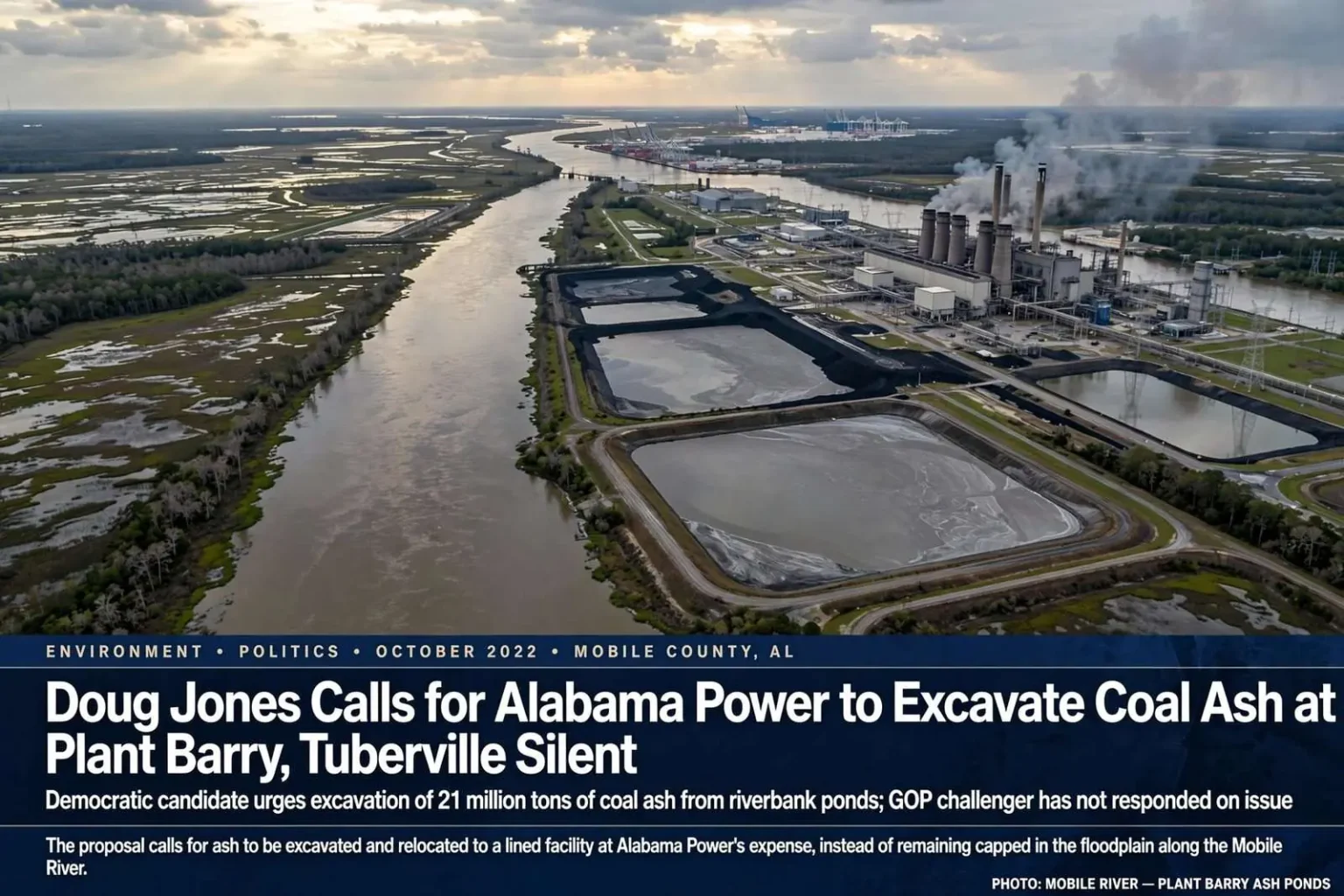
Of the two major-party candidates for Alabama governor, only one has gone on record with how Alabama Power should handle the roughly 21 million tons of coal ash stored along the Mobile River at Plant Barry. Democrat Doug Jones is calling for the ash to be excavated and either safely recycled or relocated to a lined facility, with Alabama Power and its shareholders — not taxpayers or ratepayers — covering the cost. Republican Tommy Tuberville’s campaign has not responded to questions on the issue, and a review of his public statements, Senate releases and federal coal ash proceedings found no previous position from him or his office on Plant Barry or Alabama’s broader coal ash policy.
The asymmetry is striking for an issue that sits, literally, upstream of the state’s largest port city. Plant Barry, Alabama Power’s coal-fired generating station on the Mobile River in north Mobile County near Bucks, has for years held its combustion waste in unlined ash ponds on the river’s banks. Excavating it — trucking or railing the ash away to a properly lined landfill — is the remedy environmental groups along the river have sought for most of a decade. Capping the ponds in place, the cheaper approach utilities prefer, leaves millions of tons of ash sitting in the floodplain of a tidal river, a short distance from drinking water intakes, working docks and some of the most hurricane-exposed industrial ground in America.
Coal ash is the residue left after utilities burn pulverized coal, and it concentrates heavy metals — arsenic, mercury, lead, selenium, chromium — that can leach into groundwater when stored wet and unlined. The federal government tightened the rules for managing it after the 2008 Tennessee Valley Authority spill at Kingston, Tennessee, which released more than a billion gallons of ash slurry into East Tennessee rivers. Since then, every coal state has faced the same question Alabama is facing now: dig the ash out, or seal it where it lies?
Alabama’s answer so far has tilted toward sealing. Under the federal coal ash rule adopted in 2015, utilities nationwide were required to close their legacy ash ponds, and most chose the cheaper path — draining, capping with soil and grass, and leaving the buried ash in place with monitoring wells standing guard. Alabama Power has pursued closure-in-place for the ponds at Plant Barry, while a coalition of environmental organizations has sued and petitioned for the ash’s removal, arguing that a capped pond in a flood-prone river bend is a hazard deferred, not a hazard resolved.
Jones’s position, in detail
Jones’s formulation has three parts: the ash must be excavated; it must end up either safely recycled or in a lined facility; and the bill must fall on Alabama Power and its shareholders rather than on the public. Each element tracks the argument environmental advocates have made along the Mobile River. Excavation eliminates the long-term risk of leaching and flood scouring; recycling puts the ash to engineered reuse, such as concrete production, where its chemistry is locked in; lined disposal is the containment standard the federal rule recognizes for landfills. And the funding demand answers the fear that has shadowed every cleanup debate since Kingston — that the utility’s customers, not its investors, will end up absorbing a multibillion-dollar liability.
For Jones, the position is also a natural political one. A former U.S. senator who built his reputation as a federal prosecutor putting Klansmen in prison, he has spent his political career running on accountability themes, and his 2020 Senate loss to Tuberville set up the 2022 governor’s race as something of a rematch between the two men — this time for the state’s highest office.
The question the gubernatorial race raises is what the state’s chief executive can actually do about it. Coal ash disposal is regulated through federal rules and state environmental permits — authority that sits with the Alabama Department of Environmental Management and the utilities’ compliance schedule rather than with the governor’s office directly. But a governor appoints ADEM’s leadership, sets the state’s posture in federal litigation, and carries the single loudest voice in Alabama public life. A governor who called for excavation would change what the state asked of its largest utility. A governor who stayed silent would leave the question to the utility’s own timeline.
Tuberville’s silence, meanwhile, has been consistent across every channel where a position might appear. His campaign has not responded to questions on the issue, and a review of his public statements, Senate releases and federal coal ash proceedings found no previous position from him or his office on Plant Barry or Alabama’s broader coal ash policy. For a candidate whose Senate portfolio includes committees with jurisdiction over the very federal rules governing ash disposal, the absence of any on-record stance leaves voters in the Mobile Bay region without a way to compare the two contenders on the issue that most directly affects their river.
The silence is not unique to Tuberville; it reflects how coal ash has historically been handled in Alabama politics. The issue rarely appears in statewide campaigns because it is geographically concentrated — concentrated, in this case, in a handful of Mobile County communities and along a corridor of the Mobile River that most Alabamians never see. Statewide candidates have traditionally calculated that the votes at risk from a strong coal ash position are fewer than the political costs of confronting the state’s largest utility, an institution whose rates, jobs and charitable footprint reach every county.
What the 2022 governor’s race changes is the geographic math. Jones’s call for excavation puts Plant Barry on the statewide agenda for the first time in a governor’s race, and it forces a conversation that Birmingham and Huntsville voters have had little reason to join: whether the ash that powered a century of Alabama electricity should leave the banks of the Mobile River or stay there under a cap of soil. Tuberville’s non-answer, for now, leaves that question framed entirely by one candidate and by the environmental groups pressing the same demand.
What is at stake along the river
The Mobile River is not an ordinary waterway. It is the working spine of the Port of Mobile — one of the busiest deepwater ports on the Gulf of Mexico, handling tens of millions of tons of cargo a year — and it feeds Mobile Bay, where the region’s seafood industry and its recreation economy both live. The river also supplies drinking water: intakes downstream of the industrial corridor draw from the same system that ash pond leakage would eventually reach. And it is a floodplain. The Gulf’s hurricane history, from Frederic to Katrina to the recent parade of Gulf storms, has repeatedly shown what floodwaters do to industrial sites in low-lying Mobile County, and a capped ash pond scoured by floodwater is precisely the failure mode Kingston demonstrated.
The communities nearest the ponds have carried the risk longest. North Mobile County’s riverfront neighborhoods — some of them rural, some of them working-class extensions of Prichard and Chickasaw — have watched the utility’s ash ponds grow for decades while state environmental enforcement remained thin. The 2015 federal rule gave those residents, for the first time, a national standard to organize around, and Mobile Baykeeper, the region’s Waterkeeper-affiliated environmental group, built its campaign on exactly that lever: national requirements, local enforcement, and a demand that the ash leave the river.
The utility’s counterposition has been consistent: closure-in-place is safe, engineered, approved by regulators and far cheaper — savings that, under Alabama’s regulatory structure, flow back to customers through rates. The dispute, at bottom, is over whose timeline governs. A capped pond is monitored for years; excavated ash is gone in a construction project’s lifetime. Environmental groups argue the monitoring model assumes a stable riverbank in a hurricane zone, which Mobile’s history makes a fragile assumption. The utility argues excavation itself carries risks — years of trucking and rail movements, dust, traffic through neighborhoods — that a sealed pond avoids.
Into that standing argument, the governor’s race has now dropped a candidate with a clear side. Whether it moves the outcome depends on whether Alabama’s next chief executive treats a utility’s disposal plan as a settled compliance matter or as a public question worth answering in public.
Regional stakes beyond the ponds
The debate also lands on a Gulf Coast already saturated with environmental questions. South Alabama’s shoreline communities — Gulf Shores, Orange Beach, Dauphin Island and the Fort Morgan peninsula — live with the arithmetic of hurricane season from June through November, and the region’s local governments have spent generations planning for the storm that arrives. The National Weather Service office in Mobile issues the forecasts and warnings that cover southwest Alabama, southeast Mississippi and the western Florida panhandle, and the same floodplain logic that shapes evacuation maps for Dauphin Island shapes the risk case against an ash pond on the Mobile River: water finds the low ground, and what it carries with it becomes everyone’s problem downstream.
Mobile itself carries the region’s identity into the argument. Founded by French colonists in 1702, the oldest city in Alabama and the original capital of French Louisiana, the city has grown from a colonial river settlement into the third-largest city in the state — a hub of shipping, aerospace, steel and healthcare, home to the University of South Alabama and Spring Hill College, and the anchor of a two-county regional economy in which Mobile County and Baldwin County commuters, students and shoppers cross the bay daily. An industrial corridor along the Mobile River ties the port, the shipyards, the steel plants and the power station into a single working landscape. The coal ash question is, in that sense, a question about the corridor itself: whether the river that built Mobile’s economy can carry the residue of that economy indefinitely.
The region’s civic infrastructure gives the issue its local voice. City councils and county commissions across the two counties hold public meetings where drainage, growth and industrial siting are standing agenda items, and local coverage — the daily newspaper, regional television and a growing set of digital outlets focused on south Alabama — has tracked the coal ash fight through years of hearings and filings. The school systems, Mobile County Public Schools and Baldwin County Public Schools, are among the region’s largest employers, and their buildings sit in the same watersheds the ponds drain into. In a region where residents track tropical systems, severe storms and daily conditions with particular care, an unlined pond of industrial waste beside the river is not an abstraction; it is the kind of fixture locals inventory every time the cone of uncertainty swings toward the coast.
That is the context in which the two major-party candidates for governor now differ so sharply — one on record, one not. The 21 million tons at Plant Barry will outlast the campaign regardless: either excavated on the schedule Jones demands, or capped and monitored on the schedule the utility prefers. What the election decides is which schedule Alabama’s state government will treat as acceptable — and whether the residents who live downstream of the ponds will, for the first time, hear the state’s next governor answer for it.