
Downtown Mobile Road Closure on North Broad Street Pushed Back by Utility Conflict
A utility conflict has delayed the planned closure of North Broad Street at Congress Street in downtown Mobile, part of a federal TIGER grant project.
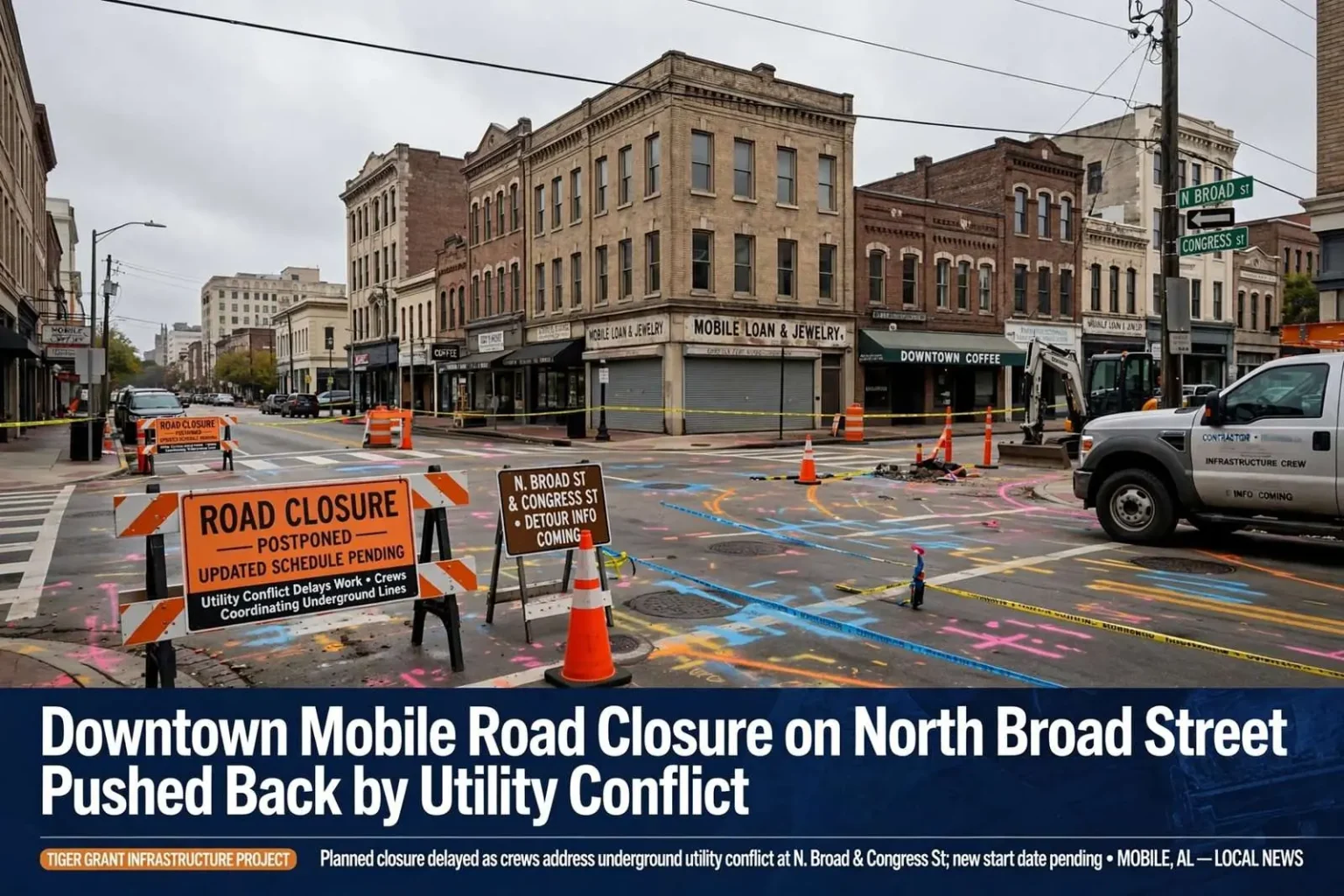
A planned downtown Mobile road closure that was set to begin Tuesday has been pushed back, according to city officials. The work at the intersection of North Broad Street and Congress Street ran into a utility conflict, forcing contractors to delay the closure while crews sort out the underground clash between existing lines and the planned improvements.
The North Broad Street project is part of a federally funded TIGER grant — short for Transportation Investment Generating Economic Recovery — which has paid for a series of street and infrastructure upgrades along the corridor. Once the utility issue is resolved, crews will close the affected stretch of roadway and continue construction.
Drivers traveling through downtown should watch for updated notices about when the closure will take effect, as the schedule will depend on how quickly crews can clear the conflict with existing utilities.
Utility conflicts are among the most common — and most frustrating — delays in urban road construction. City maps and utility records can disagree about what lies under a street, and until excavation confirms the location of every line, contractors cannot safely build the new infrastructure the plans call for. In older cities like Mobile, where water, gas, sewer, telecommunications and electric lines have accumulated over a century, the underground is a layered archive of past streetscapes.
What the Project Involves
The North Broad Street corridor work represents a streetscape-scale investment rather than simple repaving. Projects of this type typically rebuild the roadway section, upgrade sidewalks and drainage, improve lighting and signals, and replace aging water and sewer lines while the street is open — the logic being that tearing up a road twice is far more expensive than coordinating the work once.
Broad Street runs north from downtown Mobile through historic neighborhoods toward Three Mile Creek, and the corridor has been the focus of a long-running revitalization effort linking the city’s central business district to its surrounding communities. The federal TIGER funding behind the project reflects that vision: the U.S. Department of Transportation’s grant program, created in the 2009 stimulus era and later continued under the BUILD name, has funded multimodal transportation projects across the country, with an emphasis on corridors that connect neighborhoods to economic opportunity.
The intersection of North Broad and Congress sits in the stretch where the improvements are most visible to daily traffic. Congress Street itself is a corridor west toward the medical district, making the Broad Street crossing a junction commuters pass through regularly — and a natural pinch point when construction narrows or closes it.
Why Utility Conflicts Stop Work
A utility conflict means something is where the plans did not expect it — a water main a few feet from its recorded location, a gas line abandoned but never removed, a telecom duct bank crossing where drawings show clear earth. Resolving such a conflict requires the utility owner and the contractor to agree on a fix: relocate the line, redesign a portion of the improvement or adjust the construction sequence around it.
Each of those paths takes time. Relocations belong to the utility, not the road contractor, and utilities schedule their own crews. Redesigns require engineering revisions and, sometimes, agency approvals. The delay announced for Tuesday’s closure buys that coordination time, and the city’s public messaging — work will proceed once the conflict is cleared — keeps drivers informed without promising a date the underground has not yet confirmed.
For residents and businesses along North Broad, the postponement is mixed news. It postpones the disruption of a road closure, but it also extends the overall construction timeline, with the eventual closure still to come. Streetscape projects of this kind can run for months once the heavy work begins, and the contractor’s sequencing — closing sections in stages — determines how much access each block keeps.
The TIGER Grant Behind It
The TIGER program that funds the North Broad Street work has a distinctive history in federal transportation policy. Created as part of the American Recovery and Reinvestment Act, it gave the Transportation Department discretion to fund projects that traditional formula programs missed — multimodal, community-scale investments in corridors where a street rebuild can anchor a neighborhood’s revitalization. Mobile’s corridor award placed North Broad Street in a national portfolio of such projects, from streetcars to freight rail to complete streets.
For Mobile, the grant’s value lies in work the city could not have funded alone. Streetscape projects carry per-mile costs well beyond routine paving budgets, and federal discretionary grants allow a city to rebuild a corridor comprehensively — roadway, sidewalks, drainage, utilities, lighting and landscaping together. The trade-off is federal oversight: prevailing-wage requirements, procurement rules and reporting that add administrative weight to every phase.
The Broad Street corridor’s role in Mobile’s planning has grown over the past decade. City plans have identified the street as the connective spine between downtown and the neighborhoods to the north, including the areas around Three Mile Creek where flood management and greenway investments have been proposed. Street improvements along the corridor are the visible infrastructure layer of that larger strategy.
What Drivers Should Expect
Until the utility conflict is resolved, North Broad Street traffic continues on its current pattern, with the construction zone marked but the promised closure on hold. When the closure takes effect, detour routes and signage will direct through traffic around the work zone, and local access for residents and businesses along the closed stretch will be maintained to the extent the construction phasing allows.
City officials’ advice to watch for updated notices is the practical guidance that matters. Construction schedules in utility-conflict situations shift repeatedly, and a closure announced for one week can land in another; the notices the city publishes are the authoritative source, and drivers who commute through the area daily are the ones who feel each change first.
The broader lesson of the delay is the reality of infrastructure work in a historic port city. Every street in downtown Mobile carries the accumulated services of more than a century of development, and rebuilding such streets means negotiating with the past as well as the present. The TIGER-funded improvements will eventually deliver new pavement, safer sidewalks and modern utilities along North Broad — but only after the underground agrees to the plans.
Streetscapes and Neighborhood Economics
Corridor projects like the North Broad Street work are as much economic development as transportation. Research on streetscape investments consistently finds that rebuilt sidewalks, better lighting and slower traffic bring retail investment to corridors that fast, neglected streets starve. The theory behind federal programs like TIGER is exactly that: a street is a neighborhood’s front door, and rebuilding it signals to residents, businesses and lenders that the corridor’s future is worth betting on.
North Broad Street’s history gives the strategy weight. The corridor once served as one of Mobile’s principal commercial streets north of downtown, lined with neighborhood businesses that declined as traffic patterns and disinvestment shifted retail elsewhere. The street retains its building stock and its grid, the raw material streetscape programs work with, and the federal investment targets the corridor at a moment when downtown’s growth is pressing northward.
Construction disruption is the price of that transition, and cities have learned that communicating through it matters. Businesses along a closed stretch lose passing traffic, and cities typically respond with signage directing customers to open establishments, coordination on access points and, in some programs, marketing support during construction. How well the city manages the North Broad closure when it comes will shape the corridor’s merchants as much as the finished product will.
The Road Ahead for the Project
With the utility conflict pending, the project’s next milestones are the resolution itself and the revised closure schedule that follows. Contractors will excavate to confirm the underground conditions, utilities will relocate or clear the conflicting lines, and the city will announce the new closure date once the path is certain — avoiding a repeat of a pushed-back start.
The remaining work after that point follows the standard sequence of a streetscape rebuild: drainage and utility installation first, then the roadway base and paving, then sidewalks, curbs, lighting and final landscaping. Each stage narrows access further before it restores it, and the corridor’s full transformation will be visible only at the end of the sequence.
For now, drivers should build the closure into their expectations even without a date attached. The Tuesday start that slipped will become another start date soon, and the detours that follow will be part of downtown Mobile’s routine for the duration of the work. The city’s notices will carry the specifics; the TIGER-funded project itself, when complete, will leave North Broad Street with the modern infrastructure its century-old services could no longer support.
Residents with questions about the project, access during construction or the closure schedule are directed to the city’s public announcements about the North Broad Street corridor, which will be updated as the utility conflict is resolved and construction resumes.


