Downtown Mobile Rolls Out New Free Moda! Circulator Buses
Downtown Mobile introduced new moda! circulator buses, offering free rides on a loop through the city center with upgraded seating.
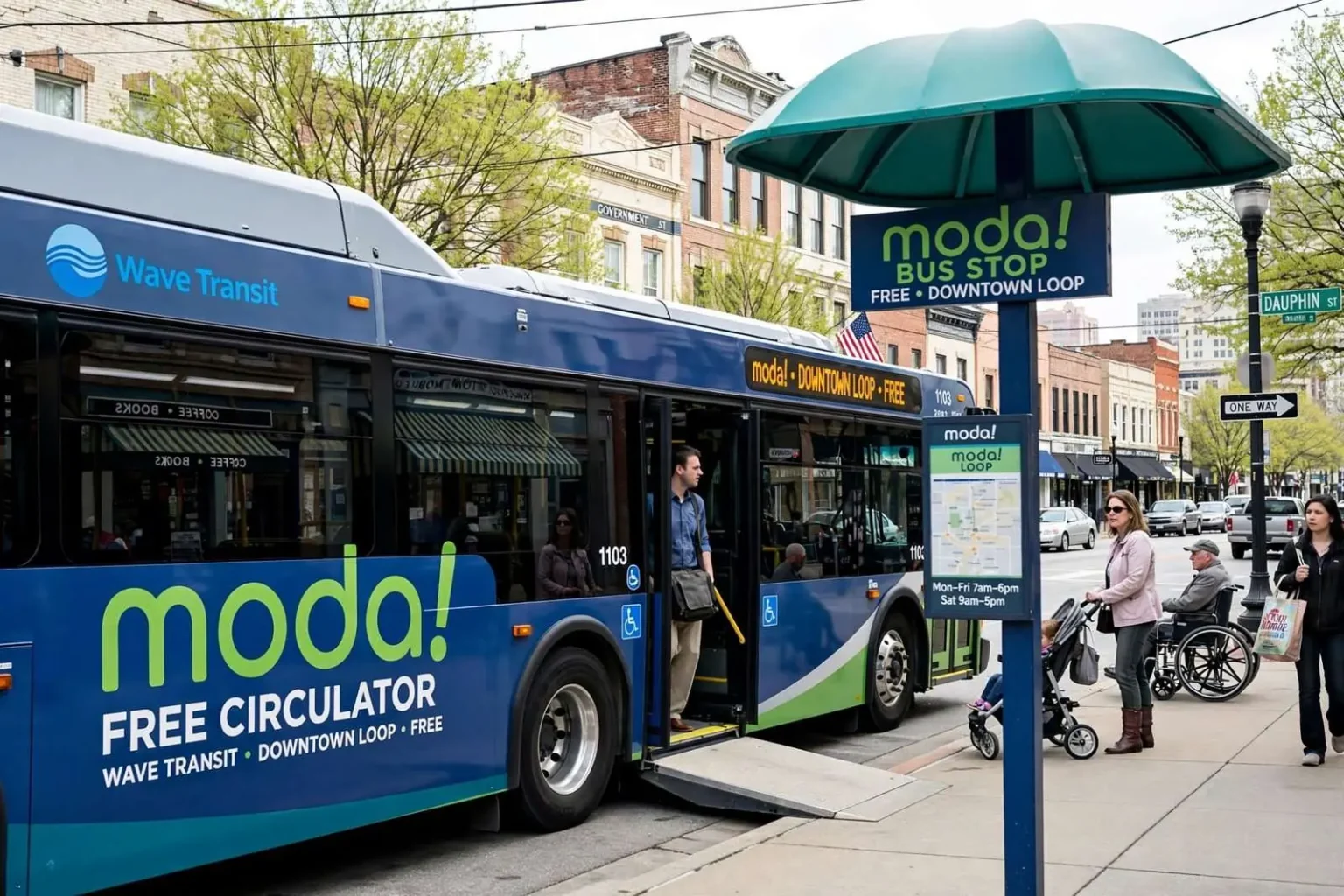
Downtown Mobile’s free transit service got an upgrade in April 2011 with the introduction of new moda! circulator buses, offering riders a more spacious and modern way to get around the city center. The new buses replaced the trolley-style vehicles that had carried downtown passengers since the service began, and their arrival marked a turning point for a program that had quietly become part of the daily routine for downtown workers, shoppers and visitors alike.
The moda! service — the name a nod to the “moda” brand that downtown Mobile had adopted for its free downtown shuttle — operated on a fixed loop through the central business district, connecting the Government Street corridor, Dauphin Street’s commercial blocks, the waterfront and the civic buildings in between. For a downtown built on a grid of one-way streets where parking fills up on weekdays and during events, a free circulating bus is more than a convenience: it is infrastructure that lets a visitor park once and reach everything, and it lets workers who commute in by bus transfer to any corner of downtown without a second fare.
Each new bus features 18 passenger seats along with two wheelchair-accessible positions, making the service more accommodating for riders of all abilities. The configuration was a deliberate upgrade over the trolley-style vehicles, whose nostalgic wooden benches and narrower aisles traded capacity and accessibility for charm. The new buses’ low-floor design and dedicated wheelchair positions meant a rider using a mobility device could board without the awkward lifts and tighter clearances the older vehicles required, and the additional seating eased the squeeze at peak times — lunch hours and event weekends — when the loop fills fast.
Upgraded Fleet for Downtown Riders
The new moda! buses replaced the earlier trolley-style vehicles that had been shuttling passengers around downtown Mobile. Trolleys had their advantages as rolling publicity — they photographed well, and they signaled “tourist friendly” in a way a standard bus does not — but as working vehicles they were aging, harder to maintain and slower to board. The 2011 fleet modernization brought the service in line with what peer downtowns were running, and gave the loop a more consistent, professional presence on the street.
The free circulator operates on a fixed loop that covers much of downtown Mobile’s commercial district, passing by shops, restaurants, and popular attractions. Riders can board at any of the distinctive umbrella-covered bus stops along the route. The umbrella shelters — a design flourish that made the moda! stops recognizable at a glance — doubled as wayfinding: a visitor who spotted the umbrella knew the loop came by, and knew that a ride to any point on the route cost nothing. In a downtown whose attractions are spread from Cooper Riverside Park to the museums along Government Street and the restaurants of Dauphin, that legibility mattered.
Free fares were the service’s defining feature. By removing the fare box entirely, the moda! eliminated the exact-change fumbling and transfer mechanics that discourage casual ridership, and it made the loop usable in a way time-based parking meters are not: a worker could ride to lunch, a shopper could ride between blocks, a family could ride from the waterfront to the history museum without anyone reaching for a wallet. Transit planners have long observed that free downtown circulators punch above their size in ridership precisely because the psychological barrier of a fare — not the fare itself — is what keeps casual riders on foot.
The loop’s reach also supported downtown’s growing residential population. The early 2010s were the years Mobile’s downtown began adding apartments and condominiums above the storefronts, converting upper floors that had sat empty for decades. New downtown residents are exactly the riders a circulator serves best: they own one car instead of two, they walk to dinner, and they use a free loop for the trips that fall in between. Every residential conversion downtown increased the value of reliable circulation, and the moda!’s 2011 upgrade was timed to a downtown that was beginning to fill in.
Schedule and Service Area
The moda! service runs Monday through Friday from 7 a.m. to 6 p.m. and Saturday from 9 a.m. to 5 p.m., providing consistent weekday and weekend coverage for commuters, shoppers, and visitors. The weekday span covers the full traditional workday — riders arriving downtown by 7 a.m. could reach their offices, and the 6 p.m. endpoint caught the end of the business day, with Saturday service carrying shoppers and festival crowds through the weekend daytime hours. The route encompasses the core of downtown Mobile, making it a convenient option for anyone looking to navigate the area without a car.
The schedule’s structure reflected the loop’s mission. This was not a commuter route feeding the suburbs — the Wave Transit system’s regular buses did that job — but a downtown circulation layer, tuned to the hours when downtown actually needs moving people: business hours, shopping hours, event hours. A circulator that runs 7 to 6 serves the office worker, the lunch crowd and the afternoon shopper, and the modest Saturday schedule matched the weekend rhythm of a downtown whose evening life came from bars and restaurants rather than retail.
Operated as part of the Wave Transit system, the moda! circulator was developed in partnership with the Downtown Alliance, which promoted the service as a way to boost foot traffic and economic activity in the downtown corridor. The partnership was the arrangement’s quiet strength. Wave Transit brought the operating expertise — drivers, maintenance, scheduling — while the Downtown Alliance brought the business community’s support and promotional muscle, and the split matched each organization to what it does best. Downtown business groups across the country have learned that a free circulator is one of the cheapest economic development tools available: the operating cost per ride is small, and the benefit lands directly in the cash registers along the route.
The free fare removed a common barrier to public transit ridership, encouraging both regular commuters and casual visitors to take advantage of the service. That dual audience — the daily rider and the once-a-month visitor — is what distinguishes a circulator from ordinary bus service, and the 2011 fleet upgrade was an investment in both at once: more seats for the regulars, easier boarding for the wheelchairs and strollers, and a modern vehicle that made riding the loop feel like part of the downtown experience rather than a compromise. For downtown Mobile in the spring of 2011, the new moda! buses were a statement that the city’s core intended to keep moving — and to keep moving people — as its revival gathered pace.
The Wave Transit context is worth expanding, because the moda! did not operate in isolation. The Wave — formally the Mobile Area Transit System — has run the region’s public buses for decades, connecting downtown with West Mobile, Prichard, Saraland and the other communities that make up the metro area. Its fixed routes converge downtown, and the moda! loop functioned as the distribution system inside that network: a commuter riding in from Tillman’s Corner or Toulminville could arrive downtown and complete the last leg of the trip free, without checking schedules or counting transfers. Transit systems that pair a regional network with a free downtown circulator effectively extend their reach into the urban core, and the 2011 upgrade strengthened precisely that connection.
The timing of the upgrade also reflected the era’s broader push for downtown investment. In 2011, Mobile was a city in the middle of rethinking its core: the convention center anchored the waterfront, the History Museum and the museums along Government Street drew visitors, and the entertainment district along Dauphin was expanding block by block. City and civic leaders were searching for the amenities that make a downtown walkable in perception as well as fact, and a modern, free, accessible circulator checked every box. Cities from Birmingham to Savannah were running their own versions of the same play, and Mobile’s moda! put the city in that company.
Accessibility, in particular, had become a central expectation rather than a bonus. Federal rules had long required accessible transit, but the practical experience of riders using wheelchairs varies enormously with vehicle design, and the older trolleys’ configurations made boarding slow for everyone and difficult for some. The new buses’ two wheelchair positions per vehicle — on an 18-seat bus, more than a tenth of the capacity — represented a genuine commitment to serving riders with disabilities on a route that passes the public library, the courthouses and the social service offices that downtown residents with disabilities actually use. For those riders, the fleet change was not cosmetic; it was the difference between a service they could depend on and one they could not.
The umbrella-covered stops, meanwhile, became one of downtown’s small visual signatures. Distinctive stops do work that plain signage cannot: they tell a visitor instantly where the service goes and where to wait, they photograph well — which matters in a downtown competing for conventions and tourists — and they signal that a city takes its circulator seriously enough to brand it. The shelters also served the practical needs of Gulf Coast waiting: shade in July, cover in a rainstorm. A branded, sheltered stop on every block of a downtown loop is a modest investment with outsized effect on how a district feels to walk.
For the businesses along the route, the service functioned as a slow-moving benefit. Restaurant employees could park at the edges of downtown and ride to work; shoppers could cover more ground without moving their cars; and event crowds, from Mardi Gras parades to downtown festivals, gained a pressure valve that kept the loop’s streets walkable even when parking lots filled. The Downtown Alliance’s promotion of the service was grounded in exactly those receipts — foot traffic is the currency of a commercial district, and the moda! manufactured foot traffic every hour it ran. The April 2011 fleet upgrade was, in the end, a bet on that arithmetic: newer buses, more seats, easier boarding, same free fare — and a downtown that kept moving people through it.