
Dozens March for Life Through Downtown Mobile as Alabama Abortion Law Remains Blocked
Pro-life demonstrators rallied at Cathedral Square and marched through downtown Mobile while Alabama's abortion ban remains blocked.
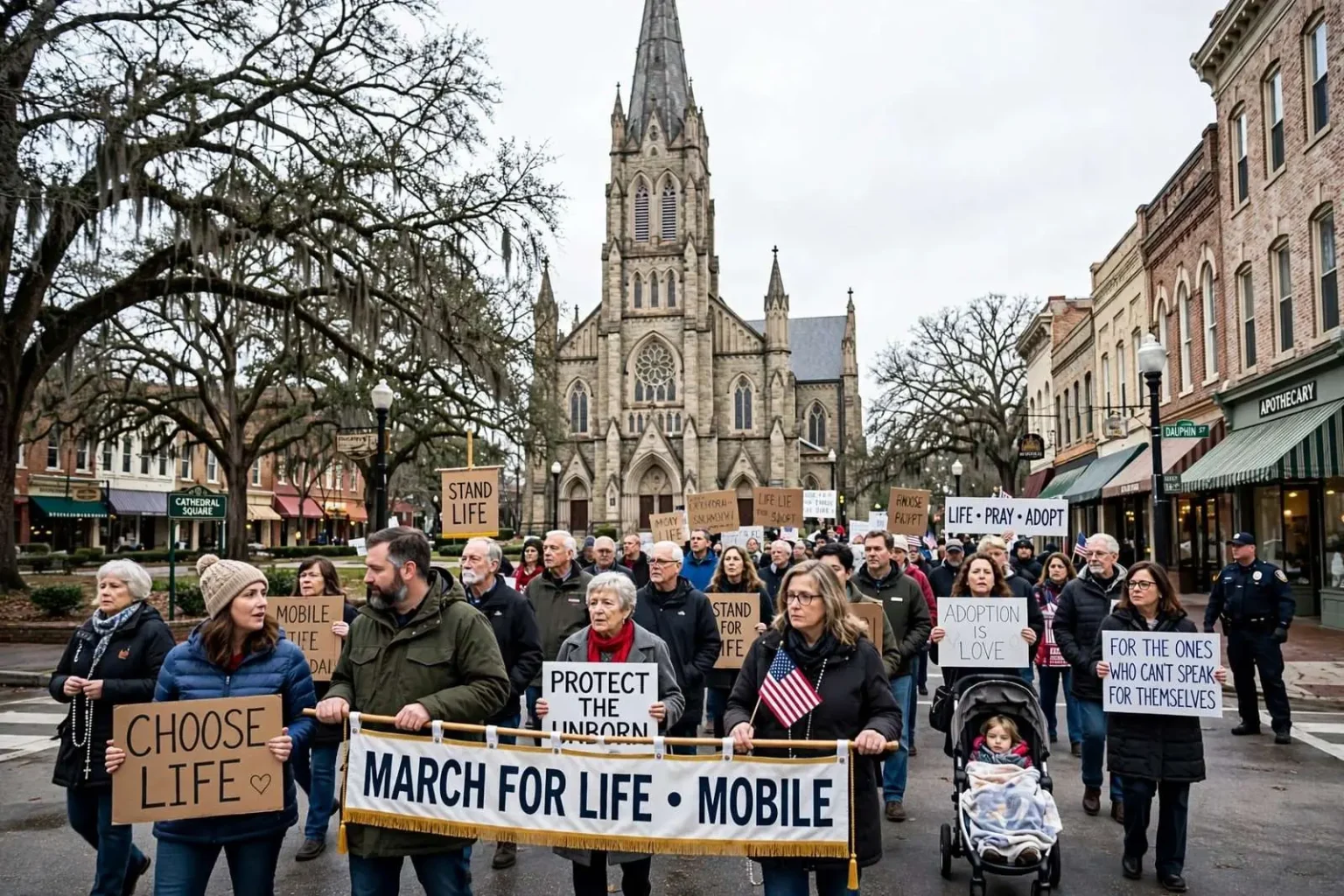
While the national March for Life drew thousands to Washington, D.C., dozens of demonstrators held their own march and rally in downtown Mobile on Friday morning, adding the Port City’s voice to a day of pro-life observances across the country. The local gathering began with a rally at Cathedral Square before participants marched through downtown streets carrying their pro-life message.
Cathedral Square, the park anchoring the block beneath the Cathedral-Basilica of the Immaculate Conception in the heart of downtown, has long served as a gathering point for civic and religious observances in Mobile. On Friday morning it hosted the local edition of an event held each year on or near the anniversary of the Roe v. Wade decision, which stood for nearly half a century before being overturned by the U.S. Supreme Court in 2022.
The Mobile march was smaller than its national counterpart by every measure, but organizers and attendees treated it as a meaningful local expression of the same cause. Speakers addressed the crowd from the square before the group set out on foot through the downtown business district, drawing glances from commuters and onlookers along the route.
The timing placed the Mobile demonstration alongside the national March for Life in Washington, which has been held annually since 1974 and has grown into the largest annual gathering of the pro-life movement in the United States. Local marches in cities like Mobile give participants who cannot travel to the nation’s capital a way to take part closer to home, and they have become a fixture on the calendars of Gulf Coast parishes and family advocacy organizations.
Downtown Mobile’s compact street grid makes it well suited to events like Friday’s march. The route from Cathedral Square moves marchers past government buildings, churches and storefronts in the historic district, where the city’s earliest French and Spanish colonial era began and where many of its most prominent congregations still worship. Police familiar with the routine briefly controlled intersections along the way, as they do for the city’s many parades and observances.
Personal Stories Front and Center
For some attendees, the issue was deeply personal. Angela Jones, an adoptive parent, told those gathered that adoption made her motherhood possible. “As an adoptive parent, without life I wouldn’t have been a parent,” Jones said, adding she was grateful for the woman who chose life.
Adoption has occupied a prominent place in pro-life advocacy in Alabama, where state leaders have pointed to family placement and support services as part of the framework surrounding the state’s abortion restrictions. Speakers at events like Friday’s march frequently pair testimony about adoption with calls for churches and community groups to support birth mothers and adoptive families in practical ways.
Bryan Jones said he hoped the state’s law would ultimately survive its court challenges. “The sanctity of life is so important according to God’s word. That’s what we’re here to support — the lives of the ones who can’t speak for themselves,” Jones said.
His reference to the state’s law pointed to the legal fight that has shadowed the issue in Alabama for years. The state’s near-total ban on abortion, enacted by the Legislature and signed into law in 2019, was designed from the start as a challenge to federal abortion precedent, and it has been tied up in litigation at every stage since.
Legal Backdrop
The Mobile march came months after a federal judge blocked Alabama’s abortion ban from taking effect. The measure — the strictest in the country at the time it passed, banning nearly all abortions with no general exceptions for rape or incest — was ruled unconstitutional by the federal court, which found that it conflicted with then-controlling U.S. Supreme Court precedent.
That ruling left the law in limbo while the case moved through the appeals process. Supporters of the ban, including state attorneys general who defended it in court, acknowledged when it passed that its fate depended on a future Supreme Court willing to revisit Roe v. Wade. Opponents pointed to the same dynamic, warning that the law’s design made it a vehicle for a constitutional confrontation rather than a measure likely to take effect on its own schedule.
Demonstrators like Sheri Sims were watching the appeals process closely. “I think it’s making its way through to the Supreme Court and we’ll just wait and see,” Sims said. “We hope that it goes through.”
Sims’s outlook captured the mood of many in the crowd: a mix of patience and expectation that the courts would eventually have the final word on whether Alabama’s ban could be enforced. For the time being, the decision rested with appellate judges, and demonstrations like the one in Mobile were aimed as much at sustaining public support as at influencing the docket.
The stakes extended beyond the courtroom. Abortion law in Alabama affects the operations of clinics and hospitals, the counseling offered to pregnant patients, and the criminal penalties that the 2019 law imposed on doctors who perform the procedure. Each of those elements was on hold under the federal court’s block, leaving the state’s practical regime unchanged while the legal questions were resolved.
Alabama’s law also became a model and a signal for legislatures in other conservative states, several of which copied its structure in their own bills. Its journey through the federal courts has been followed closely in Montgomery, where lawmakers have framed the litigation as a matter of state sovereignty over issues of life and family policy.
A Local Movement with Deep Roots
Mobile’s pro-life community has organized around the anniversary of the Roe decision for decades, with annual marches, prayer services and rallies coordinated by area churches and advocacy organizations. The presence of the Cathedral-Basilica at the edge of Cathedral Square has made the park a natural stage for religiously grounded observances, and Friday’s event followed that familiar pattern: speeches, prayer, and a march through the streets of the city’s historic downtown.
Participants came from across the Mobile area and beyond, a mix of longtime activists, church groups and families with young children. The tone of the gathering was prayerful rather than confrontational, in keeping with the character of the event in years past. Marchers carried signs and banners with messages reflecting the movement’s religious and moral arguments, and several speakers urged attendees to remain engaged through volunteering, prayer and political participation.
The national context around the march has shifted repeatedly over the years, first with the gradual tightening of restrictions in conservative states, then with the Supreme Court’s 2022 decision in Dobbs v. Jackson Women’s Health Organization, which returned authority over abortion regulation to the states. That ruling transformed legal fights like Alabama’s from long-shot challenges into central battlegrounds of American law, and it changed the tenor of gatherings like Friday’s from protest to anticipation.
For the Gulf Coast, the Dobbs ruling also sharpened the contrast between neighboring states’ laws, since abortion policy now varies sharply at state lines. Alabama’s ban remained blocked while its case moved forward, but the state’s political leadership has continued to defend the measure and to advance related legislation on adoption, foster care and pregnancy support in the meantime.
What Comes Next for Alabama’s Law
Whatever the courts decide, Friday’s marchers made clear they intend to keep the issue before the public. Organizers of local pro-life events in Mobile have historically paired the annual march with year-round activity, including support for crisis pregnancy centers, adoption ministry and legislative advocacy in Montgomery.
The appeals process that demonstrators are watching will determine whether Alabama’s ban — passed as the strictest abortion law in the country — can be enforced as written, modified, or struck down on other grounds. Each development draws renewed attention to gatherings like the one in Cathedral Square, where the movement’s arguments are made not in legal briefs but in personal testimony from people like the Joneses and Sims.
For the dozens who braved the morning to march through downtown Mobile, the day’s message was straightforward: the local movement intends to remain visible, vocal and organized regardless of how the litigation unfolds. The march ended where it began, back at Cathedral Square, with the downtown streets returning to their normal Friday rhythm.
As the national debate continues to evolve, Mobile’s annual march stands as the Gulf Coast’s most visible local expression of the cause — smaller than Washington’s, but rooted in the same conviction that brought its speakers to the square. Attendees left Friday’s rally with the same posture they carried through the streets: watching the courts, and waiting.
Organizers say the event will return next year, as it has for decades, whatever the courts decide. In a city whose public life is marked by its churches as much as its parades, the March for Life has become part of Mobile’s civic calendar — a quieter procession through the same downtown streets, with its outcome resting not on the crowd’s size but on decisions yet to come in Washington.


