
Dr. Julia Hart Box Blazed a Trail as Mobile’s First Female Anesthesiologist
From Satsuma, Dr. Julia Hart Box broke barriers to become Mobile's first female anesthesiologist and transformed Gulf Coast medicine.
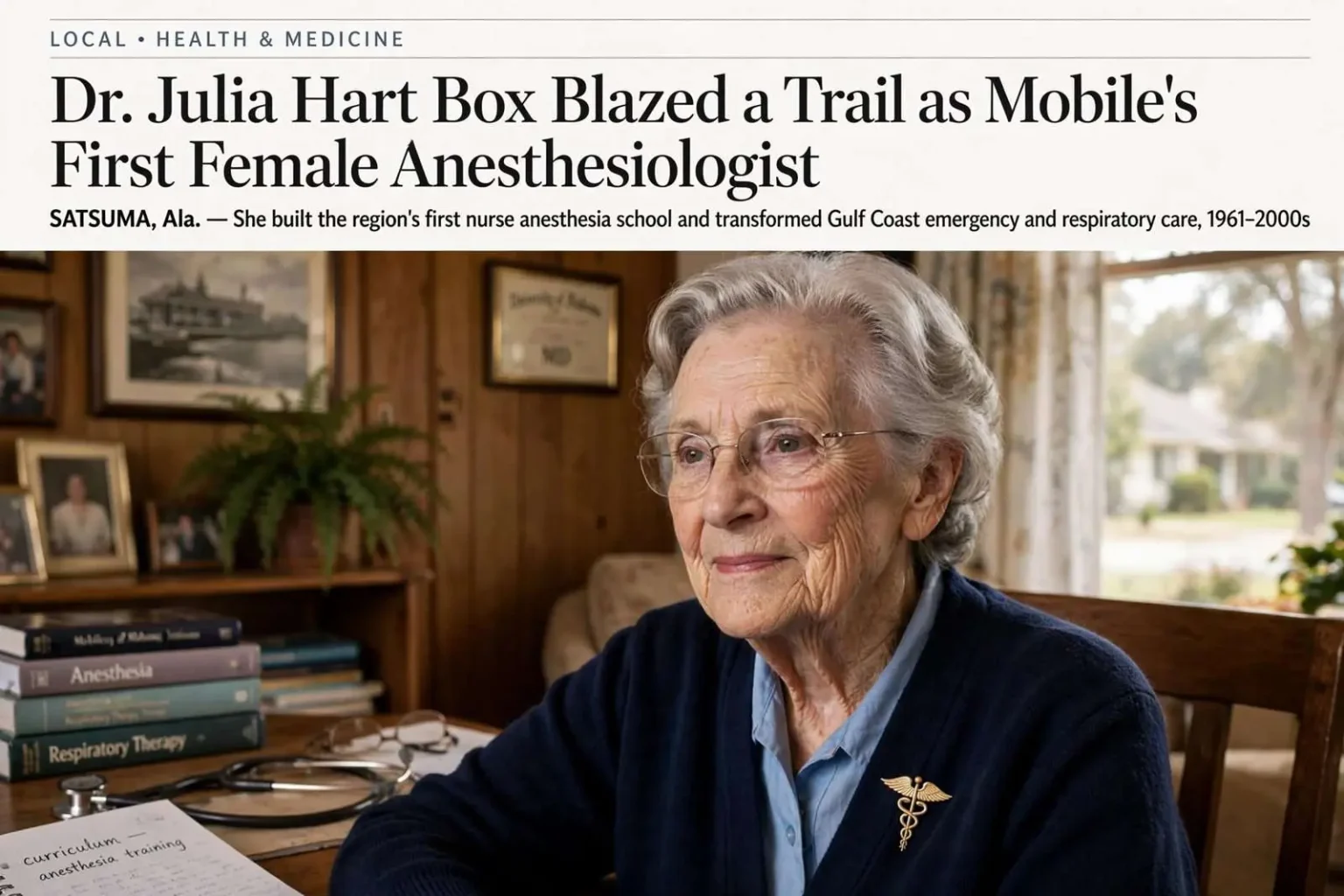
SATSUMA, Ala. — Dr. Julia Hart Box insists she did nothing remarkable. The record of her career says otherwise: she made Mobile’s ambulances safer, helped establish respiratory therapy departments at Gulf Coast hospitals, and helped create the region’s first school of anesthesia for nurses, serving as its dean.
“I have not done anything remarkable that I can say,” Box said from her home in Satsuma, the small Mobile County city north of the city limits where she has lived for decades. The modesty is characteristic of a generation of pioneering physicians who describe their accomplishments as accidents of circumstance. The paper trail — the programs she built, the students she trained, the standards she pushed into Mobile’s emergency medical system — describes something closer to a legacy.
Her career spanned the years when anesthesia itself was transforming from a technical service into a full medical specialty, and when the hospitals of the Gulf Coast were growing from community institutions into modern medical centers. Box arrived in Mobile in 1961 as its first female anesthesiologist and spent the following decades building the infrastructure that modern patients now take for granted: trained personnel, monitored operating rooms and ambulances equipped to keep patients alive on the way to the hospital.
An Early Spark and an Early Obstacle
Born in 1927, Box grew up during the Great Depression, in an era when a girl’s ambition was expected to stop at the county line. A painful bone infection at age eight set her on the path to medicine — the illness put her in the care of physicians whose work she watched from a hospital bed, and the experience planted the idea that healing was work worth doing.
But her father saw no future in it for a daughter. “My father wasn’t interested in a girl going into school anyway, to college,” she recalled. “He just laughed. He thought it was stupid to waste money on a girl going.”
Tenacity ran in the family. Her mother had emigrated alone from Scotland at 18, built her own hairdressing business, and never backed down from a goal. That example — a woman who crossed an ocean by herself and made a living with her own two hands — became the template Box followed whenever the obstacles in front of her looked insurmountable.
Box worked her way through college and graduated from the University of Alabama, then applied to medical school — only to be flatly turned down by the head of admissions, who told her he wasn’t considering any women. The rejection was not a judgment of her record but a statement of policy, delivered without apology, and it would have ended most careers before they started.
She watched male classmates with worse grades receive invitations from Tulane’s medical program while hers never arrived. The disparity stung, and it clarified something: the problem was not her qualifications but her sex, and the only available response was to change the facts on the ground. So she simply showed up in New Orleans without one.
The gamble worked. Tulane admitted her, and she completed her medical training in a city whose teaching hospitals were among the South’s finest. The route she took — applying where she was wanted, after being told no where she was not — became one of the stories she would tell generations of students who hit their own closed doors.
A First in Mobile Medicine
At Tulane, she met the man she would marry. In 1961 the couple moved to South Alabama, raised three children, and Box became the first female anesthesiologist in Mobile. The distinction sounds like a footnote until one considers what the operating rooms of 1961 looked like: anesthesia was administered in many hospitals by nurses and technicians under loose supervision, and women physicians were rare enough that patients occasionally assumed the doctor was a nurse. Box walked into that world and treated it as an ordinary place to work.
Her influence spread far beyond the operating room. She made Mobile’s ambulances safer, pushing for equipment and training that could sustain patients during transport rather than simply racing them to the emergency room. In an era before paramedic-level care was standard, an anesthesiologist’s involvement in prehospital care brought airway management and ventilatory support into vehicles that previously carried little more than a stretcher.
She helped establish respiratory therapy departments at Gulf Coast hospitals, building from scratch the staffing, equipment and protocols that respiratory care requires. And she helped create the region’s first school of anesthesia for nurses, serving as its dean — an institution that multiplied her own career many times over, sending trained anesthesia providers into hospitals across the region for years after her direct involvement ended.
Her son Mike Box attributes it to what he calls a certain hard-headedness his mother inherited from her mother. The trait shows up consistently in the story: the girl who applied to medical school after her father laughed at the idea, the applicant who appeared in New Orleans uninvited, the physician who built programs that did not exist when she arrived in Mobile.
The World She Changed
To understand what Box accomplished, it helps to remember what anesthesia looked like when she entered the field. In the early 1960s, the specialty was in the middle of a professional revolution. Anesthesiology was emerging as a physician-led discipline, with residency training, board certification and hospital departments of its own, after decades in which anesthesia had often been an afterthought staffed by whoever was available. Machines that monitored oxygenation and ventilation were primitive by today’s standards, and the death rate associated with anesthesia was a fraction of what it later became — because people like Box built the training systems that made the difference.
Mobile in 1961 was a growing port city whose hospitals served the entire Gulf Coast region, and its medical infrastructure lagged the academic centers where Box trained. The distance between those two worlds was her career: bringing academic standards in anesthesia, respiratory care and emergency medicine to a community where none of those systems existed yet.
The school of anesthesia for nurses she helped found addressed the region’s most basic shortage. Anesthesia care depends on trained hands, and in the 1960s the most practical way to staff Southern operating rooms was to train nurses in the specialty. As dean, Box shaped the curriculum, supervised the clinical training and set the standards her graduates carried into hospitals from Mobile to the Panhandle — a legacy measured not in her own cases but in the competence of every provider the school produced.
Her work on Mobile’s ambulances grew from the same logic. An anesthesiologist understands better than almost anyone what happens when a patient cannot breathe, and she applied that understanding to the vehicles that carry the sickest patients. The respiratory therapy departments she established at Gulf Coast hospitals filled a similar gap, creating a professional discipline — therapists, equipment, physician oversight — where previously there had been improvisation.
Advice With Her Characteristic Directness
Box’s advice to anyone facing similar odds is characteristically direct: “If you want it, don’t let somebody say you can’t do it. Don’t expect to sit back and expect somebody to give it to you. You just get out there and start working on it.”
It is the summary of a life lived exactly that way — a Depression-era girl from a family that had little, told no by the admissions officer, the system and her own father, who responded each time by showing up and getting to work. The Satsuma home where she reflects on it all sits a short drive from the hospitals she helped modernize, in the community where she raised three children and built, without ever calling it remarkable, a medical legacy that south Alabama still stands on.
A Door Closed, a Door Opened Elsewhere
The University of Alabama rejection story has become the piece of her biography that resonates most with young people who hear it. The head of admissions who told her he wasn’t considering any women was not making an exception he might reconsider — he was stating the school’s practice, and Box’s application went nowhere. Her classmates’ Tulane letters, arriving for students with weaker grades, made the point unambiguous: the evaluation was never about merit.
Her decision to go to New Orleans anyway required a particular kind of nerve in the early 1950s. A woman without an acceptance letter, presenting herself at a medical school that had not invited her, risked everything on the chance that someone in the admissions office would judge her on her record. Tulane did, and the episode became the defining proof of the philosophy she would later hand to students: nobody was going to hand her a place, so she would go stand in the doorway until one existed.
The pattern repeated throughout her career in ways large and small. Colleagues in Mobile’s hospitals in the 1960s encountered a woman physician in a specialty that had few of them, and patients occasionally needed the introduction explained. Box’s response, by every account, was simply to do the work — to show up in the operating room prepared, to run the programs she built with the competence that made the argument for her.
What She Built Still Operates
The institutions Box helped create have long outlived her direct involvement, which is the truest measure of a builder. Respiratory therapy is now a licensed profession across Alabama, with hospital departments that trace their local origins to the pioneers who established the first ones on the Gulf Coast. Nurse anesthesia programs — the descendants of the school she helped found and led as dean — train certified registered nurse anesthetists who staff operating rooms across the region every day. Emergency medical services in Mobile County operate under standards that early physician advisors like Box helped establish when ambulances were first becoming medical environments rather than fast transportation.
Her family sees the through-line plainly. Mike Box’s word for it — hard-headedness — is also the quality her Scottish-born mother demonstrated when she stepped off a ship alone at 18 and built a business with her hands. Three generations of women in the family, each told what they could not do, each finding out otherwise.
Sitting in Satsuma, the first female anesthesiologist in Mobile waves off the labels. The bone infection at eight that introduced her to medicine, the father’s laughter, the closed door in Tuscaloosa, the uninvited arrival in New Orleans, the three children raised while building a career — she sums it up in one sentence that could serve as the whole story: “I have not done anything remarkable that I can say.”
The operating rooms, ambulance bays and respiratory wards of Gulf Coast hospitals, still running on systems she helped put in place, quietly disagree.


