
Dreamland Skate Center Rolls Again as Mobile Businesses Reopen
Dreamland Skate Center in Mobile reopened May 22 under Alabama's safer-at-home order with temperature checks and capacity cut far below state limits.
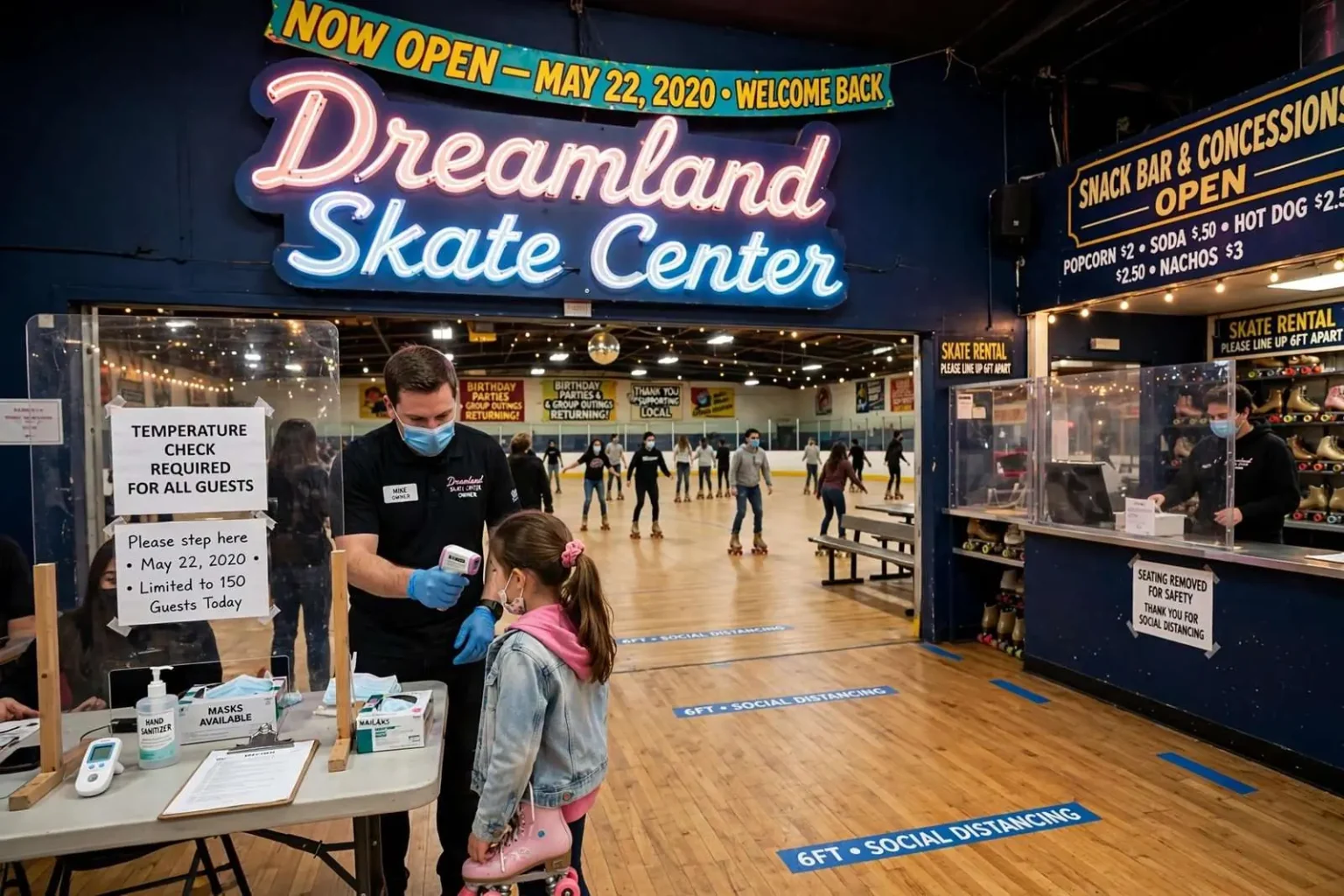
After weeks of silence and darkened lights, the sound of wheels on hardwood returned to Dreamland Skate Center on Friday, May 22, as the Mobile skating rink welcomed skaters back under Governor Kay Ivey’s updated safer-at-home order. Owner Mike Finlen said the rink had been poised to reopen for a while. “I would’ve liked to have had more time, but we were ready,” he said. “We’ve been waiting for two or three weeks ready to go.”
Dreamland’s reopening was one of the more anticipated moments in Mobile’s slow return to public life. For generations of Mobile families, the rink is not simply a business — it is where birthday parties happen, where church groups and school classes take field trips, and where weekend nights mean wheels on hardwood. Its weeks of closure under the coronavirus restrictions left a visible gap in the community’s routines, and its reopening marked the return of one of the city’s most familiar recreational traditions.
Finlen’s readiness had been building for weeks. While the rink sat dark, he and his staff used the forced pause to prepare — positioning the facility to reopen the moment state rules allowed. That preparation showed on opening night, when the changes skaters encountered were organized rather than improvised, the product of an operator who had spent the closure planning for the day the doors opened again.
Like many local operators, Finlen admitted reopening brought mixed feelings after months of lost revenue. “Still worried about the financial side of it — now I’m anxious, does tonight go well?” he said. “But I think everybody will have a good time as long as everybody works with us. It’s all a group effort.”
The Economics of a Dark Rink
The anxiety Finlen described is familiar to owners of family entertainment venues across Alabama. Skating rinks run on volume: steady weekend crowds, party bookings, and concession sales that add up over a month. When the shutdown removed that revenue entirely, the fixed costs — rent, insurance, utilities, equipment upkeep — kept arriving just the same.
Family entertainment businesses occupy a fragile middle ground in any economic disruption. They are not essential retailers, so they often wait the longest to reopen; they are not large corporations, so they have thin reserves to survive on. A skating rink’s margins depend on filling the floor on Friday and Saturday nights, and every weekend of closure is a weekend that cannot be recovered. That arithmetic made the May 22 reopening less a celebration than a necessity — the first step back toward viability for a business built on community gatherings.
The governor’s updated safer-at-home order created the opening. Under the revised rules, entertainment venues were permitted to operate at 50 percent capacity, a threshold that transformed reopening from an impossibility into a planning exercise. Operators across Mobile County read the same order that week and faced the same calculations: whether the allowed capacity, combined with the added costs of safety measures, could support reopening at all.
For Dreamland, the answer was yes — with conditions of its own. Skaters noticed some changes on opening night. Every guest now has their temperature checked at the door — beyond what’s mandated for employees — and plastic shields have been installed at the snack bar and skate room.
New Rules at the Rink
The temperature checks set Dreamland apart from the minimum the state required. By screening every guest rather than only staff, the rink adopted a standard more common among larger venues and hospitals, betting that visible safety measures would reassure the families who make up its core clientele. Parents deciding whether to bring children back for the first time were met at the door with a process they could see and understand.
The plastic shields at the snack bar and skate room addressed the two points of closest regular contact between staff and guests. The skate room, where employees fit rentals on skaters of every size, and the snack counter, where orders and money change hands, are the places where a night at the rink inevitably brings people within a few feet of each other. Shielding both acknowledged the reality of the business’s layout rather than pretending distance could be maintained everywhere.
While the governor’s order allows entertainment venues to operate at 50 percent capacity, Dreamland went further, capping its first night at just 150 people, roughly 15 percent of normal occupancy. The decision to open far below the permitted maximum reflected a deliberate choice: rather than filling the floor as far as the law allows, the rink chose to test its new procedures on a smaller, more manageable crowd.
A cap of 150 also changed the character of the opening night session. Regulars found a floor with room to spread out and a pace far calmer than a typical weekend session. For a first night back after months of closure, that margin for error mattered — staff were relearning routines while enforcing unfamiliar rules, and a lighter crowd gave everyone space to adjust. If the safety measures held and the night went well, capacity could climb in future sessions; if problems emerged, they would surface in a room built to absorb them.
Floor markings every six feet, removed tables and benches round out the changes, giving skaters extra room to spread out. The spacing markers extended the logic of the six-foot guidance into the rink’s most crowded zones, while the removal of furniture eliminated the gathering spots where skaters and parents typically cluster between sessions. The empty spaces where benches once stood were the most visible sign of the moment: a business intentionally making itself less comfortable in the name of keeping its community safe.
What Opening Night Meant
For the skaters who returned on May 22, the reopening carried a significance beyond an evening’s entertainment. The months of closure had suspended the ordinary rhythms of childhood and family life across Mobile — the birthday parties, the weekend sessions, the simple pleasure of rolling around a hardwood floor with friends. Walking back through Dreamland’s doors was, in a small way, a step back toward those rhythms.
Finlen’s request that everybody work with the rink captured the bargain reopening represented. The safety measures could only function with cooperation: guests submitting to temperature checks, keeping their distance, and accepting the stripped-down floor. His framing — “It’s all a group effort” — made the rink’s survival a shared project between operator and community rather than a unilateral business decision.
Dreamland’s approach also offered a template for other Mobile family venues watching from the sidelines. By exceeding the state minimums on screening, capping occupancy far below what was allowed, and reconfiguring the floor before reopening, the rink demonstrated that a small operator could meet the moment without waiting for perfect conditions. Other entertainment businesses across the county faced the same reopening decision in those weeks, and the ones that moved first set the norms the rest would follow.
The coming weeks would test whether the formula worked. A rink’s finances depend on the weekend sessions that follow an opening night, and the 15-percent cap meant Dreamland was reopening at a fraction of its earning capacity. Every session at reduced occupancy was a session at reduced revenue, and the path back to normal crowds ran through weeks of caution before the state’s rules — or the community’s confidence — allowed more.
But for one Friday night in late May, the measure was simpler. The lights were on, the music played, and skaters rolled across a floor that had sat silent for weeks. Mobile’s families had their rink back — changed, spaced out, and temperature-checked at the door, but recognizably the same place where the city learns to skate. In a spring defined by closures, Dreamland’s reopening counted as one of the season’s clearest signs that the community’s shared spaces were coming back.
A Mobile Institution
Dreamland holds a specific place in Mobile’s recreational history. Skating rinks across the South have long served as community anchors — affordable, weatherproof, and open to everyone from wobbling first-timers to seasoned regulars — and Mobile’s rink has filled that role for decades of local families. Children who learned to skate at birthday parties there have grown into parents hosting parties of their own, a generational cycle that few small businesses achieve. That loyalty is precisely what operators like Finlen count on during hard stretches: a rink with deep community roots can survive a lean stretch that would close a venue without one.
The rink’s closure period also highlighted how much local businesses mean to the communities around them. Beyond the families it serves directly, a venue like Dreamland supports part-time staff — often students and young workers — and contributes to the chain of local spending that flows through a weekend outing: concessions, fuel, nearby dinners. When venues like it go dark, the loss registers across a wider swath of the local economy than their size suggests.
The Road Ahead for the Rink
The weeks after reopening would bring the real test of Dreamland’s plan. Summer sessions, party bookings, and the gradual loosening of state rules would each shape how quickly the rink could climb back from the 150-person cap. Finlen’s mixed feelings on opening night — the relief of reopening tangled with the worry over whether the numbers would work — were the honest arithmetic of a small business owner stepping back into an uncertain market.
What the opening night established was that the community’s appetite remained. Skaters came back under unfamiliar rules, parents accepted the door screening, and the floor filled — carefully — for the first time in weeks. For a business built entirely on people choosing to gather, that turnout was the most important data point of all: the community had not forgotten Dreamland while the lights were out, and it was willing to work with the rink to bring the wheels-on-hardwood sound back to stay.