
Early-morning storms knock out power across the Gulf Coast
Early Friday storms left thousands without power across the Gulf Coast, with Singing River Electric reporting more than 2,100 outages in south Mississippi.
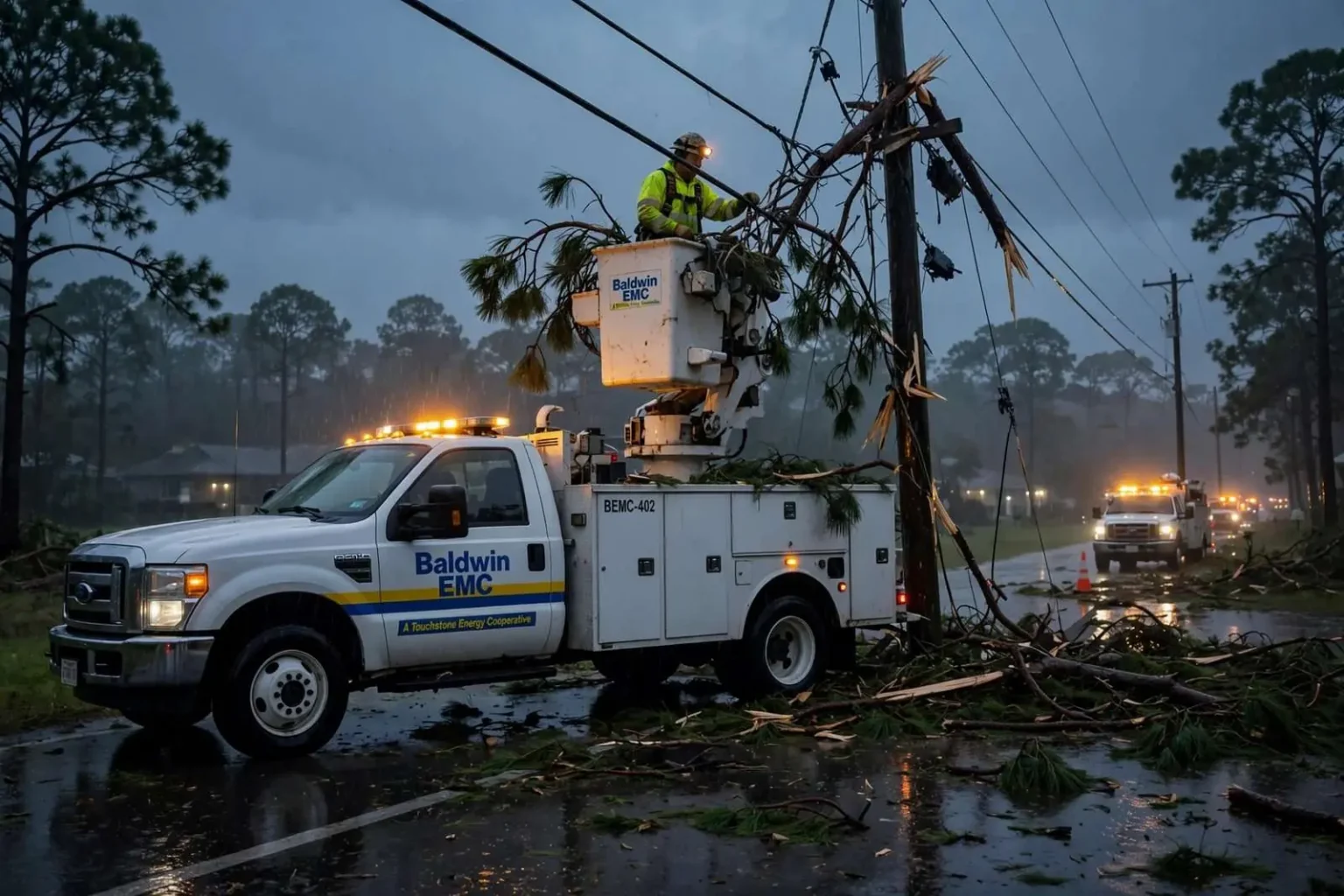
MOBILE, Ala. — As strong thunderstorms moved into the Gulf Coast viewing area early Friday, thousands of customers were left without power from southern Alabama to south Mississippi. In Baldwin County, Baldwin EMC reported 119 customers without power shortly after 5 a.m., while Riviera Utilities reported about 56. Singing River Electric, which serves Greene, George and Jackson counties in Mississippi, reported more than 2,100 customers in the dark around 3:30 a.m., a number that later climbed past 1,300 as the system pushed through. Utility officials urged customers to report outages and to use caution around downed lines as crews worked to restore service.
The overnight system was the kind of early-morning storm line that the Gulf Coast sees repeatedly through the warm months: squalls arriving ahead of a front, tightening winds and lightning that strike transformers and snap limbs onto lines. By the time most residents were waking up Friday, utility crews in two states were already working through outage lists that had built up through the night.
The Outage Numbers Across Two States
The damage was spread unevenly across the coast. In Baldwin County, Alabama’s fastest-growing county, the two primary utilities serving the area — Baldwin EMC, the member-owned electric cooperative, and Riviera Utilities, the municipal provider based in Foley — reported comparatively light totals, with Baldwin EMC’s 119 customers out shortly after 5 a.m. and Riviera’s count at about 56. Those numbers represented scattered outages: individual lines, small clusters of homes and single blown services rather than widespread system damage.
Across the state line in south Mississippi, the picture was heavier. Singing River Electric, the cooperative serving Greene, George and Jackson counties, reported more than 2,100 customers without power around 3:30 a.m., a total that shifted as the storm line pushed through and crews made repairs. The outages there tracked the path of the strongest storms, which crossed the Mississippi counties east of the Pascagoula River before moving on toward the Alabama line.
What Crews Face Overnight
Restoring power after an overnight storm line is a race between the damage and the daylight. Crews dispatched at 3:30 a.m. work in the dark and the rain, first patrolling lines to find where the faults are, then clearing the trees and limbs that most often bring them down, and only then making the repairs that put customers back online. The triage is familiar: outages that affect critical facilities and large numbers of customers move to the top of the list, while single-service calls wait until the bigger problems are handled.
Summer and early-fall storms on the Gulf Coast tend to cause different kinds of damage than the winter systems that follow cold fronts. Lightning takes out transformers and underground equipment; gust-front winds snap pine limbs and topple shallow-rooted trees onto distribution lines; and saturated ground makes standing trees likelier to fall. None of that requires a hurricane, which is why thousands of customers can lose power on an otherwise unremarkable Friday morning between Mobile and the Mississippi coast.
The timing matters, too. A system that moves through between midnight and dawn catches most people asleep, which means the first many residents know of the storm is an alarm clock in a dark house or a refrigerator that has gone silent overnight. Utilities stage their own response around that reality, holding line crews and tree contractors on standby through the night when forecasters flag a system, so that restoration begins the moment conditions allow rather than waiting for daybreak and the first wave of trouble calls.
The Utilities Behind the Numbers
The three utilities named in the outage reports each serve a different slice of the coast. Baldwin EMC is one of the largest electric cooperatives in Alabama, covering much of central and southern Baldwin County from its territory around Daphne, Fairhope, Foley and Gulf Shores. Riviera Utilities provides electricity, water and gas to the Foley area and surrounding communities as a municipally owned system. Singing River Electric, headquartered in Lucedale, serves more than 70,000 meters across its southeast Mississippi territory, where rural lines run through the pine woods that make the region’s outages heavier when storms pass through.
Each of the three systems posts outage information and takes trouble calls through its own channels, and the early-morning totals reported Friday were snapshots of a situation that changed by the hour. Cooperative members in Baldwin County and southeast Mississippi are used to the routine: report the outage, stay away from anything that looks like a downed line, and wait for the bucket trucks to work through the list.
The distribution of the outages also said something about how the storm moved. Scattered counts in Baldwin County suggested the strongest cells had weakened by the time they crossed Mobile Bay, while the heavier totals in Greene, George and Jackson counties indicated the line was at full strength as it crossed the Mississippi territory, where long rural circuits mean a single broken line can darken dozens of homes spread across miles of pine forest. Utilities in both states watch storm lines move across their systems in real time, and the outage maps that residents check on their phones are built from exactly those trouble calls and meter readings.
The Warning That Matters Most: Downed Lines
The consistent message from utility officials as crews worked was the one that matters most during any coastal storm: customers should report outages promptly and treat every downed line as if it were energized. Lines that fall in storms do not always spark or sizzle, and a wire lying across a road, a fence or a flooded yard can carry lethal voltage even when it appears dead. Storm debris and darkness make the hazard worse in the early-morning hours, when drivers and residents moving through damaged neighborhoods cannot see clearly what is on the ground.
Utility crews are the only people equipped to handle downed equipment, and officials urged residents to keep their distance from workers as well — a bucket truck working a line is not a signal that the line is safe. Generators, too, come with their own warnings during outages, since improper setups can back-feed power into lines that crews believe are de-energized. The same caution applies to standing water after a coastal storm, which can hide fallen lines beneath flooded streets and yards.
What Comes After the Storm Passes
By the time the system cleared the coast Friday, the restoration work was well underway. Outage counts that climb and fall through the early morning usually settle into a steady decline as the main feeder lines are repaired and the remaining single-service calls are worked off. For most of the customers affected, the interruption lasted hours rather than days, the ordinary cost of living on a coast where strong thunderstorms can arrive without much notice in any month of the year.
The early-Friday system was a reminder of how quickly conditions change on the Gulf Coast during storm season. The same line of thunderstorms that knocked out power for thousands arrived with little more than a night’s worth of warning, and the region’s utilities — cooperatives, municipal systems and investor-owned companies alike — maintain storm plans designed for exactly this kind of event, with crews on call, repair materials staged and mutual aid arrangements ready if the damage exceeds local capacity.
For residents, the practical lessons from nights like this one are simple and repeated often. Keep phones charged when storms are forecast. Sign up for outage text alerts from the utility that serves your home. Report an outage rather than assuming the utility already knows, since trouble calls help crews map the extent of the damage. And above all, stay away from downed lines and report them, because they are the single greatest danger a routine storm leaves behind.
Friday’s outages also showed the difference that local utility structure makes in how customers experience a storm. Cooperative members in Baldwin and Jackson counties deal directly with a local office and a board they elect; municipal customers in Foley deal with their city’s own system. That closeness tends to show up in restoration speed and communication, with local crews who know the territory working the outages rather than imported teams learning the map as they go.
As the morning progressed, the lights came back on across the affected areas, first in the larger clusters and then in the scattered single-service outages that linger after every storm. The count that began at more than 2,100 in south Mississippi and triple digits in Baldwin County wound down as crews worked, and the Gulf Coast headed into the weekend having absorbed one more early-morning storm line — with nothing worse than dark houses, reset clocks and the usual reminders about downed lines to show for it.