
Eastbound I-10 Crash at the I-65 Ramp Backed Up Traffic to Tillman’s Corner
A crash on eastbound I-10 at the northbound I-65 on-ramp blocked lanes and backed up Mobile traffic to Tillman's Corner.
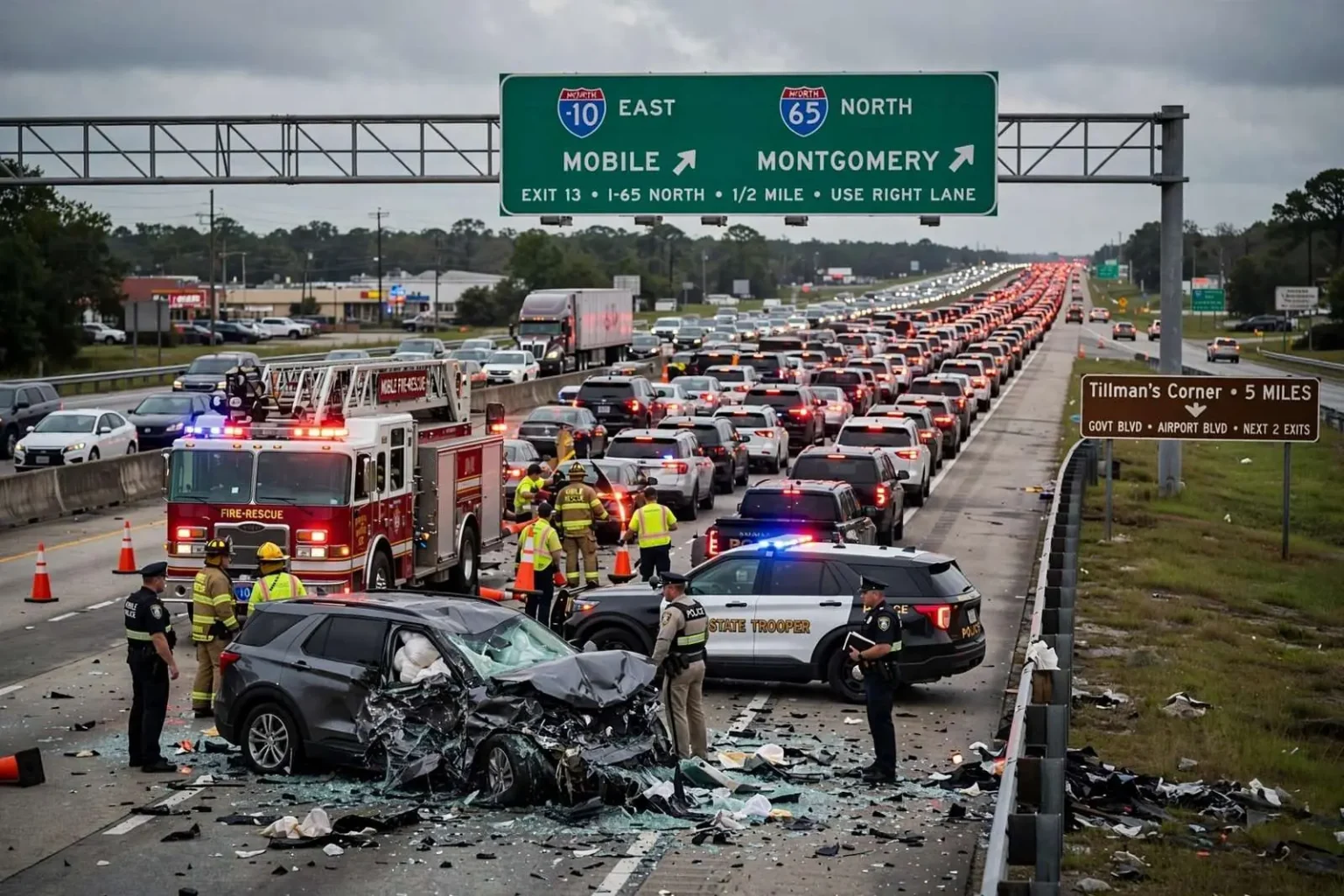
A crash on eastbound Interstate 10 at the on-ramp to northbound Interstate 65 brought afternoon traffic in Mobile to a crawl, with backups stretching all the way to Tillman’s Corner and turning one of the region’s busiest interchanges into a gridlocked choke point during the height of the commute.
Emergency crews were dispatched around 3:45 p.m. on a Wednesday afternoon to the crash site, which blocked both eastbound lanes and the left shoulder of the interstate at one of the busiest interchanges in the region. The timing could hardly have been worse, coming just as the evening rush was building and before any alternative-route adjustments could spread the load across the road network.
With eastbound I-10 completely shut at the interchange, traffic backing up from the crash site extended west along the interstate for miles, reaching as far as the Tillman’s Corner area where drivers first encountered the wall of brake lights. Motorists reported long waits with virtually no movement, and the sight of a packed interstate in midafternoon drew comparisons to the worst hurricane evacuation gridlock the region experiences.
One wreck, region-wide delays
Because eastbound I-10 feeds directly into the I-65 interchange, a stalled crash there ripples across the entire northeast Mobile commute. Drivers heading toward the Eastern Shore, north on I-65, or through downtown all funnel past the same choke point, and delays quickly extended for miles along the Government Boulevard and Airport Boulevard corridors as rerouted drivers crowded onto surface streets.
The interchange where the crash occurred is the junction of two of the Gulf Coast’s most important highways. Interstate 10 carries coast-to-coast traffic through Mobile, including the heavy truck volume that moves freight to and from the Port of Alabama, while Interstate 65 links Mobile to Montgomery and the rest of the state. Where they meet in northeast Mobile, the roadways converge through ramp movements that leave little room for error when something goes wrong.
Commuters who know the interchange well describe the eastbound approach to I-65 as the most demanding stretch of the daily drive, with merging traffic entering from the left and vehicles jockeying across lanes in a short span of pavement. A crash anywhere in that weave zone halts the flow in both directions of the decision point, catching every driver whose route passes through it.
The lanes were reopened once crews cleared the wreckage, but not before the evening rush hour was thoroughly snarled. Residual congestion lingered into the evening as the backlog slowly drained, and drivers who left work late still encountered slowdowns well after the crash scene itself had reopened.
Authorities did not immediately release details about injuries. Information about crash victims is typically withheld while families are notified and investigations proceed, and officials focused Wednesday evening on reopening the roadway and clearing the massive traffic jam the wreck created.
Why this interchange matters so much to Mobile
The I-10/I-65 junction is the heart of Mobile’s highway network, and anything that blocks it paralyzes movement across a broad swath of the city. Traffic engineers have long identified the interchange as a critical node, because it combines commuter traffic, through-freight and local trips in a single compact area with limited alternates for eastbound travelers.
For eastbound drivers there is no parallel freeway. The Bankhead Tunnel and the Wallace Tunnel carry I-10 traffic under the Mobile River downtown, and the highway’s path through the city concentrates everything onto the same alignment that passes the I-65 interchange. When a wreck closes eastbound lanes west of downtown, the detour options — surface streets like Government Boulevard and Airport Boulevard, or a long loop around the city — are slow and quickly overwhelmed.
Tillman’s Corner, the landmark at the far end of Wednesday’s backup, sits several miles west of the interchange along I-10, anchoring a major commercial district in west Mobile. When backups reach that point, they swallow the on-ramps in between, trapping drivers who have not yet entered the interstate as well as those already on it, and extending the recovery time long after the crash scene is cleared.
The crash underscored the vulnerability of the region’s commute to a single incident. Transportation planners use crash closures like this one to illustrate the case for improvements along the corridor, including projects that would add capacity or provide alternate routes around the interchange. Until those projects materialize, a midweek afternoon wreck remains capable of stopping the metro area’s eastbound travel for hours.
How drivers coped and what responders do
Mobile police and state troopers worked the scene alongside fire and EMS crews, and traffic incidents of this scale typically trigger a cascade of response: closing the affected lanes, diverting traffic where possible, clearing the wreckage, investigating the crash and finally reopening the roadway. Each step takes time, and the investigation component is often the longest, since investigators document the scene thoroughly before vehicles can be moved.
Drivers stuck in the backup shared the experience in real time on social media, posting photos of the stalled interstate and warning others to stay away. Local traffic apps reflected the gridlock for miles in every direction, and radio traffic reports repeated the same advice — avoid eastbound I-10, expect delays on every east-west surface street, and delay travel if possible.
Motorists along Government Boulevard and Airport Boulevard reported the surface-street spillover firsthand, with signal queues backing up block after block as drivers cycled through the parallel corridors. The pattern repeats at every major interstate closure in Mobile, demonstrating how tightly the city’s arterial network is coupled to the freeway system.
Safety officials use incidents like Wednesday’s crash to reinforce the habits that reduce both crashes and their consequences: leaving following distance in the interchange’s merge zones, staying off the phone, and moving over for emergency vehicles. The vast majority of peak-hour interstate crashes in Mobile are preventable driver-error events, and each one that happens at the I-10/I-65 junction costs thousands of commuters their evening.
By the time the lanes reopened and the backlog cleared, the crash had written another chapter in the ongoing story of Mobile’s most consequential interchange — a reminder that in this region, one wreck at the right place and time can hold an entire metro area still.
The bigger picture for Mobile’s highways
Wednesday’s gridlock came amid ongoing, long-running discussions about the future of I-10 through Mobile. The interstate’s crossing of the Mobile River and Mobile Bay — currently routed through the downtown tunnels — has been the subject of a proposed bridge project that would carry through-traffic around the south of the city, and officials have argued for years that the existing configuration funnels more traffic than the urban corridor can reliably handle.
Every closure at the I-10/I-65 interchange feeds that debate, because it demonstrates in real time how little slack the system has. The interchange was built for an era with far less traffic, and its ramps and merge points now carry volumes that leave no reserve capacity for even a minor incident. Commuters who experienced Wednesday’s backup lived the data point that planners have been citing in public meetings across the county.
Truck traffic compounds the problem. Interstate 10 is one of the nation’s primary freight corridors, and the Port of Alabama’s container terminal and the region’s industrial plants generate heavy truck movements through Mobile around the clock. A lane-blocking crash mixes commuter vehicles with tractor-trailers, and clearing large commercial vehicles from a travel lane takes far longer than clearing cars.
The timing of Wednesday’s crash — 3:45 p.m., just ahead of the peak — magnified all of those factors. The same wreck at 10 p.m. would have backed up traffic for an hour; at the leading edge of rush hour it seized the entire eastbound commute, because every subsequent mile of queue accumulated behind a line that was not yet moving when the workday ended.
Regional transportation agencies continue to work on incremental measures, including incident-management programs, highway helper patrols and improved real-time traffic information, all aimed at shortening the life of a closure once it happens. Those programs have measurably reduced clearance times in many cities, but they cannot create capacity that does not exist, and a full closure of eastbound I-10 at the I-65 ramp will always be a metro-wide event until the underlying bottleneck changes.
For the drivers who sat through Wednesday’s backup from Tillman’s Corner to the interchange, the practical lessons were familiar: build time into the commute, know the surface-street alternates before they are needed, and remember that on Mobile’s east side, the entire region’s traffic can turn on a single wreck at a single interchange.
As the evening wore on and the last of the queue drained through the reopened lanes, crews finished their work at the scene and investigators continued piecing together what happened. The details, like the question of injuries, would come later. What Mobile residents already knew was the shape of the disruption — miles of stopped traffic, crowded surface streets and a rush hour measured in hours — and how much of it traced back to a few blocked lanes at the most important interchange in the region.