
Elevator Breakdowns Leave Visitors Stranded at Mobile Government Plaza
Two of four elevators serving the courts at Mobile Government Plaza are down, leaving visitors waiting 40 minutes or more to reach courtrooms.
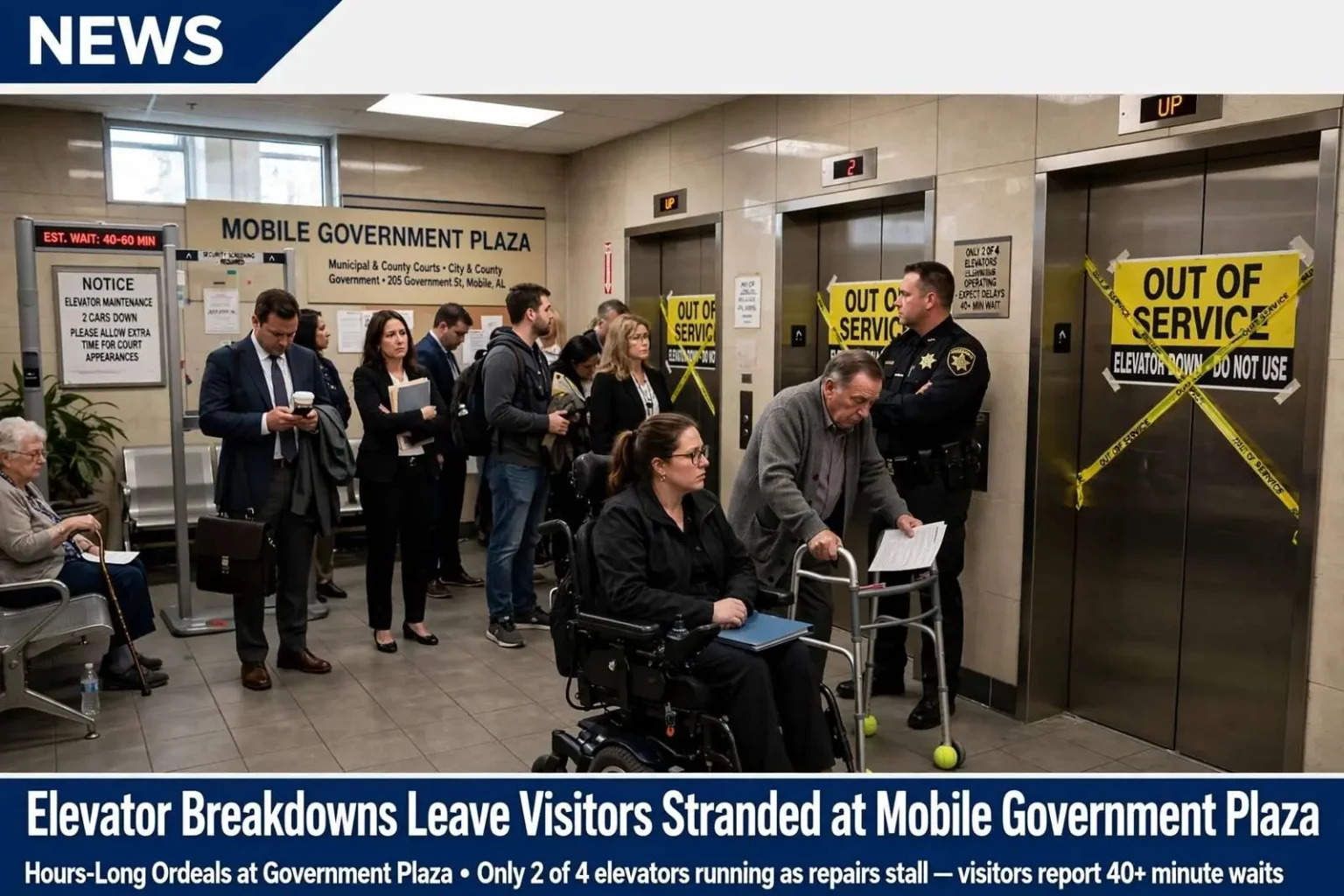
Hours-Long Ordeals at Government Plaza
Court appearances have turned into hours-long ordeals this week at Mobile Government Plaza, where two of the four elevators serving the courts were out of service. The tower on Government Street houses both city and county government under one roof, including the municipal and county courts, so a failure in the elevator bank is felt simultaneously by jurors, attorneys, litigants, clerks and everyone else with business on the upper floors. This week’s breakdowns turned a routine trip to a courtroom into a test of patience that some visitors said consumed a large share of their day.
With only two working elevators available to carry people up to the courtrooms, some visitors reported waiting more than 40 minutes just to board a car. The delays stacked on top of the building’s morning security screening, and by mid-morning the elevator lobby had become one of the busiest rooms in the building. Attorneys reported missing or nearly missing hearings, and court staff worked to accommodate parties who arrived late through no fault of their own.
Deputy sheriffs and court personnel are accustomed to moving large crowds on high-volume days such as docket calls and jury qualification, but those operations depend on a full fleet of four elevators. Losing half of that capacity leaves almost no margin. Each car that still runs is also pressed into service for inmate transports, evidence moves and maintenance crews, stretching the two remaining units even further.
Stairs That Go the Wrong Way
The building’s stairwells are no help for the trip upstairs. Their entrances sit outside the building and are limited to people with security clearance, leaving the elevators as the only practical way up for most visitors. That design, common in government towers built with security in mind, means the public cannot simply climb a flight of stairs when a car is slow or out of order.
For visitors unfamiliar with the layout, the arrangement adds another layer of confusion. A person arriving for a hearing must pass through screening, learn that the stairs are not an option, and then join the elevator queue with no alternative except to wait. On days when both lines run deep, the combined wait can stretch well past the appearance time printed on a court notice, and the risk of missing a hearing grows with each stop the remaining cars make.
County and city employees who work above the lobby have more flexibility, but they feel the crunch too. Staff who spend the morning shuttling files between floors, escorting witnesses or moving between the municipal and county sides of the building report losing chunks of the workday to the same queues. When a system this central slows down, the whole tower slows down with it.
A Strain on Visitors With Disabilities
The crunch has been especially hard on visitors with disabilities. One woman who uses a wheelchair described crowded cars so packed that other riders grew frustrated trying to squeeze in around her power chair before she could exit. With fewer cars running, every trip concentrates more people into each cab, and riders with mobility devices are frequently the last to board and the last to leave.
Federal accessibility law, including the Americans with Disabilities Act, requires public buildings such as courthouses to provide equal access to services and programs. When the only practical route to the courtrooms is a reduced elevator fleet, that obligation becomes harder to meet in practice. Advocates for people with disabilities have long noted that a single broken elevator in a government building is not a minor inconvenience but a barrier that can keep someone from reaching a hearing, paying a fine or filing paperwork on time.
The problems compound for people who cannot stand for long periods. Waiting forty minutes for a car is difficult for anyone, but it is a different matter for someone using a walker, someone recovering from surgery, or an older adult with stamina limits. Benches near the elevator lobby are limited, and a crowded lobby leaves many people leaning against walls or waiting outside the screening line.
Ripple Effects Across the Courts
Government Plaza houses both city and county offices along with the municipal and county courts, so elevator failures ripple across jury duty, hearings and everyday business with government offices housed in the tower. Prospective jurors reporting for service have to reach assembly areas upstairs like everyone else, and each delayed juror pushes back the start of the panels they are meant to fill.
Municipal court, which handles traffic citations, ordinance violations and misdemeanors for the city, draws heavy foot traffic on busy docket days. District and circuit courts on the county side carry felony matters, civil suits and family court calendars. The same two elevators serve all of it, along with the clerk’s offices and other county functions spread through the building, so a slowdown in one courtroom’s schedule can cascade into another’s.
Attorneys who practice regularly in the building say they have learned to budget extra time, arriving far earlier than they otherwise would. Litigants without lawyers, who already navigate the courts with less guidance, have fewer tools to cope. Court coordinators can sometimes hold a case briefly, but calendars are full and judges are reluctant to delay other parties who arrived on time.
Businesses with filings due also feel the pinch. Deadlines for appeals, answers and responses run on the clock, and a visitor stuck in the elevator lobby is still responsible for getting documents to the clerk on time. The practical advice circulating among regulars this week has been simple: come early, expect a crowd, and build in far more time than usual.
One Fix Coming, Another Still Pending
A representative with the Mobile County Commission said one of the broken elevators should be back in service within the week. The second unit, however, has been out of order since April, and officials could not provide a timeline for its repair. The gap between the two situations has drawn attention because the April outage has already lasted for months, well before this week’s second failure made the shortage acute.
Major elevator repairs in a government high-rise are rarely quick. Modernizing or repairing a cab can involve ordering parts specific to the original installation, coordinating licensed contractors, and scheduling inspections before a unit returns to passenger service. Buildings of this age and size often run on equipment that has been maintained for decades, and replacements for components are not always sitting on a shelf.
The county and city share responsibility for the building, and questions about which budget carries a repair bill can add time to the process. Neither government has announced a long-term modernization plan for the elevator system in response to this week’s outages, and no figures for the pending repair costs were released.
What Visitors Should Know
Until both units are back, anyone with business in the building should plan for delays. That includes jurors, defendants, witnesses, attorneys and residents paying bills or handling permits on the upper floors. Arriving well before a scheduled appearance remains the most reliable protection against the current waits, particularly on weekday mornings when the queues are longest.
Visitors with disabilities who anticipate difficulty can contact the relevant clerk’s office before their visit to ask about accommodations. Court staff can often make arrangements once they know a visitor needs help, but the arrangements work best when requested in advance rather than requested from the elevator lobby on the day of a hearing.
The episode has renewed familiar questions about how an aging government tower keeps its critical systems running. For now, the answer that matters to the public is the one posted in the lobby by the elevator bank: two cars working, two cars down, and everyone going up in the same line. Relief for at least one of those lines is expected within the week; the rest remains an open question.
The building has served as the region’s center of government for decades, and its systems reflect that age. Air-conditioning, plumbing and vertical transportation in towers of this kind all require steady capital investment, and deferred maintenance tends to surface all at once during periods of heavy use. Court weeks, with their fixed calendars and guaranteed crowds, are exactly the kind of period that exposes a fleet running at reduced capacity.
For the woman in the power chair and the hundreds like her who move through the tower each week, the measure of any repair is simple: whether the ride upstairs is dependable, dignified and available to everyone who is required to be in the building. That is the standard the elevator bank will be judged against once the current fixes are complete.