
Emergency officials across the coast prepare for severe weather threat
Emergency managers in Clarke and Baldwin counties are urging Gulf Coast residents to prepare as a heightened risk of severe weather is forecast this week.
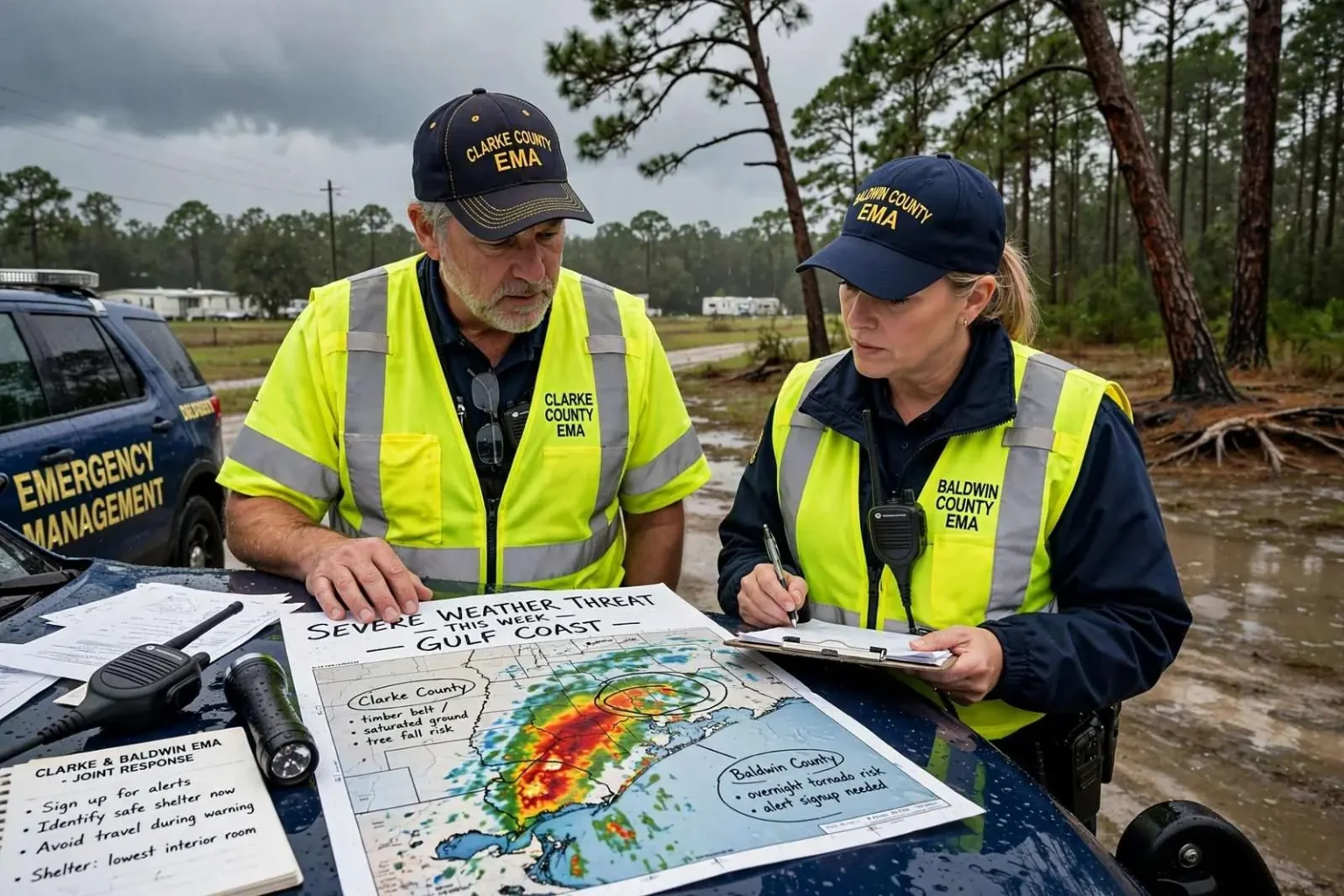
CLARKE COUNTY, Ala. — With a heightened risk of severe weather forecast this week, emergency management agencies across the Gulf Coast are urging residents to prepare now, and the warnings carry particular weight in a region still repairing itself from an unusually destructive 2020 hurricane season. The threat spans county lines from Clarke County in the interior to Baldwin County on the coast, and officials in each say the same thing: the time to make a plan is before the warning sirens sound, not after.
In Clarke County, officials pointed to damage from the previous year, when a tree toppled onto a mobile home during storms, a reminder of the specific hazard that dominates this rural Alabama county’s severe weather risk. With the ground already saturated and many trees weakened by an active 2020 hurricane season, they warned the danger could repeat with even less resistance from root systems loosened by months of tropical winds and heavy rain.
Clarke County sits in Alabama’s timber belt, one of the most heavily forested counties in a state whose economy has been built on pine for more than a century. That landscape, so central to the county’s identity and livelihood, becomes a liability when storm systems move through. Roy Waite, the Clarke County EMA director, put the problem plainly.
‘We’re a large timber industry in this county; there’s a large number of trees that are leaning,’ Waite said. His description captured the situation facing emergency managers across south Alabama: hurricanes that struck the coast in 2020 — from Sally’s landfall in September to earlier tropical systems — left thousands of trees stressed, leaning or partially uprooted far inland from where the storms came ashore, and each subsequent round of severe weather brings some of them down.
Waite encouraged residents, especially those in mobile homes or RVs, to identify a safe place to go before a tornado warning is issued. The advice reflects a hard reality of rural emergency planning: manufactured housing, which houses a significant share of Clarke County residents, offers little protection against tornado-strength winds or falling trees, and mobile home parks rarely have community storm shelters. Residents who wait for a warning to decide where to go lose the minutes that matter most.
Emergency managers across the region recommend that mobile home and RV residents identify a sturdier structure nearby — a site-built home, a church, a business — and be ready to travel there at the first watch rather than the warning. In counties like Clarke, where distances between communities can stretch to twenty minutes or more of driving, that decision has to be made early, with weather radios and phone alerts providing the lead time.
Baldwin County’s Message: Sign Up Before You Sleep
On the coast, Baldwin County officials are preparing for the same system, with a focus on reaching residents while they sleep. Jenni Guerry, deputy director of the Baldwin County EMA, emphasized the role of automated notifications in overnight severe weather.
‘The alerts and notifications are incredibly important to individuals, if we’re asleep we may not have the TV or radio on,’ Guerry said. Her point addresses the deadliest gap in severe weather response: tornadoes that strike between midnight and dawn, when most residents are in bed and conventional warnings go unheard. Baldwin County, with more than 200,000 year-round residents and a coastline stretching from Mobile Bay to the Florida line, has repeatedly experienced overnight tornado events, and officials treat sign-up campaigns as a core part of readiness.
Baldwin County is urging residents to sign up for alerts through the county app or the text-message system so they can be reached even while sleeping. Both channels push warnings directly to phones, bypassing the television and radio dependence that Guerry flagged. The county’s emergency management apparatus, one of the most active in Alabama given the coast’s exposure to hurricanes year after year, maintains the systems alongside its broader hurricane and flood preparation work.
What Officials Want Residents to Do
Officials asked residents not to travel during a tornado warning unless absolutely necessary. Vehicles are among the most dangerous places to be caught in a tornado, and road travel during a warning also puts drivers in the path of downed trees and power lines — the leading hazards in wooded counties like Clarke. The guidance is consistent across Gulf Coast emergency management agencies: once a warning is issued for your area, stop moving and take shelter where you are.
When a warning is issued, residents are told to take shelter immediately — in a hallway or bathroom, the interior rooms of a house that put the most walls between occupants and the outside. On the lowest floor, away from windows, an interior hallway or bathroom offers the best structural protection available in most Alabama homes. Emergency managers supplement that advice with standard guidance: shoes and a helmet if time allows, a mattress or blankets for overhead cover, and a way to communicate if the worst happens.
The saturated-ground factor that officials highlighted compounds every other hazard in this week’s forecast. Soil that has absorbed months of tropical rainfall loses its grip on root systems, so trees that survived hurricane winds intact can fall in ordinary thunderstorm gusts. Utility crews across south Alabama have spent the period since the 2020 hurricane season responding to tree-related outages that had nothing to do with new storms’ intensity — and each falling tree is a potential strike on the manufactured homes that officials specifically flagged.
A Region That Plans Together
The coordinated warnings from Clarke and Baldwin counties illustrate how emergency management works along the Gulf Coast, where a single storm system can put the piney woods of the interior and the beachfront communities of the coast under the same risk map. Clarke County EMA operates with the rural county’s limited staff, relying heavily on volunteer fire departments and a network of outdoor warning sirens; Baldwin County EMA runs one of the state’s larger operations, with dedicated alert systems, storm shelters and a full-time staff shaped by years of hurricane response.
The two agencies coordinate through Alabama’s Emergency Management Association structure and with the National Weather Service office in Mobile, which issues the watches and warnings that drive local response. That relationship matters in events like this week’s threat, when forecast uncertainty — will the line of storms intensify, and where — is resolved in real time and local officials have to get the message out quickly.
For residents, the officials’ advice reduces to a short checklist: sign up for phone alerts tonight; know where you will go if a warning is issued and how long it takes to get there; avoid travel during warnings; and shelter in an interior hallway or bathroom on the lowest floor. In a season when saturated ground and hurricane-weakened trees have already proven lethal across south Alabama, none of those steps costs anything, and each one addresses a danger that officials in both counties have seen up close.
Emergency management officials in Clarke and Baldwin counties will continue monitoring the forecast through the week, and residents can expect updated guidance as the storm system’s timing firms up. The core message, from both counties, was set before the first storm cell formed: prepare now, because the trees are leaning and the ground is full.
Clarke County’s risk profile deserves particular attention from residents this week. The county’s seat, Grove Hill, and its communities along the Tombigbee and Alabama rivers sit amid some of the densest timber stands in the state, and the same industry that anchors the local economy — logging, paper and wood products — means tree cover extends to nearly every road and homesite. A leaning pine over a mobile home is not a hypothetical in Clarke County; it is the damage the county already recorded during last year’s storms, when a tree fell onto an occupied mobile home and gave emergency officials the example they now cite.
The math of the current threat is straightforward, officials say: saturated soil plus weakened root systems plus strong storm gusts equals falling trees, and falling trees are the primary killer in Gulf Coast severe weather events that do not produce a direct tornado strike. That is why the counties’ advice reaches past tornado-specific shelters to general preparation — knowing where the sturdiest roof in the house is, and being under it when the wind starts to howl.
Residents who have not reviewed their alert settings since hurricane season should check them now, officials said. The Baldwin County app and the text-alert sign-up both take only minutes to complete, and both remain active year-round for severe thunderstorm, tornado and flash-flood warnings. Clarke County residents can follow the EMA’s public channels for county-specific warnings, and both agencies recommend a battery-powered weather radio as a backup for the hours when cell service or power fails.