
Environmental Group Warns of Catastrophic Failure Risk at Plant Barry Coal Ash Pond
A two-year study by Mobile Baykeeper warns the Plant Barry coal ash pond could fail catastrophically, threatening the Mobile River and Mobile-Tensaw Delta.
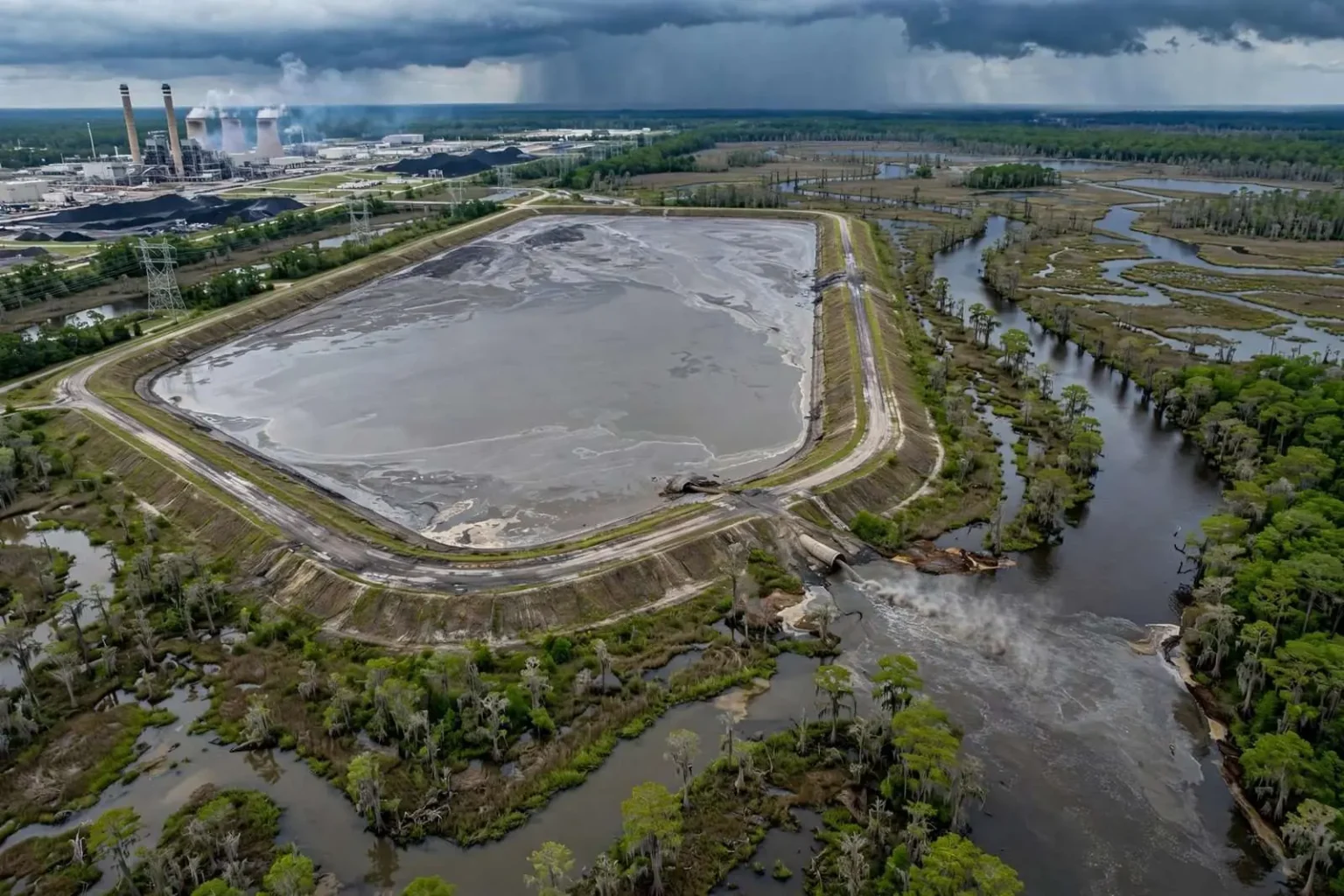
More than 21 million tons of coal ash sit behind a roughly four-mile earthen embankment at Alabama Power’s Plant Barry, and a two-year study by the environmental group Mobile Baykeeper concludes that the arrangement poses a high risk of dam failure while already polluting the surrounding river and groundwater. The 597-acre pond, located about 25 miles north of downtown Mobile in the heart of the Mobile-Tensaw River Delta, is separated from the Mobile River by that earthen berm and nothing more. The U.S. Environmental Protection Agency has classified the pond as having “significant hazard potential,” a designation reserved for impoundments whose failure could cause serious damage downstream.
The research behind the warning drew on the site’s long permitting history, regulatory records and years of monitoring data. Study authors concluded that frequent illegal pollutant discharges have occurred at the plant and that contaminants including arsenic, lead, barium and selenium have been detected at elevated levels. The combination of an unlined waste pit, a floodplain location and a single discharge pipe carrying pond water into the Mobile River, the group argued, stacks risk factors on top of one another rather than offsetting them.
Casi Callaway, executive director of Mobile Baykeeper, said the findings left little room for reassurance. “It is evident there is groundwater pollution, river pollution and potential for catastrophe if we don’t move the ash off the river,” she said. Her organization’s position is that the pond’s location — squarely inside the delta that drains into Mobile Bay — makes any structural failure a threat to one of the most ecologically significant landscapes in North America.
Baykeeper Program Director Cade Kistler pointed to the pond’s single discharge pipe and its situation in a floodplain, noting that major storms can keep water draining into the delta for days after a hurricane passes. “It’s really not a matter of when, but if,” he said of a potential breach. The group has frequently cited past coal ash disasters in the Southeast as evidence that impoundment failures tend to follow heavy rain, when saturated earthen dams are weakest and rivers are already running high.
How the pond came to hold millions of tons of ash
Plant Barry, a large generating station in the community of Bucks in north Mobile County, burned coal for decades as one of the workhorses of Alabama Power’s fleet. Burning coal leaves behind ash, a residue that concentrates the heavy metals naturally present in coal, including arsenic, lead, mercury, selenium and barium. For most of the industry’s history, utilities handled that ash by mixing it with water and sluicing it into large surface impoundments like the one at Barry, where the waste settles and sits indefinitely.
That method, cheap and simple for utilities, leaves the ash in constant contact with water. Without a liner between the ash and the earth, dissolved metals can migrate into groundwater, and in a setting like the Mobile-Tensaw Delta the groundwater is never far from the surface. Environmental groups across the country have documented the pattern at unlined ponds, and federal rules adopted in 2015 required utilities for the first time to monitor groundwater around coal ash impoundments and close ponds that fail to meet new standards.
The Mobile-Tensaw River Delta, where the Mobile and Alabama rivers converge into a braided wetland of swamps, oxbows and bottomland forest, is often called Alabama’s Amazon. It supports extraordinary biodiversity, shelters hundreds of species of fish, birds, reptiles and mammals, and functions as the nursery for the seafood industry that depends on Mobile Bay. Any large release of contaminated water or saturated ash upstream of the bay would flow directly through that system.
Regulators weigh in, and fines follow
Earlier this month, the Alabama Department of Environmental Management fined Alabama Power and PowerSouth a combined $1.5 million for ongoing water pollution violations at Plant Barry and other sites. ADEM is the state agency responsible for issuing discharge permits, enforcing water quality standards and overseeing the closure of coal ash impoundments in Alabama. Environmental advocates described the fine as significant in size but argued it underscored their central claim — that violations at the sites were not hypothetical but ongoing and documented.
Alabama Power says it plans to cap the pond in place, the closure method it and other Southern Company subsidiaries have favored across their generating fleet. The company notes that the embankment holding back the ash received the highest safety rating available from the EPA during a 2010 inspection, and it has argued that capping — sealing the ash under a cover system, removing ponded water and managing the site long-term — can be done safely at the current location. Capping in place is generally far less expensive and far faster than digging out millions of tons of saturated waste and hauling it away.
Environmental lawyers, including those at the Southern Environmental Law Center, argue that only excavation of the ash to a lined, upland landfill will protect the river. Their position is that capping leaves the ash sitting in groundwater below the water table, where even a sealed cover does not stop saturated ash from leaching contaminants, and that a berm in a floodplain will face rising stress as severe storms become more common on the Gulf Coast. The closure-in-place versus excavation debate has become the central coal ash fight across the Southeast, playing out in permit hearings, courts and federal enforcement actions from the Carolinas to Alabama.
What a failure would mean for Mobile
The stakes extend well past the plant’s fence line. Mobile Bay is the engine of the region’s seafood economy, supporting oystering, shrimping and crabbing operations that have sustained working families on the bay’s eastern shore for generations. Tourism along the Eastern Shore and the delta — from Five Rivers Delta Resource Center to the paddling trails that wind through the upper delta — depends on clean water. Drinking water intakes downstream on the Mobile River system serve communities across the area, and a major contaminant plume moving toward the bay could force closures and lasting damage to fisheries.
Hurricane history weighs on the debate as well. South Alabama has absorbed repeated Gulf storms, and forecasters have long warned that the Mobile area is overdue for a direct major-hurricane strike. Because storm surge pushes up the river system from the bay and heavy inland rain flows back down from the north, an impoundment in the delta sits between the two forces. Kistler and other advocates have stressed that the window of greatest danger can come after the storm itself passes, when days of drainage continue to pour into an already swollen watershed.
For now, the ash remains where it has been for decades, behind the four-mile berm along the Mobile River. Baykeeper says it will continue pressing ADEM and the utility for a full excavation plan, and the group’s two-year study is intended to serve as the evidentiary backbone for permit challenges and public pressure. The utility, for its part, maintains that its closure plan meets federal standards and that the embankment is engineered and inspected to federal criteria. The gap between those positions — a riverbank cap versus a removal campaign that would rank among the largest cleanup projects in the Southeast — remains the open question for residents of the delta.
The larger picture on coal ash in Alabama
The dispute at Barry is part of a broader reckoning over how the Southeast stores its coal combustion residuals. Utilities across the region built their impoundments beside rivers for a simple reason: plants needed water, barge and rail delivery, and flat land. That siting logic, settled decades ago, now collides with modern floodplain science and with federal rules that treat coal ash as a waste stream requiring groundwater protection. In neighboring states, utilities have been ordered to excavate ponds after groundwater monitoring showed violations, and the costs of removal have run into billions of dollars, figures that utilities cite when arguing for capped closure instead.
In Alabama, the decision on each pond rests with ADEM, which issues the closure permits under the federal coal ash program. Public comment periods give residents of the delta and downstream communities a formal avenue to weigh in on the Barry closure plan, and Baykeeper has urged its members to use them. The group has also pushed for more aggressive groundwater monitoring and for the utility to commit in advance to removing ash if monitoring shows continued contamination after capping.
What happens at the 597-acre pond will shape more than one plant’s footprint. The delta it borders feeds Mobile Bay, Mobile Bay feeds the Gulf, and the economies layered on top of that water — seafood, tourism, shipping and recreation — all sit downstream of the decision. That is the calculation Callaway and Kistler say they hope regulators will weigh: not the cost of moving the ash, but the cost, ecological and economic, of leaving it where a four-mile earthen wall and the weather can decide the outcome.


